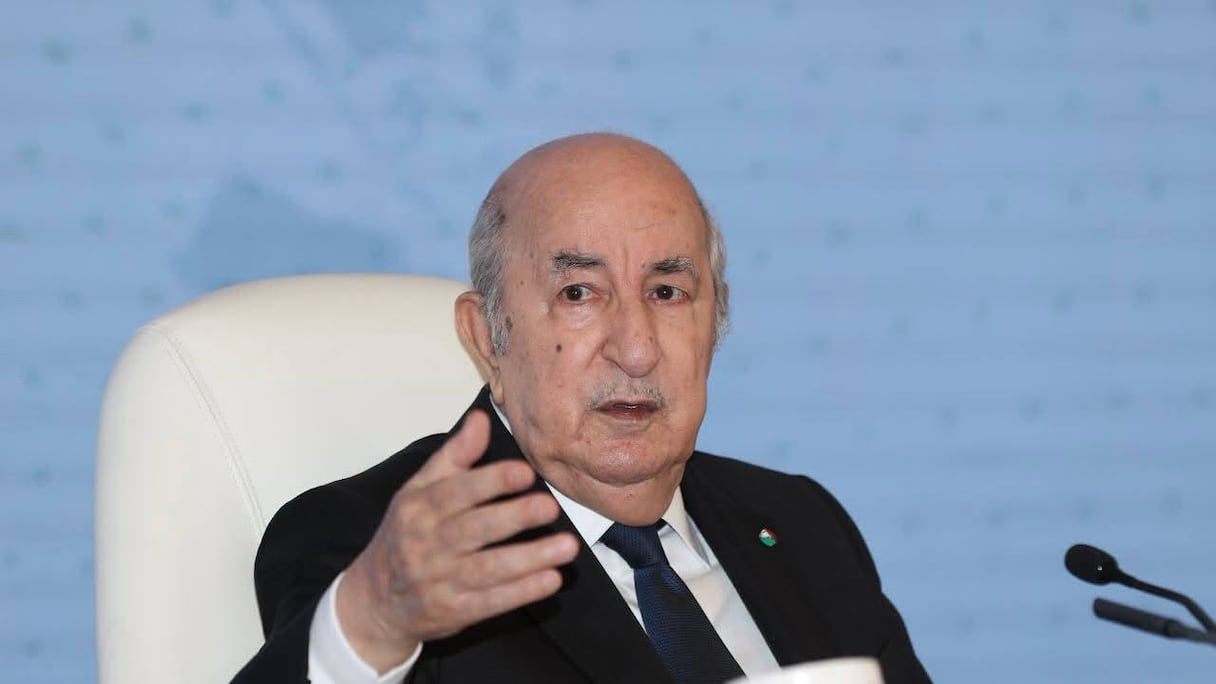
Both houses of Algeria’s Parliament are meeting in extraordinary session on Sunday, October 25, with the National People’s Assembly convening in the morning and the Council of the Nation in the afternoon. Lawmakers received their summons by text message, with no official announcement or published agenda. Parliamentary groups were given just 20 minutes each to speak. According to sources quoted by El Khabar, a mouthpiece for the Algerian presidency, the session was called to approve the use of Article 91 of the Constitution, which allows the president to deploy units of the People’s National Army abroad with a two-thirds majority in each chamber. The El Bina party urged its lawmakers to be “present, mobilized, and ready to “vote.”
El Khabar, a regular mouthpiece for the regime, had laid the groundwork a day earlier. In an article headlined “Signs of moves to formalize and regulate military activity beyond borders,” the newspaper raised the need to “justify any form of military activity abroad.” It cited agreements between Algeria’s military high command and the authorities in Niamey, the deployment of Su-30 fighter jets in late August at Niger’s request, the donation of four helicopters and a military cooperation agreement signed during Nigerien Defense Minister Salifou Mody’s second visit in a matter of days. Mody was received by Algeria’s army chief, Saïd Chengriha. A former Foreign Ministry spokesman also raised the prospect of “broader military involvement” in Niger.
For a country whose official military doctrine ruled out intervention abroad for decades, this marks a major departure. It is the first time Parliament has been asked to authorize a troop deployment abroad since a constitutional amendment in 2020 made such operations possible. The regime that rails against foreign “interference” almost every week is now preparing to send its own soldiers to prop up the authorities in Niamey.
Read also : Why has Algeria intervened in Niger?
But it is another interpretation of events that has raised alarm. On Saturday, October 24, the eve of the parliamentary session, exiled opposition figure Saïd Bensedira, a spokesman for the faction of generals associated with Algeria’s Black Decade, devoted more than an hour of live commentary on his Flash News TV channel to a broadcast with an unambiguous title: “Declaration of a state of emergency, general mobilization, suspension of the Constitution and extension of President Tebboune’s term.” His argument follows a sequence of events. Algerian military involvement in Niger would be used to justify declaring a state of emergency on national security grounds. General mobilization and the suspension of constitutional provisions would follow, bringing “a freeze on presidential elections” and “the extension of incumbent President Abdelmadjid Tebboune’s term until the end of the war.”
Bensedira goes further. “Tebboune knows the Constitution allows him only two terms, yet he needs to remain in power indefinitely,” he says. “He therefore has no choice but to invoke exceptional circumstances, suspend the Constitution and extend the president’s term.” Then comes a warning he says should be remembered “for the historical record”: “Tebboune will declare a state of war, but he will not be able to announce its end.”
He also claims the High Security Council gave its approval several days earlier. Bensedira can hardly be accused of sympathy for Rabat. He himself accuses Morocco, France, Israel and the United Arab Emirates of setting a “trap” for Algeria’s army in Niger. The fear that the authorities might turn to war to prolong their hold on power has thus spread even into circles with ties to the machinery of Algeria’s ruling system.
Bensedira’s warning is dramatic, but an important legal distinction needs to be made. Declaring a state of emergency does not, in itself, suspend the Constitution. The constitutional provisions underpinning his argument, however, are real.
Algerian law sets out a series of escalating emergency powers. Article 98 allows the president to declare a state of emergency for 60 days when the country’s institutions or territorial integrity face imminent danger. Article 99 empowers him to order general mobilization through the Council of Ministers. A law adopted in 2025 spells out the arrangements in 69 articles, placing coordination under the Defense Ministry and providing for an organized transition “from a state of peace to a state of war.” Article 100 allows the president to declare war in the event of actual or imminent aggression. Article 101 then sets out the consequences: during a state of war, the Constitution is suspended, the president assumes all powers and, should his term expire, it is automatically extended until the war ends.
In other words, war offers the only constitutional route for an Algerian president to remain in office beyond his term without holding an election or amending the Constitution. Abdelmadjid Tebboune, re-elected in September 2024, is due to complete his second and final permitted term in 2029.
Read also : Drones, munitions and factories: What is really behind Algeria’s latest fury at Abu Dhabi?
There is no evidence that Algiers is preparing for war. Sending troops to Niger falls under Article 91, not the constitutional provisions governing a state of war. Yet the broader context makes the question worth asking. The regime has systematically built a narrative of a country under siege. Since the summer, the army has accused exiled opposition figure Amir Dz of setting forest fires on orders from abroad. The penal code has been toughened to make arson committed “on behalf of foreign parties” punishable by death. Pro-regime newspapers threaten the United Arab Emirates with “open escalation on all fronts.” Relations with Abu Dhabi have been severed, as have those with Rabat since 2021, while ties with Paris and Bamako are at rock bottom. Every domestic crisis, from soaring living costs to tomatoes dumped in the countryside, is blamed on “criminal elements” and conspiracies.
A regime that constantly speaks the language of war eventually assembles the means to wage it: a general mobilization law, a revised military doctrine, troops authorized to cross borders. All that remains is an opportunity. The Sahel offers plenty.
Recent history is littered with leaders who have used conflicts abroad to put political deadlines at home on hold. Algeria has not reached that point. But its neighbors, its partners and its own citizens have good reason to examine closely what Parliament voted on Sunday and what the regime intends to do with it.
Algeria’s Constitution provides only one way to extend a president’s term without re-electing him: war. The regime does not even have to declare one. It need only persuade people, week after week, that it has already begun.
