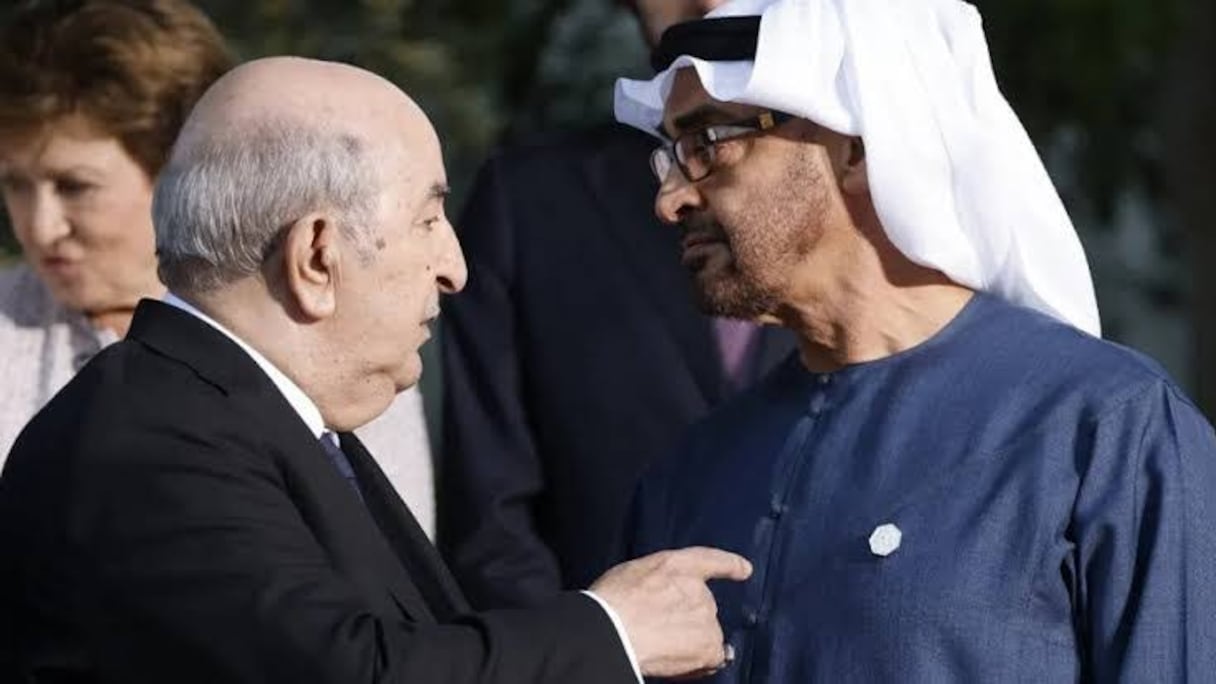
The headline in El Khabar was belligerent: “The Emirates continue to play with fire.” The newspaper claimed Algeria had detected “new hostile acts” by Abu Dhabi against its interests. It warned that the severing of diplomatic relations on September 10 was no longer the only option and that “the price will be heavier than before.” The website Algérie Patriotique republished the article the same day under an even more explicit headline: “Algeria threatens Abu Dhabi’s belligerent regime with escalation on all fronts.” Other newspapers swiftly followed suit.
Reading the two articles leaves a peculiar impression. They accuse the Emirates of crimes “from Palestine to the Sahel and Sudan,” portray the Emirati economy as being in an “existential crisis,” and El Khabar goes so far as to claim that Abu Dhabi financed Algerian opposition figure Amir DZ to recruit those responsible for the August forest fires. Just a week earlier, the Algerian military had accused the same dissident of acting on behalf of mysterious contacts inside the French Interior Ministry. The alleged mastermind, it seems, changes to suit the week’s requirements.
More striking, however, is what the articles leave out. Not one “hostile act” is described. No dates are given. Not a single verifiable fact is offered. And Morocco is never mentioned, either in El Khabar or by the chorus of newspapers that picked up its story. For a press corps that habitually sees the hand of the “Makhzen” everywhere, the omission speaks volumes.
Read also : From insults to rupture: Algiers cuts ties with UAE and retreats further into isolation
Yet what these articles conspicuously fail to mention has been public knowledge since October 10. That day, at the Marrakech Air Show, EDGE Group, the Abu Dhabi government-owned defense conglomerate, announced its first commercial deals in Morocco. One contract, signed with Morocco’s National Defense Administration, covers the supply of Desert Sting 16 and Thunder P-31 guided munitions for the Royal Air Force’s combat drones, along with their integration onto the aircraft. A memorandum of understanding was also signed to manufacture small arms in Morocco through EDGE subsidiary Caracal and drone engines through Powertech.
In its October 23 edition, Africa Intelligence explains how the deal came about. Beginning in 2021, Morocco took delivery of around 20 Turkish-made Bayraktar TB2 drones. The Emirates acquired a similar number the following year. EDGE subsequently entered into a partnership with Turkish manufacturer Baykar, enabling it to integrate its Desert Sting 16 bombs onto Emirati TB2 drones in January 2026. That capability is now being offered to foreign customers, with Morocco the first to sign up. The specialist publication notes that EDGE’s arrival in Morocco “has not gone unnoticed among Algeria’s security establishment.” It recalls that Morocco’s use of armed drones has long been a source of friction between the two neighbors, particularly since strikes targeting armed Polisario fighters.
There is another dimension to the story, one even more embarrassing for Algiers. According to Africa Intelligence, EDGE has operated in Algeria since 2012 through its subsidiary Nimr, which undertook to manufacture armored vehicles under license for the Algerian Defense Ministry in partnership with the Mechanical Industry Promotion Group. The stated target was 200 vehicles a year. Production fell short of expectations. Algeria’s break with Abu Dhabi now raises questions about the future of that partnership.
In other words, Algeria’s army operates Emirati-branded armoured vehicles, while the same Emirati defence group is now arming Moroccan drones. It becomes easier to understand why severing diplomatic ties is no longer enough for Algiers. Abu Dhabi has not merely chosen to do business with Rabat. It is supplying Morocco with weapons and industrial capabilities that Algeria has struggled to develop at home, even with Emirati assistance.
The Algerian regime cannot put it quite so plainly. That would mean acknowledging that Morocco is expanding both its military arsenal and its defense industry, that Gulf partners are making their choices, and that Algeria’s much-vaunted “national military industry” depended in part on the very people it is now insulting. Hence the furious but nebulous articles, accusing the Emirates of everything except what really troubles Algiers.
Algiers can threaten Abu Dhabi “on all fronts.” The one that matters has already been lost. Morocco’s Royal Air Force drones will carry Emirati munitions, small arms and aircraft engines will be manufactured in Morocco, while the Nimr armored vehicles promised to Algeria’s defense industry have never reached their projected production rate. The regime is not angry with the Emirates for “playing with fire.” It resents them for handing the matches to Rabat.
