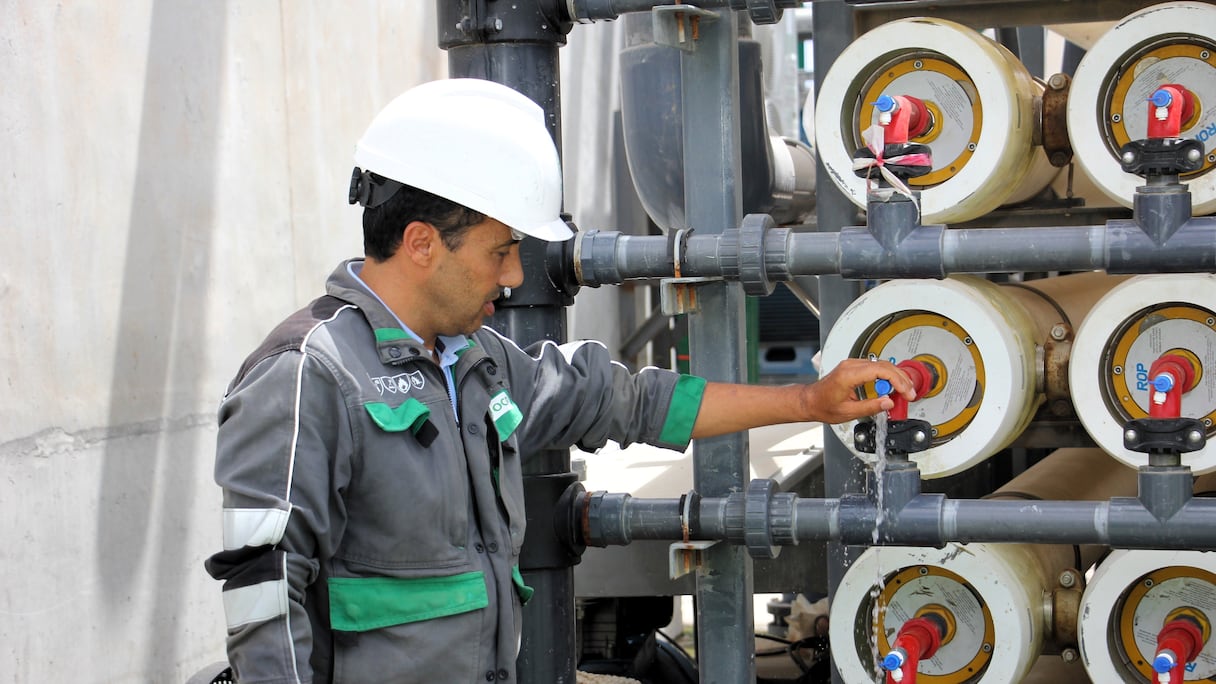
Emergency water projects, desalination plants and transfers between river basins have helped Morocco become more resilient to water shortages, according to the government’s program. But progress on managing demand has been slower. Water is still being used inefficiently, and schemes to reuse treated wastewater have been slow to take off.
The government has identified three priorities for securing supplies. First, it plans to build more small dams and hillside reservoirs and improve rainwater harvesting, particularly in arid, semi-arid and mountainous areas and oases. Second, it wants to speed up seawater desalination, with the water produced used primarily for drinking supplies and, in some areas, irrigation. Third, it plans to expand transfers between river basins and regions, provided the projects are feasible and do not jeopardize water supplies in the areas concerned.
Read also : Casablanca’s mega desalination plant connected to national power grid
In total, the government plans to develop around 400 water infrastructure projects, including small dams, hillside reservoirs and rainwater collection facilities.
It also intends to build six new desalination plants in addition to those where construction has recently started, with a target of producing 1.8 billion cubic meters of desalinated water by 2031. The program includes the second phase of an inter-basin transfer scheme that will carry water from the Bouregreg basin to the Oum Er-Rbia basin at the Al Massira dam.
Bringing water demand under control
The government is also turning its attention to how water is used. Groundwater is an immediate priority, with plans to protect aquifers through shared-management agreements involving all relevant stakeholders. Strict limits on extraction volumes are intended to curb overexploitation, while artificial recharge schemes would help replenish depleted reserves.
The government also wants to accelerate the reuse of treated wastewater, reducing the amount of freshwater used to irrigate parks, green spaces and sports grounds. It has pledged to review the rules governing how water stored in dams is allocated and distributed, while strengthening oversight of public water resources.
The measures will form part of a new national water plan to be developed in consultation with government ministries, public agencies, local authorities, businesses and civil society. It will set out a strategy for each river basin, covering priorities, investment needs, funding arrangements and monitoring. The aim is also to bring water policy into closer alignment with agriculture, energy, environmental protection and land-use planning.
Read also : Morocco says Casablanca desalination plant to begin operating in February 2027
Agriculture is a major focus. The program notes that Morocco’s dams held more than 11.1 billion cubic meters of water in early October 2026, putting the national filling rate at 65.7%, up from 32.1% a year earlier. The government argues that the improvement makes it all the more important to use available supplies efficiently, starting with a wider rollout of water-saving irrigation.
Less water per hectare, greater returns per cubic meter
The government plans to introduce water-efficient irrigation across a further 350,000 hectares, bringing the total area covered to around 1.2 million hectares—nearly 70% of Morocco’s irrigated farmland. It also wants more accurate monitoring of water use, with meters installed more widely and groundwater management agreements extended to agriculture. Support from the Agricultural Development Fund would be linked to the water balance of individual projects.
Read also : Tan-Tan and Assa-Zag step up water-saving measures amid drought
The agricultural investment code is also due for an overhaul, with subsidies and other incentives tied to water-efficiency standards. A national agricultural zoning system would steer crop choices towards those best suited to local soils, climate and water availability. The program also signals a change in how agricultural performance will be judged: instead of measuring success mainly in hectares cultivated and tonnes harvested, the focus would shift to economic value generated per cubic meter of water and per job. Solar-powered pumping would also be encouraged to lower irrigation costs in areas reliant on wells and boreholes.
Read also : Al Hoceima downpours send water rushing into Ghiss dam
Rural water access is another priority. The government plans to extend drinking water supplies to villages that are not yet connected, install public fountains and household connections in rural centers, and repair existing water points.
Wastewater collection and treatment services will also be expanded in rural centers. Around 1,000 water points are planned for pastoral areas as part of efforts to rebuild the national livestock herd. Schools are included in the program, with the government pledging to provide safe drinking water and adequate sanitation facilities in every school by 2031.