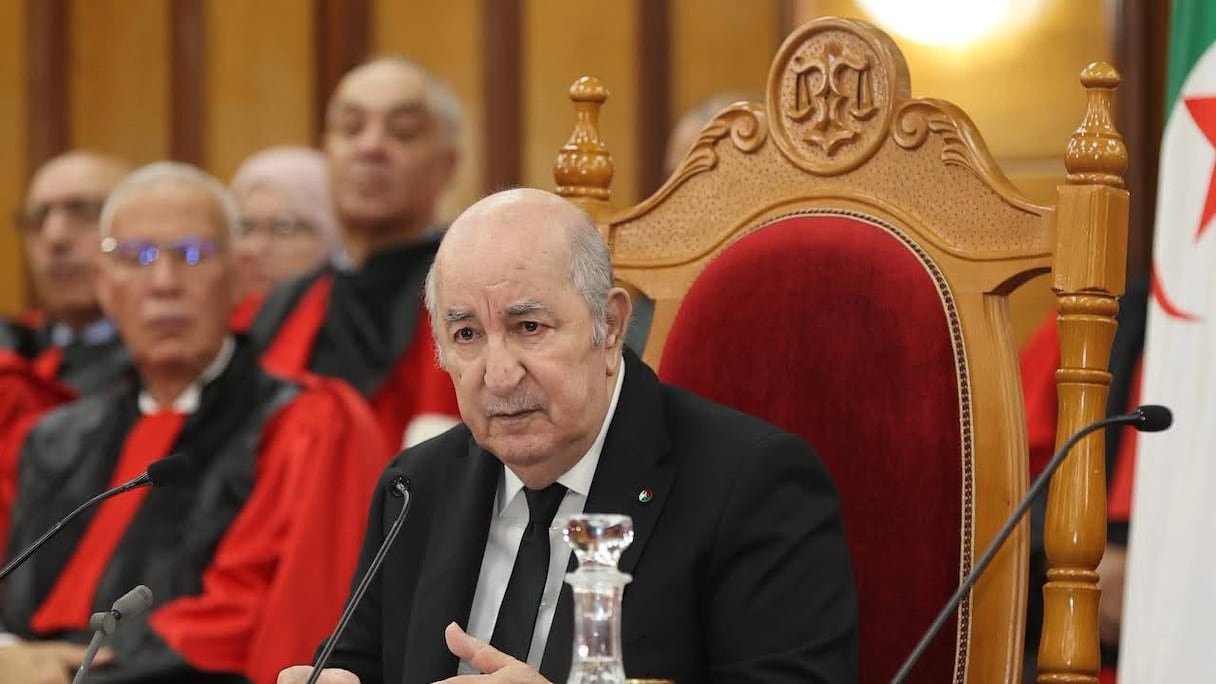
On Sunday, November 15, Abdelmadjid Tebboune presided over the opening of the judicial year at the Supreme Court. An ideal setting to talk about justice. He preferred to talk about war. Before an audience of judges expected to applaud, the Algerian president exchanged judicial robes for military fatigues in a 28-minute speech posted online by the presidency itself.
At 15 minutes and 15 seconds, he declares that drugs are “a war declared against Algeria, and when there is a war, the People’s National Army is always on the front line.” At 16 minutes and 21 seconds, he speaks of “tonnes and tonnes and tonnes.” Then, at 16 minutes and 50 seconds, comes the decisive thrust: “If necessary, we will go further, right to the source where these drugs are manufactured.” Applause. And he immediately adds, “Self-defense. We have entered a phase in which we are defending ourselves.”
The website Algérie Patriotique sounded the battle trumpet, while Le Jeune Indépendant saw the president “brandishing the sword of retaliation at the source.” The sword, no less. Pro-regime YouTube channels, faster off the mark than the army itself, have already flattened Morocco’s “hashish factories” with their headlines. The war has been won. All that remains is to declare it. Saïd Chengriha’s army on the front line against drugs: we shall return to that, for it is the finest moment of the speech.
The president named no one. There was no need. In Algiers, when someone says “source,” everyone looks west. Official propaganda has turned drugs into a “hybrid war” waged against Algeria, and the army magazine El Djeich mentions only one border in its pages on narcotics: Morocco’s. The script has already been written. The poison comes from abroad, Algeria is the victim and, as always, those in power have noticed nothing. That same day, according to Business News, Tebboune also promised to protect “our country and our neighbors through the strength of our People’s National Army.” Protecting your neighbors while threatening to bomb them: a bold doctrine indeed.
Read also : Plots, saboteurs and hybrid warfare: Algeria’s army paints a picture of a nation under siege
Drugs were only one chapter. The rest of the speech, which anyone can listen to again, offers a collection of what the regime does best: words. At 16 minutes and 3 seconds, Tebboune declares that a state which produces graduates becomes a nation of intellectuals to whom “you cannot lie.” Eight seconds later, he proclaims that “charlatanism no longer exists, especially political charlatanism.” The room applauds. Nobody laughs. At 19 minutes and 35 seconds, he recounts how, in the 1990s, the army was forbidden from buying a rifle while terrorists were receiving night-vision binoculars and how a terrorist in the Sidi Ali Bounab mountains possessed “a fax machine powered by solar energy.” The terrorist with the solar-powered fax machine: a museum piece if ever there was one.
The shortages? They are not the queues produced by a state-controlled economy but the work of enemies who, he says, “are waging war against us by attacking citizens’ purchasing power.” His response comes at 22 minutes and 27 seconds: “If necessary, reopen Tanezrouft prison,” followed by “Whether people like it or not, there will be the death penalty, and the death penalty will be carried out.” Potatoes are in short supply, oil is in short supply, anesthetics are in short supply. The gallows, however, will not be. At 23 minutes and 45 seconds, he claims the right to “invent means of defense.” At 24 minutes and 46 seconds, he wonders about those who “took billions of dollars from the state: where are they?” An excellent question. The El Bouchi trial might provide an answer, if it ever took place. Finally, at 26 minutes and 4 seconds, he reminds the judges that judicial independence “is not achieved through legal texts alone.” He could hardly have put it better: the El Bouchi case offers a full-scale demonstration.
One awkward detail: the largest drug seizure in the country’s history did not cross the Kiss River. In late May 2018, 701 kilograms of pure cocaine arrived quite peacefully at the port of Oran, concealed in a shipment of frozen meat from Brazil. Steak and white powder, all in the same container. The importer was a prosperous Algiers property developer, Kamel Chikhi, known as “El Bouchi,” the butcher. The investigation brought down the police chief, judges and local officials. It also landed a certain Khaled Tebboune in prison in June 2018, the son of a former housing minister destined, eighteen months later, for a promising future: the presidency of the Republic.
Prosecutors had sought a two-year prison sentence for Abdelmadjid Tebboune’s son. Then came an electoral miracle. The father was elected, and the son promptly discovered, as Le360 revealed, the unsuspected comforts of the infirmary at El Harrach prison. On February 26, 2020, two months after Daddy moved into El Mouradia, the Sidi M’Hamed court acquitted him. The generosity proved contagious: the sentences handed down to the other convicted defendants, including El Bouchi, were subsequently halved on appeal, as Le360 reported. Algerian justice is not slow. It is selective.
As for the cocaine, however, the courts have all eternity. Eight and a half years after the seizure, the narcotics case is still awaiting a verdict, to our knowledge. In January 2024, the hearing was postponed: 28 of the 48 witnesses had forgotten to turn up, and the former police chief was unwell, according to Ennahar. In June 2025, another postponement. On January 11, 2026, yet another adjournment, “until the next criminal court session.” The case of the century is moving at the speed of a forgotten container on a dock. The caution is understandable: trials have a habit of making defendants talk. And some defendants may have very long memories.
Tebboune, for that matter, would only need to cross the street to look for the “source” at military headquarters. Saïd Chengriha, whose magazine denounces drug “plots” every month, has himself been accused of trafficking. In 2022, Guermit Bounouira, former private secretary to the late General Gaïd Salah, described him as a “notorious trafficker in drugs, weapons and fuel.” Bounouira was rewarded for his candour with a death sentence from the Blida military court. On September 23, 2025, former diplomat Mohamed Larbi Zitout claimed that Chengriha had been “involved in large-scale drug trafficking since 2004,” when he commanded the Béchar military region, and that Gaïd Salah had dismissed or imprisoned 33 officers from that region, as Le360 reported. In early November, Saïd Bensedira, an ardent pro-regime YouTuber, spoke of a smuggling network dismantled in Béchar, Tindouf and Adrar, while swearing that Chengriha knew nothing about it. With friends like these, who needs enemies? Le360 interpreted his remarks as an admission. In Algeria, those who make accusations end up sentenced to death or driven into exile. The accused, meanwhile, commands the army.
Read also : Algeria’s money-printing machine has turned the dinar into Monopoly money
Let us recap. A president who threatens to bomb laboratories abroad, while his courts cannot bring defendants held for eight years just a few kilometers from his palace to trial. A son implicated in the case of the century and cleared as soon as Daddy came to power. A chief of staff whom former insiders identify as a drug baron, and who signs indignant editorials in his magazine denouncing those who poison the nation’s youth. If Tebboune is genuinely looking for the source, he does not need military maps. A mirror will do.
And then there is geography. The cocaine seized in Oran came from Brazil. If the president’s idea of “self-defense” involves striking countries of origin, the Algerian air force will therefore have to fly over the Amazon. We await the flight plan. One suspects it will never arrive: the regime prefers enemies that cost nothing more than a speech.
Then there is the drug the president carefully avoided mentioning. The one truly ravaging Algerian youth is called neither cocaine nor kif. It is called “saroukh,” the rocket. Behind that nickname lies pregabalin, a medicine diverted from its intended use, along with illicitly manufactured capsules whose contents are unknown, as the Algerian website Twala explains. It is the poor man’s drug, found in neighborhoods, secondary schools and queues, and its scale is measured in millions of tablets: more than 16.5 million seized by customs in 2025 and 14.4 million by the police alone during the summer of 2026, according to figures published by El Djeich itself. As recently as last Thursday, authorities announced the destruction of 33 million psychotropic tablets, AFP reported. If that many are being seized, one can only imagine how many get through.
These tablets do not come from the Rif. They travel north along routes through Libya and the Sahel when they are not produced locally as generic medicines. They cross thousands of kilometers of desert under the watch of an army that boasts of being “on the front line.” Are we supposed to believe they pass through without anyone deliberately looking the other way? Former diplomat Mohamed Larbi Zitout has his answer: according to him, these psychotropic drugs are manufactured “in laboratories located particularly in the Béchar region,” “under the authority and supervision of the army,” with Saïd Chengriha as their “chief mastermind,” as Le360 reported. If the “source” of saroukh lies inside the southern barracks, the president’s doctrine of “self-defense” faces a problem: striking it would mean bombing his own military high command.
For this threat is merely another act in a spectacle that has been running for years. The regime sees Morocco’s hand everywhere: in forest fires, in an alleged “chemical attack” on the waters of a river, in “subversive networks” involving 61 Moroccans illustrated with AI-generated images and, now, in drugs. The agitation has intensified since the end of MINURSO, which Algerian diplomacy itself helped bring about. Every week brings another plot, another documentary and another set of “confessions.”
But this spectacle unfolds on a very particular stage: social media, state television studios and the pages of newspapers that take their orders from above. This is where the regime fights its battles, wins its wars and bombs imaginary laboratories. The day its “nif” — the pride Algerian leaders invoke in every speech — decides to leave the stage set and confront reality, it will discover that reality cannot be commanded like an El Djeich editorial. Until then, the only frontier crossed by the threats emanating from El Mouradia is the boundary of the ridiculous.
