
The Moroccan labor market experienced job losses and a rise in unemployment during the third quarter of 2026. According to the High Commission for Planning’s (HCP) information note, based on its Labor Force Survey (EMO), the number of individuals in income-generating employment was 10,470,000. This represented a net decrease of 173,000 people (1.6%) compared to the second quarter. The strict unemployment rate reached 10.5%, an increase of 0.9 percentage points over the same period.
The composite labor underutilization rate, which measures the overall unmet need for work, rose to 19.6% from 18.9% in the previous quarter, an increase of 0.7 percentage points. Significant disparities persisted across population groups. This rate reached 44.5% among young people aged 15 to 24 and 28.5% among women. Strict unemployment also disproportionately affected these two groups, reaching 30.5% among young people and 16.7% among women. Geographic disparities were also pronounced.
These findings are based on the new conceptual framework adopted by the HCP. The Labor Force Survey (EMO) replaces the National Employment Survey (ENE) and introduces the concept of income-generating employment, defined as any work performed for remuneration or for individual or family profit. Strict unemployment covers only individuals without income-generating employment who are actively seeking such work and are available to take it up. The HCP specifies that EMO results are not directly comparable with those of the ENE.
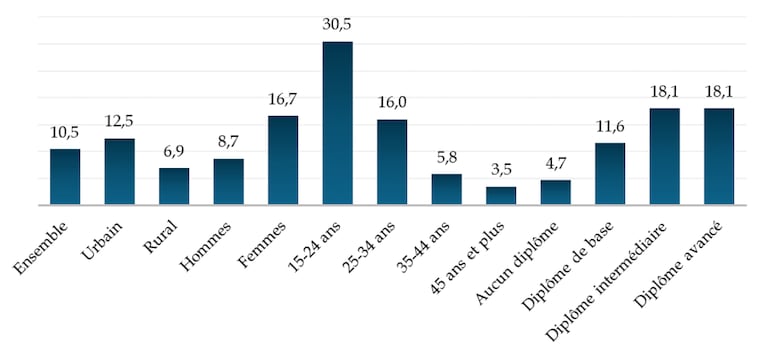
Strict unemployment rate by population group in the second quarter of 2026. (Source: HCP)
The new survey system is based on an expanded annual sample of 135,000 households. Its sampling frame has been updated using the 2024 General Population and Housing Census and a new rotation scheme. This scheme ensures a 50% overlap between two consecutive quarters and between the same quarter in two successive years. According to the HCP, this improves the accuracy of results, particularly at the subnational level. The EMO also replaces an approach based solely on unemployment with four indicators that measure labor underutilization.
The labor force, which includes individuals in income-generating employment and those who are strictly unemployed, totaled 11,694,000 people, a decrease of 70,000 from the second quarter. Nearly 64.1% of this workforce resided in urban areas. Women constituted 21.7% of the labor force, while representing 70.6% of the population outside the labor force.
The net loss of 173,000 income-generating jobs was predominantly in rural areas, where the number of employed individuals fell by 148,000, compared with a decrease of 25,000 in urban areas. The HCP emphasized that these figures represent net changes between two quarters and do not, in themselves, indicate a structural destruction of jobs. According to the institution, these changes may reflect structural factors, seasonal effects, and temporary economic conditions.
Read also : Transporters to get fresh fuel support after MAD 1 diesel price hike
The national income-generating employment rate stood at 37.4%, down from 38.2% in the previous quarter. It decreased by 1.6 percentage points in rural areas to 40.0% and by 0.3 points in urban areas to 36%. Among men, the rate dropped from 61.1% to 59.9%, while among women it declined from 15.4% to 15%.
Services remained the primary source of income-generating employment, accounting for 5,155,000 people, or 49.2% of the total. This was followed by agriculture, forestry, and fishing (23.2%), industry (14.6%), and construction (12.9%). In urban areas, 64.2% of employed individuals worked in services and 18.9% in industry. In rural areas, agriculture, forestry, and fishing accounted for 54.1% of employed individuals, ahead of services at 24.1%.
Between the second and third quarters, industry was the only sector to record a net increase in jobs, adding 69,000 (+4.8%). Agriculture, forestry, and fishing lost 145,000 jobs (-5.6%), services shed 96,000 (-1.8%), and construction lost 3,000 (-0.2%).
Young people and graduates among the hardest hit
The number of strictly unemployed individuals rose by 103,000 from the second quarter, reaching 1,224,000. This increase included 46,000 additional unemployed people in urban areas and 57,000 in rural areas. Urban residents constituted 76.4% of the strictly unemployed, while women accounted for 34.6%.
Nationally, the strict unemployment rate was 10.5%, climbing to 12.5% in urban areas and 6.9% in rural areas. This represented a 0.9 percentage point increase over the quarter. Specifically, the rate in rural areas jumped by 1.5 points to 6.9%, while in urban areas it rose by 0.6 points to 12.5%. In the first quarter of 2026, the national rate was 10.8%.
By gender, the unemployment rate for women increased by 1.9 percentage points, from 14.8% to 16.7%, while for men it rose by 0.6 points, from 8.1% to 8.7%. Consequently, the unemployment rate among women remained nearly double that of men.
Young people aged 15 to 24 continued to be the most affected group, with an unemployment rate of 30.5%, up 3.3 percentage points over the quarter. Among those aged 25 to 34, the rate increased from 14.5% to 16%. For individuals aged 35 to 44 and those 45 and over, the rate remained largely stable, rising by only 0.2 and 0.1 points, respectively.
Read also : Foreign trade: What Morocco sells to its nine biggest African customers
Strict unemployment grew across all education levels. The rate for individuals with intermediate-level qualifications increased from 16% to 18.1%, mirroring the rise for those with advanced qualifications, which also went from 16.7% to 18.1%. Among holders of basic qualifications, the rate reached 11.6%, and for people with no qualifications, it was 4.7%.
The labor force participation rate decreased by 0.4 percentage points, from 42.2% to 41.8%. For men, it fell by 0.8 points to 65.6%, while for women it remained stable at 18.1%.
The composite labor underutilization rate increased by 1.5 percentage points in rural areas and 0.2 points in urban areas. Among women, it rose by 1.7 points, from 26.7% to 28.5%, while among men it increased by 0.4 points, from 16.6% to 17.0%. The most significant changes were observed among young people aged 15 to 24, whose rate climbed by 2.8 points to 44.5%, and holders of intermediate-level qualifications, among whom it increased by 2.4 points to 28.8%. The rate stood at 22.5% in the first quarter.
Overall, 2.4 million people were affected by one of the three forms of labor underutilization, an increase of 80,000 from the previous quarter. Of these, 50.2% were strictly unemployed, 29.9% belonged to the potential labor force, and 19.9% experienced time-related underemployment.
The two complementary indicators also showed increases. The combined rate of strict unemployment and the potential labor force rose from 14.7% to 15.7%. The combined rate of strict unemployment and time-related underemployment increased from 14% to 14.6%.
