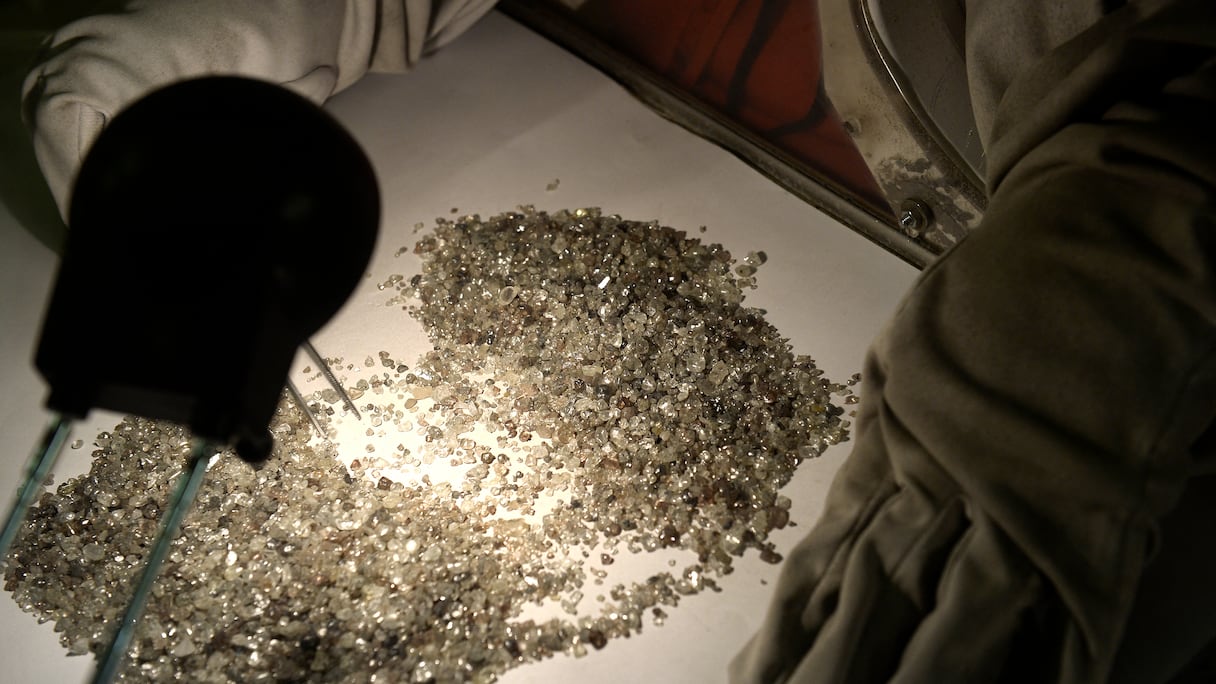
One of the report’s key findings concerns the evolution of global supply. Worldwide natural diamond production peaked at around 150 million carats in 2017 before declining to just over 100 million carats in 2025. Output is expected to continue falling, reaching approximately 96 million carats by 2030.
This contraction comes at a time when few new mining projects are entering production. According to the report, Angola’s Luele mine is the only major commercial diamond mine to have begun operations over the past decade.
As a result, African producers are becoming increasingly important in the global market. Botswana and Angola ranked among the leading contributors to rough diamond supply in 2025, alongside Russia.
For African economies dependent on the sector, shrinking global supply could provide long-term support, provided demand stabilizes. Quoted in the report, De Beers’ chief economist argued that traditional market mechanisms remain at work, with tighter supply helping to rebalance production and consumption once demand regains momentum.
The real challenge for Africa, however, lies not only in production but also in transforming diamond revenues into sustainable economic development.
Botswana, a model for diversification
The report devotes significant attention to Botswana, one of the world’s leading natural diamond producers. According to the document, diamond revenues have helped finance free education, healthcare, and critical infrastructure across the country.
Botswana’s experience illustrates a broader question facing many resource-dependent African economies: how can a finite resource be used to prepare for the post-mining era?
The report highlights the EntreprenHer program, developed with UN Women and public authorities. More than 3,900 women have benefited from the initiative since its launch, including through its expansion into Namibia and South Africa.
Another program singled out is Tokafala, which supports business development. According to the report, it has helped create more than 11,000 jobs in Botswana since 2017, involving around 1,300 small and medium-sized enterprises.
These figures reflect a shift in thinking about natural resources in Africa. The value of diamonds is no longer measured solely through the export of rough stones but also through their capacity to finance the emergence of a broader and more diversified productive base.
This approach is also reflected in the Stanford Seed Transformation Program, supported by De Beers. Since 2018, more than 100 companies have completed the training. Together, they have raised more than $400 million in capital, increased revenues by more than $220 million, and created over 4,500 jobs.
Growing importance of traceability
Another trend highlighted in the report could have significant implications for African producers.
Consumers are paying increasing attention to the origin of diamonds and the conditions under which they are produced. According to the report, provenance is gradually becoming a source of value in its own right, alongside rarity and quality.
This evolution could create new opportunities for African producing countries. If consumers are willing to place a higher value on diamonds whose origins and socioeconomic impact are clearly identified, producing nations could gain greater recognition for their role in the value chain.
The report cites De Beers’ Origin platform, which allows customers to trace a stone’s country of origin, its commercial journey, and selected indicators of social impact. Initial consumer feedback mentioned in the study points to strong interest in such information.
Ultimately, the Diamond Report 2026 portrays more than a market facing short-term pressures. It points to a deeper transformation of the natural diamond business model.
The gradual tightening of global supply, the enduring importance of African producers, and growing demands for traceability are reshaping the industry’s balance of power. In this context, the ability of African countries to move beyond a purely extractive model will be decisive.
