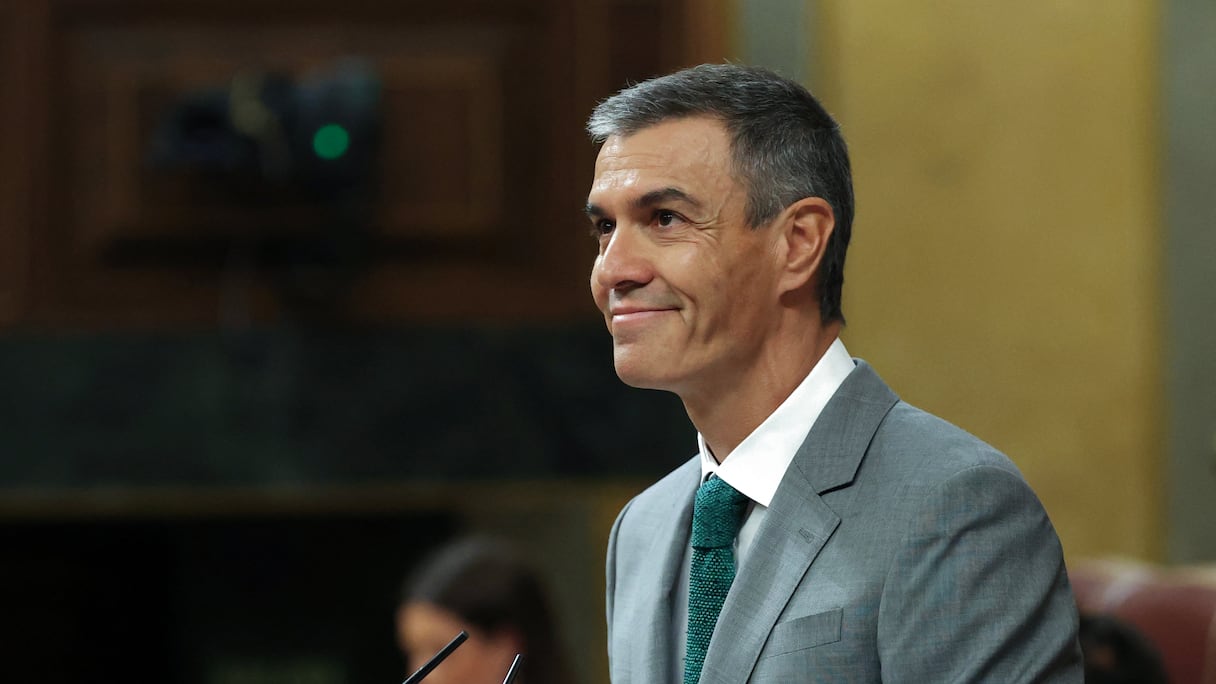
Pedro Sánchez did not yield to pressure from the Spanish right, which is demanding that his government reverse its position on the Moroccan Sahara and enter into a diplomatic confrontation with Rabat. During his second address before the Congress of Deputies, the prime minister clearly reaffirmed Spain’s support for the autonomy initiative, while stressing that Madrid is far from isolated on the issue.
“The majority of European countries, including the continent’s leading powers, have supported the autonomy proposal within the framework of Moroccan sovereignty,” he said in response to criticism from several parliamentary groups.
Pedro Sánchez placed Spain’s position within the framework of United Nations Security Council resolutions and the efforts of the international community to reach a political solution to a dispute that has been deadlocked for five decades.
“The Spanish government, alongside Europe and the international community, is trying to contribute to a political solution to a conflict that has been at an impasse for 50 years,” he said.
A Position Spain Fully Stands By
Far from presenting the shift in Spain’s position announced in March 2022 as a concession that should now be regretted, Pedro Sánchez defended it as a decision consistent with the international evolution of the issue. Madrid considers Morocco’s autonomy initiative the “most serious, realistic and credible” basis for reaching a settlement of the dispute, an assessment now shared by a growing number of major European powers.
Read also : Sánchez once again dismantles the anti-Morocco narrative Some circles continue to cling to
The prime minister’s intervention put an end to pressure from a right wing that seeks to portray any dialogue with Morocco as a sign of weakness. Pedro Sánchez explicitly rejected that interpretation and denied that his government was pursuing a policy of “appeasement” toward the Kingdom.
“We are not pursuing a policy of appeasement with Morocco. We are pursuing a policy of good neighborliness,” he said, adding that he had “no intention of provoking a major diplomatic crisis with the neighboring country.”
The prime minister recalled that this desire for understanding was not unique to his government, but formed part of the policy pursued by every Spanish government since the beginning of the democratic transition, regardless of its ideological orientation.
The Contradictions of a Right Wing That Aspires to Govern
The offensive against Spain’s position on the Sahara also reveals a contradiction that is difficult to ignore. The same political forces that aspire to govern Spain are now demanding a policy of confrontation with Morocco, even though any Spanish government will necessarily have to cooperate with its southern neighbor in areas as essential as security, migration, counterterrorism, trade, energy and regional stability.
Nor is it realistic to claim that Spain can maintain a privileged strategic relationship with Rabat while acting against the Kingdom’s territorial integrity. Morocco has made clear that the Sahara issue is the prism through which it assesses the sincerity and strength of its international partnerships. Respecting that position does not mean that Spain is giving up the defense of its own interests. It means recognizing that a solid relationship necessarily rests on reciprocity and respect for the fundamental priorities of both partners.
From the opposition benches, the Spanish right can instrumentalize the Sahara in an attempt to weaken Pedro Sánchez. It would, however, find it far more difficult to maintain that posture if it came to power and had to manage relations with Morocco on a daily basis. Asking for Rabat’s cooperation when it is needed while fueling positions hostile to Morocco’s territorial integrity cannot amount to a coherent foreign policy.
Read also : The PP’s Morocco double game on the road to La Moncloa
Pedro Sánchez, by contrast, stayed the course set by his government and refused to be drawn into a rupture that would harm both countries. He also recalled that good-neighborly relations do not preclude either disagreements or red lines, as demonstrated by his defense before Congress of Spain’s positions on territorial sovereignty.
Pedro Sánchez’s intervention ultimately confirms that Spain will not reverse a decision dictated by political realism, the evolution of international support and the need to preserve a strategic relationship with Morocco. Faced with the agitation of an opposition prepared to turn its southern neighbor into an electoral weapon, the prime minister chose consistency and a foreign policy designed for governing, not for generating headlines.
