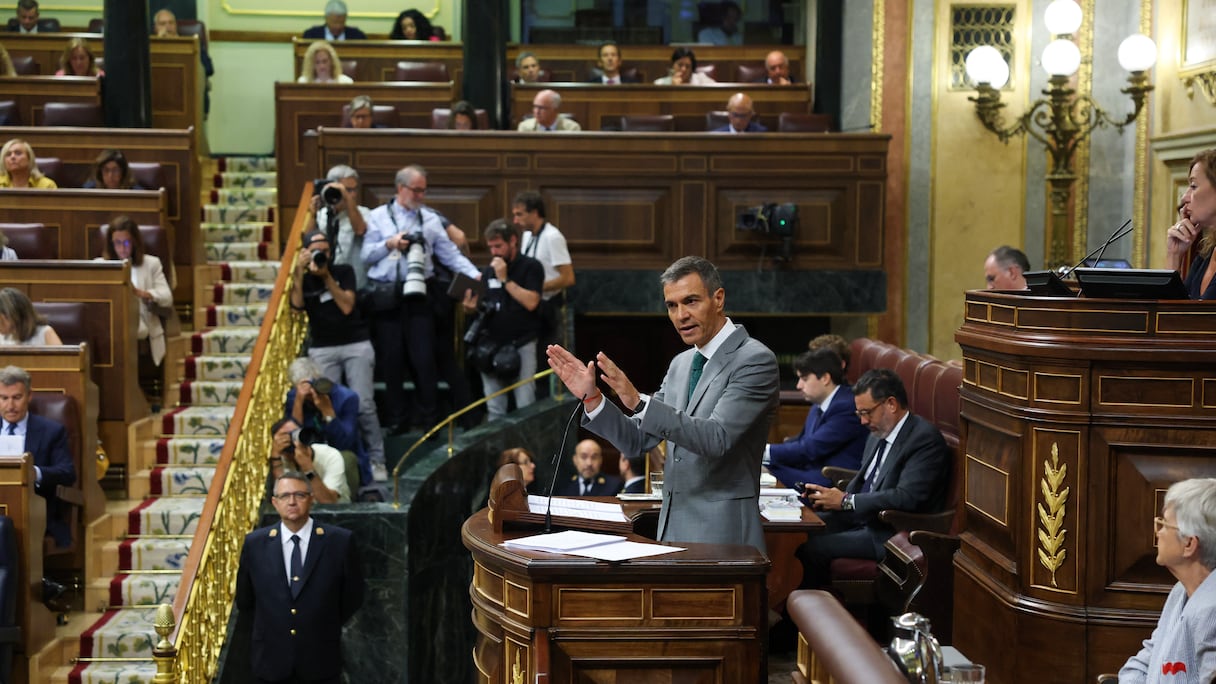
Pedro Sánchez repeated it, this time from the floor of Congress, leaving no room for the tendentious interpretations that have dominated part of the Spanish and international media debate in recent hours. The government has no evidence that would allow it to attribute to Morocco the planning or organization of the mass entry of migrants into Ceuta on July 30 and 31.
The Spanish prime minister’s remarks echo the clarification issued Wednesday by the director general of the police, Francisco Pardo. He had informed Interior Minister Fernando Grande-Marlaska that no police report blamed the Moroccan authorities for organizing the events.
Read also : Ceuta: The false Spanish police narrative implicating Morocco that upended Spanish politics
Yet while the accusations against Morocco have dominated front pages, fueled television debates and made headlines, the police denial has received nowhere near the same exposure. Some media outlets continue to relay the initial version, based on excerpts from a document submitted as part of a judicial investigation, even though the Spanish authorities themselves have ruled out the hypothesis of an operation orchestrated from Morocco.
No Institution Has Provided Evidence
Pedro Sánchez was categorical about the investigations conducted so far. “It cannot be concluded that this operation was devised by Morocco,” he told lawmakers. The prime minister then specified that none of the institutions consulted by the government had provided any evidence to substantiate such an accusation.
“I can guarantee you that none of these institutions, nor the diplomatic services, the European Commission or any other international body, has provided the Spanish government with solid evidence indicating that Morocco planned or organized this episode,” he said.
The investigation remains open, and Pedro Sánchez said that if new evidence were to emerge, his government would make it public and act accordingly. But the central message of his intervention leaves no room for ambiguity. On the basis of the information currently available, Spain cannot attribute the planning of the events to Morocco.
This clarification dismantles the narrative built around the supposed existence of a police report directly implicating the Kingdom. It is a narrative that triggered calls for resignations, demands for early elections and a fresh escalation of hostile statements against Morocco, even before the origin, scope and precise nature of the documents cited had been established.
Pedro Sánchez Demands Explanations From CENIF
A large part of the questions raised by the prime minister concerned the role of the National Center for Immigration and Borders, CENIF, a body attached to the National Police.
“Why did CENIF not send any superior in the National Police chain of command or the Interior Ministry the information note dated July 29?” Pedro Sánchez asked.
He also wanted to know why the contents of the report requested by a judge of the Audiencia Nacional, which could have implications for state security, had been communicated neither to senior police officials nor to the government.
“Why was the content of a report commissioned by a judge and potentially carrying implications for state security transmitted neither to the relevant superiors nor to the Spanish government? That, too, will have to be explained, ladies and gentlemen of the House,” he said.
The question has taken on particular importance since it emerged that the judge had ordered that information gathered as part of the judicial investigation not be passed on to the police hierarchy without her authorization. The controversy therefore concerns not only the contents of the documents, but also how they circulated, their judicial framework and the political and media exploitation of certain excerpts.
Morocco’s Cooperation Made the Returns Possible
Pedro Sánchez also stressed that the response to the mass entry would not have been possible without Morocco’s direct cooperation. Once the border had been reinforced, he explained, the government’s second priority was to take charge of and rapidly return those who had no right to remain on Spanish territory.
Staff assigned to migration issues were therefore reinforced, temporary reception capacity was increased and “close coordination with the Moroccan authorities” was established. Without that cooperation, he insisted, the results achieved would have been impossible, both legally and logistically.
The prime minister said that within less than 24 hours, some 50,000 people had returned to Morocco and that, 72 hours later, the figure had reached 63,000, representing more than 90% of those who had entered Ceuta irregularly. Pedro Sánchez described the operation as “one of the fastest return processes ever carried out in Europe’s recent history” and recalled that its effectiveness had been praised by the European Commission.
As for subsequent operations, Pedro Sánchez reported that 3,658 migrants had been returned to Morocco and 3,300 people transferred out of Ceuta since August 10. He added that 1,530 people had left the streets thanks to accommodation solutions, returns or expulsions. The government intends to find a solution for at least another 1,500 people over the next two weeks in order to significantly ease the pressure that continues to weigh on Ceuta.
A Disagreement Taken to the Diplomatic Level
Pedro Sánchez also responded to statements on Ceuta and Melilla made by two Moroccan ministers. He said representatives of the Spanish government had met Morocco’s ambassador to Madrid, Karima Benyaich, on August 21 to convey their rejection of remarks he described as “unacceptable.”
Spanish Foreign Minister José Manuel Albares had already said a few days earlier that Madrid had made its position known “through all available diplomatic channels,” without the government having disclosed until now that the meeting had taken place. Pedro Sánchez concluded this part of his intervention by reaffirming Spain’s position on the two cities. “Ceuta and Melilla are Spanish cities and will remain so until the end of time,” he told lawmakers.
No Exceptional Warning Had Been Issued
Pedro Sánchez also denied that his government had received a warning that would have enabled it to anticipate the scale of the mass entry.
“The answer is clear. No, it did not,” he replied when asked about the existence of prior warnings. The government, he explained, had reviewed all reports, messages and notes transmitted to the political authorities and the government delegation in Ceuta by the security forces, the National Intelligence Center and other bodies.
“I can assure you that none of these documents went beyond a simple description of the available data and routine warnings. None, moreover, anticipated either the scale or the likelihood of what ultimately happened,” he stressed.
The prime minister also referred to a routine Frontex report that predicted no mass entry, as well as the note drawn up by CENIF. According to his explanation, the latter assessed that the movements observed on social media were not a cause for concern, while noting that favorable conditions at sea could lead to a gradual increase in attempts to cross via the border breakwaters. It therefore did not in any way warn of an episode on the scale of what subsequently occurred.
Faced with accusations that the government had been informed of the risk but deliberately chose not to intervene, Pedro Sánchez was categorical. “It is absurd to think that the government had been warned and knowingly decided to do nothing.”
All Reports Will Be Made Public
To put an end to the controversy, the prime minister announced that he had ordered the compilation of a dossier containing all the reports produced in the days preceding the events.
“The government has nothing to hide in this affair. I have in fact ordered the publication of a dossier containing all the reports, absolutely all of them, so that the media and citizens can examine them for themselves,” he said.
Their publication will make it possible to compare the routine notes, the available warnings and the documents subsequently submitted to the judicial investigation. It will also make it possible to determine to what extent the version that has fueled Spain’s political debate for the past two days faithfully reflects the full contents of those reports, or whether it was constructed from excerpts taken out of context.
Pedro Sánchez nevertheless announced a review of cooperation mechanisms with Morocco to prevent such a situation from happening again.
“We are currently reviewing all the coordination and warning mechanisms we share with the Moroccan state, and we are going to put additional safeguards in place so that the situation we experienced on July 30 does not happen again,” he explained.
At the same time, the prime minister stressed the need for Spain to preserve its cooperation and good-neighborly relations with Morocco. That desire has also been expressed by the Moroccan authorities, which have refused to turn immigration into an instrument of pressure and have advocated maintaining dialogue with Madrid. “We must continue to cooperate with Morocco and maintain good-neighborly relations with it. But it is clear that, after what happened, that cooperation will have to evolve,” he said.
