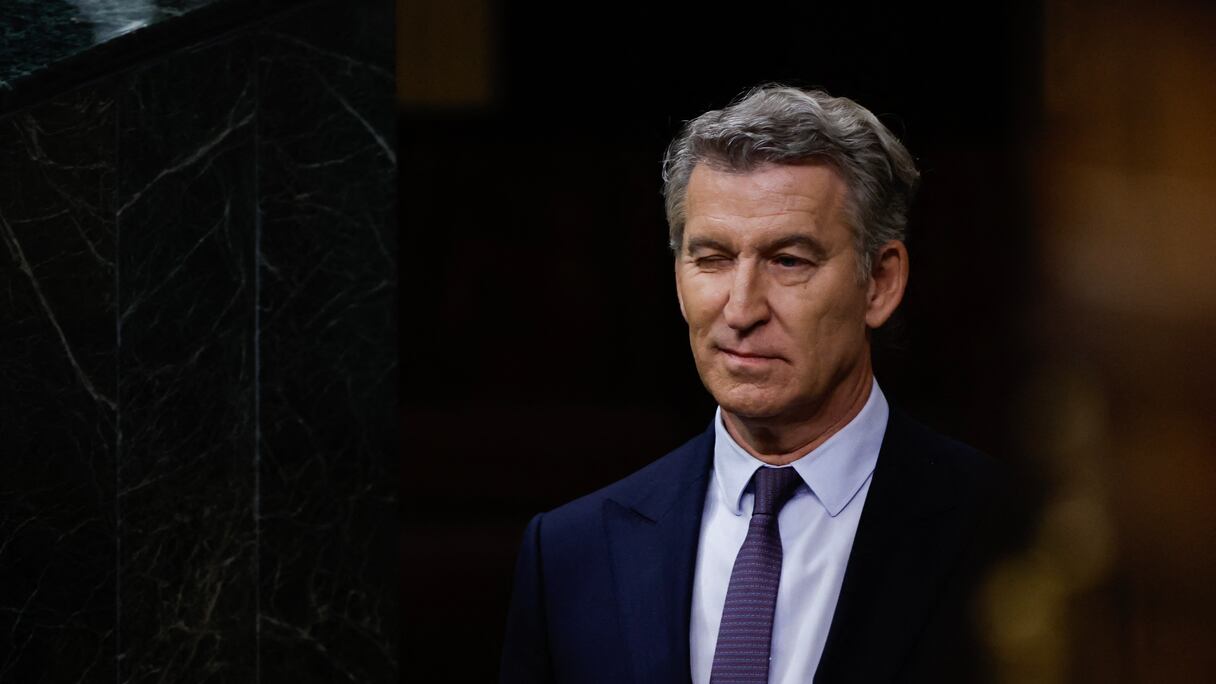
The accusation is unusually serious by the standards of Spanish foreign policy.
In recent days, Spain’s Minister of Foreign Affairs, European Union and Cooperation, José Manuel Albares, has described the Popular Party (PP) as an “anti-Morocco” political force amid an escalating war of words that extends far beyond another dispute between the government and the opposition.
Spain’s top diplomat argues that the PP is turning the country’s foreign policy—and its relationship with Morocco in particular—into a tool of domestic political confrontation. Tensions have intensified following a series of controversial statements by current and former senior PP figures, prompting Albares to accuse the opposition of becoming “an obstacle” to Spanish foreign policy.
Behind the political clash lies a much deeper issue.
Since 2022, Spain and Morocco have built a strategic partnership based on cooperation in migration, trade, investment, policing, and security. That relationship has since expanded to include the joint hosting of the 2030 FIFA World Cup alongside Portugal. In December 2025, the two governments further strengthened that framework by signing 14 new cooperation agreements and issuing a joint declaration aimed at deepening political dialogue.
The PP wants to govern Spain. If it succeeds, it will inherit precisely that relationship.
The question is what it intends to do with it.
The Sahara, the PP’s greatest contradiction
The Sahara issue is arguably the biggest unresolved question.
When Prime Minister Pedro Sánchez announced in March 2022 that Spain regarded Morocco’s autonomy initiative as “the most serious, credible and realistic basis” for advancing a solution, the Popular Party turned that policy shift into one of its principal lines of attack against the government.
Alberto Núñez Feijóo denounced what he described as a break with decades of bipartisan consensus in Spanish foreign policy, criticizing in particular the fact that the decision had been made without consulting the country’s main opposition party.
Since then, the PP has maintained a far more ambiguous public position than the government. Its policy documents have consistently emphasized respect for international law and United Nations resolutions, while stopping short of explicitly endorsing the formula used by Madrid to support Morocco’s autonomy initiative.
Yet the party’s recent history shows that its position on the Sahara has not always been consistent. During Mariano Rajoy’s tenure as prime minister, Spain pursued a cautious approach, but not one of confrontation with Morocco’s proposal. The PP itself has also long encompassed differing views, ranging from figures supportive of a strategic partnership with Rabat to others far more aligned with the positions defended by the separatists.
The contradiction became particularly visible in July 2025, when the Polisario Front’s purported representative in Spain attended the Popular Party’s National Congress. His presence sparked a major controversy and fueled doubts in Morocco over the position a future Feijóo government might adopt.
The issue took on a new dimension in February 2026.
Albares then accused the PP of speaking with two voices—one in Spain and another in its dealings with Moroccan authorities. According to the minister, senior PP figures were sending “envoys” to Morocco to quietly endorse the very position on the Sahara that they publicly attacked at home.
If that accusation reflects reality, the dilemma facing the PP is obvious. Using the Sahara issue to weaken Pedro Sánchez from the opposition is one thing. Reversing Spain’s policy toward Morocco from La Moncloa—and bearing the diplomatic consequences—is quite another.
An international landscape very different from 2022
Nor would the PP take office in the same international environment that existed when Sánchez announced Spain’s new position in March 2022.
Since then, Morocco’s autonomy initiative has continued to gain international backing, while developments at the United Nations have reshaped the diplomatic landscape surrounding the Sahara. At the same time, Spain has integrated its position on the dispute into a much broader bilateral relationship with Morocco.
Reversing course would no longer mean simply changing a sentence in a diplomatic communiqué. It would reopen one of the most sensitive issues in relations between the two countries.
That remains one of the central questions the PP has yet to answer publicly. Would a government led by Feijóo maintain Spain’s current position on the Sahara, or would it seek to return to the policy that preceded March 2022?
So far, the party has carefully avoided giving a definitive answer.
Pressure from Vox and the shift toward “national priority”
The Sahara is not, however, the only source of friction between the PP and Morocco.
In recent months, the party has also hardened its rhetoric on immigration and access to certain public benefits, against the backdrop of growing electoral competition with Vox.
The clearest example came in April 2026, when the concept of “national priority” entered Spain’s political debate. Historically associated with Europe’s far right and championed in Spain by Vox, the idea calls for giving Spanish nationals preferential access over foreigners to certain public assistance and social benefits.
The debate forced the PP to take a position after Vox introduced a parliamentary initiative on the issue and the concept began appearing in regional political agreements.
The controversy exposed tensions within the PP itself, with some party members concerned about the political and legal costs of embracing a formula long associated with the far right.
The party later sought to soften its message. Senior PP figure Jaime de los Santos stated that “any legally resident immigrant has exactly the same rights as those of us born here,” while others within the party preferred to speak of “integration” or “residential priority.”
But by then, the political signal had already been sent.
Vox was succeeding in moving part of its political agenda into Spain’s main conservative party.
Feijóo’s paradox
The PP’s central dilemma can be summed up in a single paradox.
From the opposition benches, it can use Morocco and the Sahara issue to attack Pedro Sánchez. From government, however, it would have to manage one of Spain’s most important and complex foreign relationships. Those two positions are not always compatible.
If Feijóo reaches La Moncloa, he may discover that many of the decisions he criticizes today are rooted in a strategic reality that no Spanish government can afford to ignore.
Cooperation with Morocco is not merely an ideological choice made by the Socialist government. It is dictated by geography, economics, security, and an increasingly dense web of shared interests.
For that reason, the most likely scenario would not necessarily be a rupture, but rather a contradiction between opposition rhetoric and governing policy—a PP compelled to preserve much of the current relationship with Rabat while explaining to its own electorate why it has not reversed the very decisions it spent years denouncing.
Albares’ allegation that the PP has quietly sent “envoys” to Morocco points precisely in that direction: that the party may be considerably more pragmatic behind closed doors than its public discourse suggests.
The real question, therefore, is not simply whether the PP is “anti-Morocco,” as Spain’s foreign minister contends.
The deeper issue is the extent to which Spain’s main opposition party is prepared to use relations with its southern neighbor as an electoral weapon against both the Socialist government and Vox—and how much of that rhetoric it would actually be willing to translate into state policy if it came to power.
Spain will remain the Kingdom’s closest European neighbor, and Morocco will remain an indispensable strategic partner for Madrid, regardless of who governs.
That is precisely why the PP’s current contradictions matter.
If Alberto Núñez Feijóo becomes prime minister, he will not inherit a blank slate. He will inherit a profoundly transformed bilateral relationship, Spain’s position on the Sahara embedded within a new international reality, an established security partnership, and preparations for the 2030 World Cup that will require both countries to work side by side for years to come.
At that point, he will face a choice between two paths: turning the rhetoric he embraced in opposition into government policy, at the risk of opening a new chapter of uncertainty with Rabat, or accepting that relations with Morocco demand a degree of pragmatism that the Popular Party has not always been willing to acknowledge publicly.
That choice could well become one of the first major foreign policy tests of a Feijóo government.
