
With 97 seats, the PAM moves from second to first place compared with 2021, when it won 87 seats. The RNI, which came first five years ago with 102 seats, drops to 66. Istiqlal, meanwhile, falls from 81 to 65 seats.
| Party | 2021 | 2026 | Evolution |
|---|---|---|---|
| PAM | 87 | 97 | +10 |
| RNI | 102 | 66 | -36 |
| Istiqlal | 81 | 65 | -16 |
| PJD | 13 | 54 | +41 |
| MP | 28 | 29 | +1 |
| USFP | 34 | 26 | -8 |
| PPS | 22 | 19 | -3 |
| UC | 18 | 17 | -1 |
| MDS | 5 | 8 | +3 |
| Left Alliance | 1 | 8 | +7 |
| FFD | 3 | 2 | -1 |
| Party of Equity | — | 2 | +2 |
| PND | — | 1 | +1 |
| PUD | — | 1 | +1 |
| PSU | 1 | — | -1 |
| CNI | 1 | — | -1 |
| Total | 395 | 395 | — |
The most dramatic change, however, concerns the PJD. After collapsing to 13 seats in 2021, the Justice and Development Party has climbed back to 54 seats, reclaiming a central position in the new House.
Behind the top four, the Popular Movement won 29 seats, compared with 28 in 2021. The USFP fell from 34 to 26 seats, while the PPS dropped from 22 to 19. The Constitutional Union won 17 seats. The MDS and the Left Alliance each secured eight seats. The FFD and the Party of Equity each won two seats, while the Neo-Democrats and the Party of Unity and Democracy each have one representative. In total, the 14 represented parties share the House’s 395 seats.
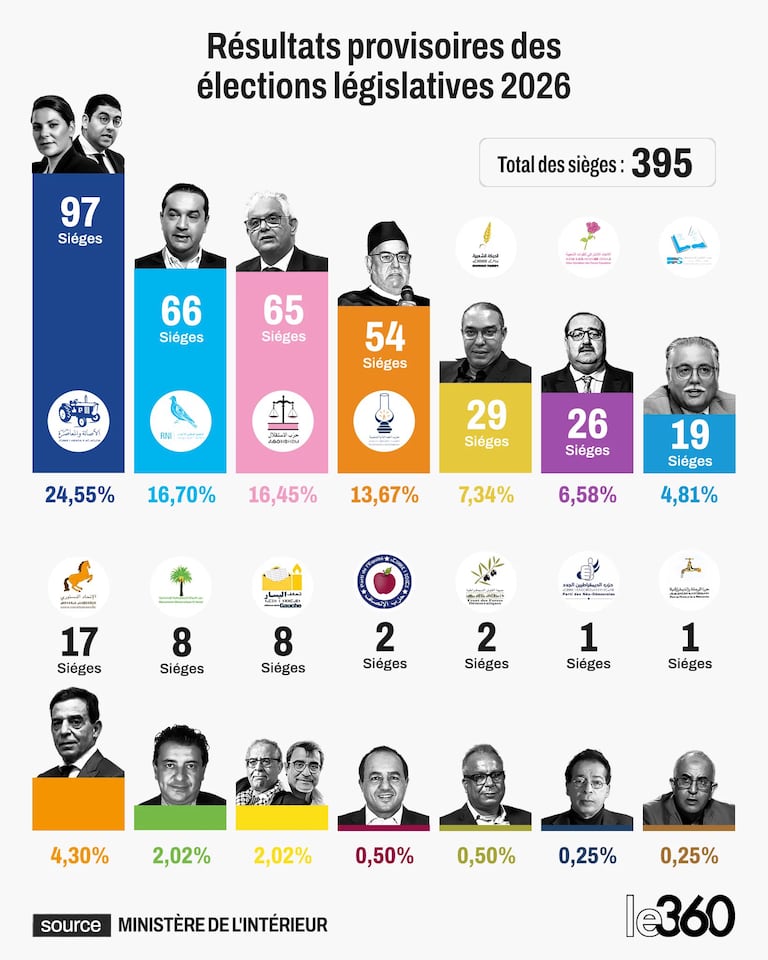
Arithmetically, the three parties that made up the outgoing governing coalition still hold an absolute majority. The PAM, RNI and Istiqlal have 228 seats combined, 30 more than the 198-seat threshold needed for a majority in the House of Representatives.
Read also : From social media to Parliament: Barik beats bigger party machines to claim PUD’s lone seat
But that arithmetic masks a political reality very different from that of 2021. The PAM is now the largest parliamentary force, while the RNI, which led the outgoing government, has lost 36 seats. More importantly, relations between the two parties deteriorated considerably in the weeks leading up to the election.
The campaign was marked by a succession of accusations and clashes between the two former allies. At the end of August, the RNI denounced efforts to poach several of its MPs, elected officials and local leaders during the electoral period, going as far as targeting a member of its political bureau.
The leak of a recording attributed to Rachid Talbi Alami further escalated the confrontation. During an RNI political bureau meeting, the speaker of the House of Representatives referred, without naming him, to Fouzi Lekjaa, who had recently joined the PAM. He said, among other things, that Lekjaa would not get the Economy and Finance portfolio, adding that the ministry already had “its tenant,” referring to Nadia Fettah.
The PAM had also clearly stated its position toward the RNI before the election. Fatima Ezzahra El Mansouri said she did not want to join a government led by the RNI if the party came first in the election. Mohamed Mehdi Bensaïd later confirmed that position, also ruling out PAM participation in a government coalition led by the RNI.
The two leaders were careful, however, to specify that the final decision on post-election alliances would be taken by the party’s governing bodies, particularly the National Council. That distinction is now particularly significant. The RNI did not come first after all. With 66 seats, it finished second behind the PAM, which won 97.
The position expressed before the election therefore does not, on its own, answer the question posed by the current configuration. It nevertheless remains an important element of the political context in which talks on the next governing majority will begin.
Several possible combinations
The renewal of the PAM-RNI-Istiqlal alliance remains, on paper, the first possible majority, with 228 seats. But tensions that built up during the campaign and the public positions taken by the two parties make this prospect less straightforward politically than a simple addition of seats would suggest.
Other combinations are also possible. An alliance between the PAM, Istiqlal and PJD would have 216 seats. The PAM, RNI and PJD would reach 217 seats.
The PJD’s return to the new House also changes the balance. With 54 MPs, compared with just 13 in 2021, the party has regained enough parliamentary weight to feature in several possible combinations.
Another factor in the coalition equation is that relations between PJD and PAM leaders remained relatively calm during the campaign, in contrast to the particularly bitter exchanges between the PAM and RNI. Abdellah Bouanou did not hesitate, during a televised appearance, to praise Fouzi Lekjaa, who had recently joined the PAM. Abdelilah Benkirane, for his part, also expressed his esteem for the Budget minister on several occasions, even as he remained highly critical of the PAM as a political party.
This relationship is not entirely new. Before joining the PAM, Fouzi Lekjaa had already maintained cordial relations with PJD MPs during his appearances in Parliament as minister delegate in charge of the Budget, particularly when defending finance bills. Debates could be heated, but PJD MPs also voted several times in favor of certain provisions in finance bills, depending on the texts and amendments under consideration.
The coalition equation must also take into account the red lines some parties have drawn toward others. The USFP has notably ruled out any alliance with the PJD. This position creates an additional constraint for configurations involving the two parties and reduces the room for maneuver in forming a broader majority.
Istiqlal at the center of the equation
With 65 seats, Istiqlal retains a central position in the new political landscape. The party has enough MPs to become an important partner in several possible majority configurations.
Before the election, Istiqlal had signaled openness to different political parties without setting a general red line on alliances. The Balance Party could therefore find itself at the heart of talks once the government formation process gets underway.
The equation is therefore no longer simply a matter of adding up seats. It will have to take into account the new balance of power, statements made by party leaders before and during the campaign, the incompatibilities declared by some parties, as well as the degree of consistency between electoral platforms. PPS Secretary-General Nabil Benabdallah, in particular, has repeatedly stressed the need for programmatic convergence before considering an alliance.
Read also : Six million votes later, the dust settles on Morocco’s election
Article 47 of the Constitution provides that the King appoints the Head of Government from the party that comes first in elections to the House of Representatives. With its 97 seats, the PAM is therefore at the center of the next political phase.
The Tractor Party does not have an absolute majority on its own, meaning that forming a government will require agreements with one or more other parties. The upcoming consultations will show how much weight the red lines declared before the election actually carry and to what extent the campaign’s clashes will influence coalition choices.
