Essaouira, the city of the trade winds, has long been associated with coexistence. Muslims and Jews shared its streets for centuries, and today Bayt Dakira, the House of Memory, displays the Quran and Torah side by side.
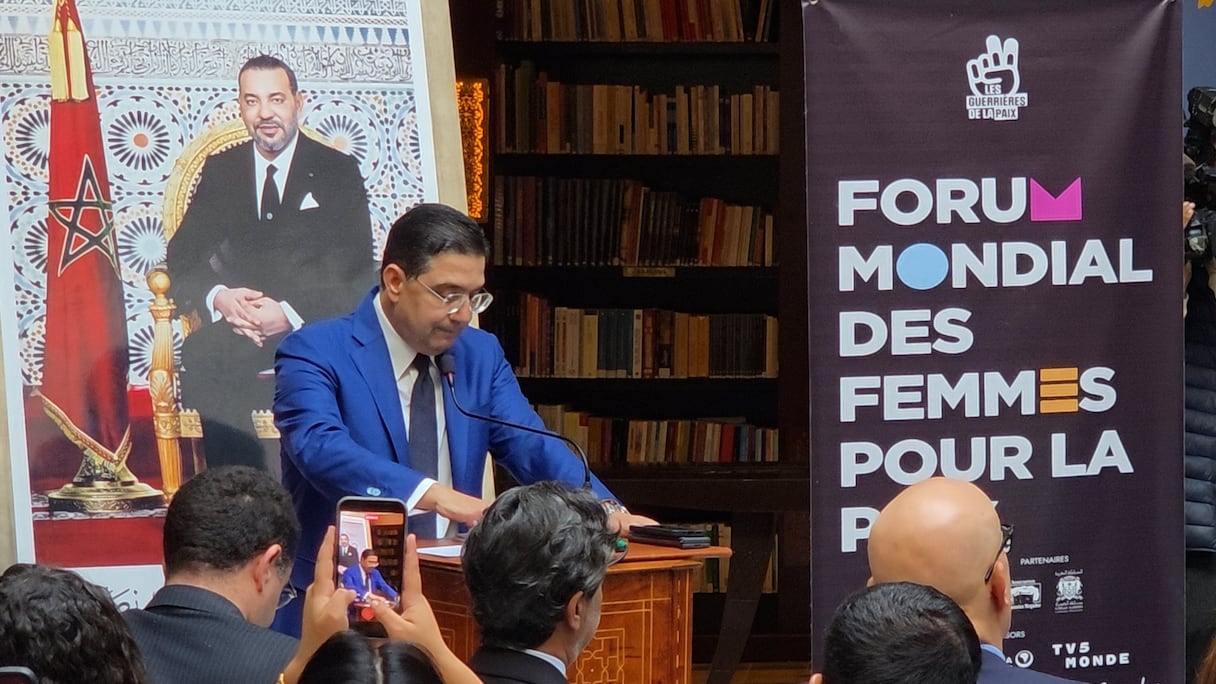
It was in this city, now a symbol of dialogue between communities, that Bourita and Barrot addressed peace activists from conflict zones on Friday at Dar Souiri.
The meeting took place on the second day of the third World Forum of Women for Peace, held from November 12 to 14 and organized by the association Les Guerrières de la Paix, which was nominated for the 2025 Nobel Peace Prize.
The forum has brought together more than 500 participants, including activists, elected officials, diplomats, artists and representatives of international organizations. Its sessions are taking place at Bayt Dakira, Dar Souiri and the Sqala, and are set to conclude on Saturday with the adoption of an “International Appeal by Women for Peace.”
Bourita opened the meeting by paying tribute to King Mohammed VI’s adviser André Azoulay, whose commitment helped make Essaouira a distinctive place of memory and dialogue. “I look at you, Mr. André Azoulay, and I tell myself that this forum could not have been held anywhere else, or without you,” he said.
Bourita: Essaouira is a symbol of dialogue and coexistence
The minister recalled that Bayt Dakira, inaugurated by King Mohammed VI on January 15, 2020, stands as a testament to this history of coexistence and the determination to preserve it.
“It is difficult to imagine a more symbolic place than Essaouira to reflect on the future, the path to peace, and the role of diplomacy and civil society in the difficult circumstances we are going through,” he said.
Turning to Hanna Assouline, founder of Les Guerrières de la Paix, Bourita praised the initiative as “a civic initiative before being a feminist one, and above all, a human one.” He recalled that Morocco’s embassy in Paris was among the first diplomatic missions to welcome her and hear about her project.
He also praised the activists for continuing to defend dialogue despite tensions caused by the war in Gaza and the criticism directed at them.
“You chose peace before October 7. You continued to defend it while the war made your struggle more difficult, but also made your voices more necessary. You faced criticism and sometimes received messages of hate, yet you stood firm. Your determination commands our admiration,” he told them.
Moroccan-French ties and regional diplomacy
Bourita welcomed the opportunity to take part in the meeting alongside his French counterpart, whom he described as “a colleague, a brother and a friend.” He said the two ministers were working under the guidance of King Mohammed VI and French President Emmanuel Macron to strengthen relations between Rabat and Paris.
The planned signing of a friendship treaty between the two countries marks another step in that rapprochement. “Moroccan-French relations are going through one of their most distinctive periods, marked by calm, ambition and a strategic partnership,” he said.
The closer ties have also translated into cooperation on several international issues, including peacekeeping, climate diplomacy and the Middle East. Bourita recalled Morocco’s support for the French initiative promoting a two-state solution, presented at the UN General Assembly, as well as the Kingdom’s hosting of a meeting of the Global Alliance for its implementation.
Read also : Bayt Mal Al-Quds Agency distributes 3,000 school kits to students in Jerusalem ahead of new school year
He also highlighted the role of King Mohammed VI as chairman of the Al-Quds Committee and the French president’s commitment to a “just and lasting peace based on the two-state solution.”
Turning to the substance of the discussions, Bourita argued that peace cannot rest solely on agreements between governments. It must also take root in society and create the conditions for people to live together.
“Peace is not war fatigue. Peace is a decision,” he said.
He explained that agreements are sometimes reached when warring parties, exhausted by fighting, conclude that the cost of continuing has become too high. But peace born only out of exhaustion can remain fragile. To last, it must go beyond a halt to the fighting and help “heal memories, ease fears and restore hope.”
This, Bourita said, is where civil society has a vital role to play. Diplomats can negotiate and governments can sign agreements, but lasting peace also depends on whether people are willing to live together. Rejection of the other and extremist rhetoric can undermine even the most significant progress.
This belief also explains the importance he attaches to women’s participation in peace processes. Noting that women account for just 16% of participants in negotiations worldwide, he said their involvement increases the chances of reaching an agreement by 35%. “Women’s voices are not a luxury. They are indispensable,” he stressed.
Diplomatic engagement backed by concrete action
To illustrate Morocco’s approach, Bourita said the Kingdom’s position on the Middle East reflects King Mohammed VI’s consistent commitment to defending the legitimate rights of the Palestinian people and establishing an independent Palestinian state within the borders of June 4, 1967, with East Jerusalem as its capital, living in peace and security alongside Israel.
“Those who believe that war and the logic of force can change a course that history, geography and demography have made unviable are mistaken,” he said. For the minister, the two-state solution remains the only path to lasting stability in the region.
Morocco’s position is reflected in diplomatic initiatives as well as practical support on the ground. As chairman of the Al-Quds Committee, the King relies in particular on the Bayt Mal Al-Quds Agency to assist Palestinians and preserve the identity of the holy city.
Bourita listed several of the agency’s activities, including managing 10 schools in Jerusalem, supporting more than 300 orphans in the Gaza Strip and providing assistance to over 100 children injured during the war. Its work also includes food aid, support for women through income-generating activities and efforts to preserve Jerusalem’s Palestinian character.
“In Morocco, when we talk about solidarity, it is not just a slogan or a speech. It means taking action on the ground,” he said.
Support for Palestinians, however, is only one part of Morocco’s approach. Bourita also described the Kingdom’s efforts to bring Israelis and Palestinians closer together by creating opportunities for people from both sides to meet, even when some initially refused to sit in the same room.
Read also : Director General of Israeli Defense Ministry Amir Baram in Morocco for working visit
He recalled early meetings held at the French Institute in Morocco, where the two sides had to be placed in separate rooms. Organizers initially served as intermediaries between them. Only after lengthy discussions did participants agree to sit around the same table. Over time, relations evolved to the point where some began taking part in informal activities together, including running sessions.
For Bourita, these experiences show that the barriers to dialogue are not purely political. They are also psychological and human.
“Sometimes, and quite often, official and political considerations become psychological obstacles that civil society and people working on the ground must overcome. They must push open doors and move agreements forward,” he said.
He urged the activists to continue their work, maintain links between civil societies and amplify moderate voices, which are often weakened during conflicts. He also called on them to prepare for the postwar period, stressing that rebuilding Gaza’s infrastructure will not be enough without addressing people’s minds and education.
“Rebuilding a city is good. Even turning it into a new Singapore is good. But what about the people? What about those who will live in those skyscrapers?” he asked.
Without genuine public commitment to coexistence, he warned, the investments poured into reconstruction could fail to withstand future tensions.
Bourita also warned against actors seeking to derail peace efforts, saying they are currently setting the agenda in the Middle East. “It is time for us to take back that agenda,” he said, concluding that the prospect of two states must not be abandoned: “There is no Plan B. There is no alternative to peace.”
Barrot: Civil society offers a light against the “culture of war”
Taking the floor, Jean-Noël Barrot first paid tribute to his Moroccan counterpart, addressing him as “my friend, my brother.” He highlighted the symbolic importance of this first visit by a French foreign minister to Essaouira and thanked André Azoulay for hosting the meeting at Dar Souiri. He also praised the commitment of those attending, including Hanna Assouline and activists from different conflict zones.
The French minister then turned to the international climate, which he said was increasingly shaped by what he called a “culture of war.”
“We are living through dark times. Times we have known before,” he said.
He described this culture as one in which people stop seeing others as their equals and instead regard them as enemies, while force takes precedence over the rule of law in resolving disputes. In his view, this mindset often begins with language.
“Wars are born in the minds of women and men, because violence in words inevitably follows violence in deeds,” he warned.
Read also : On royal instructions, Lalla Meryem receives Al-Quds children taking part in Bayt Mal Al-Quds summer camp
Barrot denounced the spread of hate speech, racism and antisemitism, saying these contribute to the normalization of violence. He cited conflicts in Ukraine, Sudan, South Sudan, Congo and Gaza, where civilians continue to bear the cost of fighting.
Yet France’s top diplomat said he refused to give in to pessimism. Drawing on the writings of Albert Camus, he recalled that a light remains at the end of the darkness and that everyone has a role in bringing it out.
He said he sees that light in the commitment of 145 young people from around the world who launched an appeal for a new culture of peace over the summer. The appeal was adopted by UNESCO’s Executive Board on October 20. He also pointed to Essaouira, which he described as a “small mosaic miracle of peoples and stories,” where different communities have learned to live together.
Addressing the activists directly, Barrot praised those who continue to defend dialogue despite the suffering they have experienced and the divisions caused by war.
“You are the vanguard, the pioneers of a movement that will grow, gather strength and prevail,” he told them.
He added: “Resistance begins here, peace is built here, in the minds of women and men of goodwill and in the beating heart of civil society.”
Barrot then stressed the influence civic organizations can have on political decisions. To illustrate this, he described France’s initiatives to revive the Israeli-Palestinian peace process.
“Without your mobilization, France would not have succeeded last year in saving the two-state solution,” he said.
He recalled France’s call for all parties to make simultaneous commitments to peace. Western countries were urged to recognize the State of Palestine; Arab countries were asked to condemn Hamas’s October 7 attacks and express their willingness to pursue regional integration alongside Israel; the Palestinian Authority was expected to undertake reforms; and Israel was called on to recognize the Palestinians’ right to dignity and self-determination.
Barrot retraced the steps behind this diplomatic push, including a June 13, 2025 meeting in Paris between representatives of Israeli and Palestinian civil society, which gave rise to the Paris Call. Its principles were later reflected in the New York Declaration, adopted by the UN General Assembly on September 12, 2025.
France recognized the State of Palestine a few days later, followed by other countries. Barrot also referred to subsequent meetings in Paris and New York, where representatives of the two civil societies presented their proposals to political and diplomatic leaders.
He said this mobilization had kept the two-state solution on the international agenda at a time when prospects for resolving the conflict appeared increasingly remote.
“Without the perseverance of civil society, the two-state solution would probably have disappeared from the political horizon,” he said.
He urged the activists to keep up their efforts, promote the Paris Call and persuade public opinion that coexistence remains possible. He also said their work should extend to the democratic process, helping ensure that voices in favor of peace can influence election results.
The French minister also addressed the humanitarian situation in the Palestinian territories.
“Unfortunately, the situation in Palestine remains catastrophic,” he said.
In Gaza, torrential rain is worsening conditions for displaced families, whose makeshift shelters are repeatedly flooded. Barrot also denounced Israeli authorities’ restrictions on humanitarian aid entering through border crossings. Tons of French humanitarian supplies have been held up for months in El Arish, Egypt.
Read also : Gaza: Hamas agrees to deal with Israel
“Israeli authorities must allow them to enter. It is their obligation under international law, and it is their moral obligation,” he stressed.
In the West Bank, he condemned settler violence against Palestinians, citing uprooted olive trees, destroyed harvests and residents driven off their land. He also denounced the expansion of settlements and recalled the measures France took on October 8 against their main proponents.
Palestinians urged to hold elections in September 2027
Barrot also addressed upcoming elections, which he considers essential to giving people a say in their political future.
In Israel, he noted gains by political forces that support coexistence between Israelis and Palestinians, saying their election results show that an alternative to permanent war exists.
In Palestine, he called for free and democratic elections and criticized the decision by the Palestinian Authority president to postpone the vote.
“That was the worst possible service he could have done for his people,” Barrot said.
The French foreign minister argued that Palestinians must be able to choose their representatives and restore democratic legitimacy through the ballot box. He also made a commitment before the forum’s participants:
“I will use all my influence to ensure these elections take place in the first quarter of 2027, so that the Palestinian activists here in Essaouira today can stand as candidates and return next year with their parliamentary mandates.”
