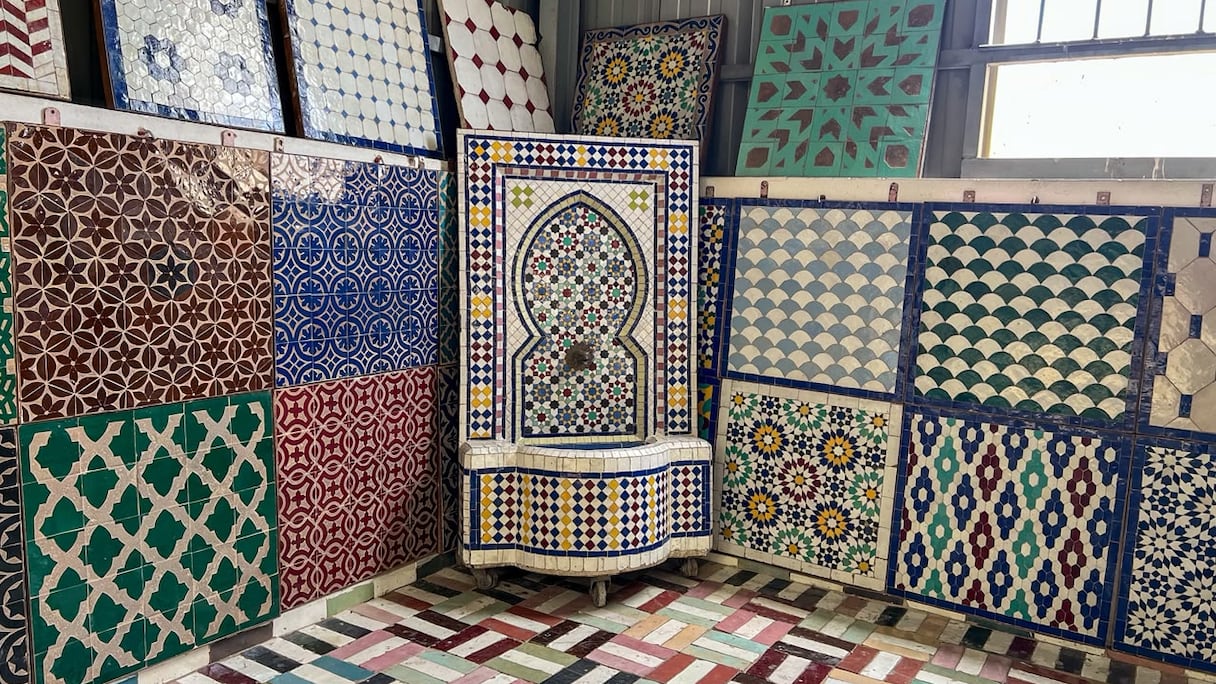
Summer is hardly downtime in the zellige workshops of Fes. When temperatures shoot up, craftsmen get down to preparing as much clay as they can before winter makes drying a longer affair.
For Abdelfattah Chelh, who has been at it for more than 40 years, the work still starts with clay brought down from the Benjalik mountains near Sidi Hrazem.
“Beldi zellige remains closely tied to a very specific raw material and to techniques passed down from one artisan to another,” the master zlayji told Le360.
At the workshop, the clay goes into what craftsmen call a zouba. It is mixed, spread out and left to dry before being fired. From there begin the cutting, colouring and shaping that turn the baked pieces into the familiar geometry of Fassi zellige.
It is painstaking work, and not every clay will do.
Chelh says Benjalik clay has the right give for shaping but remains firm enough to survive the different stages without falling apart.
“The distinctive quality of Benjalik clay lies in its composition. It is flexible enough to be shaped while also being solid enough to maintain its cohesion throughout the different stages,” he said.
Read also : Inside Marrakech’s riads: Where Moroccan heritage meets modern hospitality
That balance becomes all the more important when a craftsman gets down to fin travail, the thinner, more intricate pieces where a poor batch of clay can make an already exacting job harder.
“To produce fin travail, we need clay that can be cut and shaped with precision. When its quality is not up to standard, the task becomes much more difficult,” Chelh said.
Fassi zellige has meanwhile travelled far beyond the workshops where it is made. Chelh says orders come from France and Spain and from other markets in Europe and the Americas.
Read also : As machines move in, Morocco’s master zellige artisans fear for a centuries-old tradition
He puts that pull down to the colours, the geometry and the handwork that goes into each composition.
But keeping up the quality comes back to where the process began — the quarry.
Some quarries, Chelh says, are no longer yielding clay good enough for the finer pieces. Other deposits around the region have better material, but craftsmen need access to them.
“The region has several quarries containing excellent-quality clay. Giving artisans the necessary permits to access them would make their work easier,” he said.
