For centuries, Fassi zellige has defined the visual identity of Moroccan architecture. Its intricate geometric mosaics are the product of generations of master craftsmen who passed their knowledge from one apprentice to the next, making the craft one of the most enduring expressions of Morocco’s artisanal heritage.
Today, that tradition stands at a crossroads.
As mechanisation is introduced into parts of the production process, many artisans fear that the manual expertise at the heart of zellige could gradually give way to industrial methods, altering the very character of a craft that has flourished for more than twelve centuries.
Abdellatif Hissouf, who has worked as a zellige artisan for more than 41 years, embodies that living tradition. Trained in the workshops of Fez’s medina, he learned the basics of drawing at an early age using reed stems before mastering the techniques of pattern design and decoration. He went from being an apprentice to becoming a master craftsman (maâlem), eventually exporting Moroccan zellige to Europe, the Americas, and Asia.
Speaking to Le360, Hissouf said the profession goes far beyond a simple economic activity.
“Zellige is a way of life,” he said, noting that its production involves more than 14 stages, from extracting clay in the Benjellik region to transforming it into works of art that decorate palaces, mosques, and historic monuments. “The value of the product lies in the manual work involved from beginning to end,” he added.
According to Hissouf, mechanization threatens that balance.
“We are not against progress, but the craft’s distinctive character must be preserved,” he said, warning that replacing the work of the “maâlem" with machines risks stripping zellige of its soul and authenticity. “If machines do everything, we will become a factory like any other, even though Morocco is the birthplace of zellige, and what makes it unique is that it is crafted by hand,” he said.
Concerns are particularly strong over the gradual disappearance of the “menqach,” the traditional tool used to cut individual pieces by hand. This crucial stage, which gives rise to highly precise geometric patterns, provides a livelihood for nearly 2,000 artisans.
“It is not simply a cutting process. It is an art that requires years of training, and no machine can faithfully reproduce it,” Hissouf said.
Read also : Arab Fashion Awards 2026: Morocco leads the field with 11 finalists
Beyond the technical aspect, an entire system of values is at stake. Master craftsmen did not simply teach a trade; they also passed on discipline, respect for tools, and a strong work ethic. According to Hissouf, that human dimension cannot be replaced by mechanization.
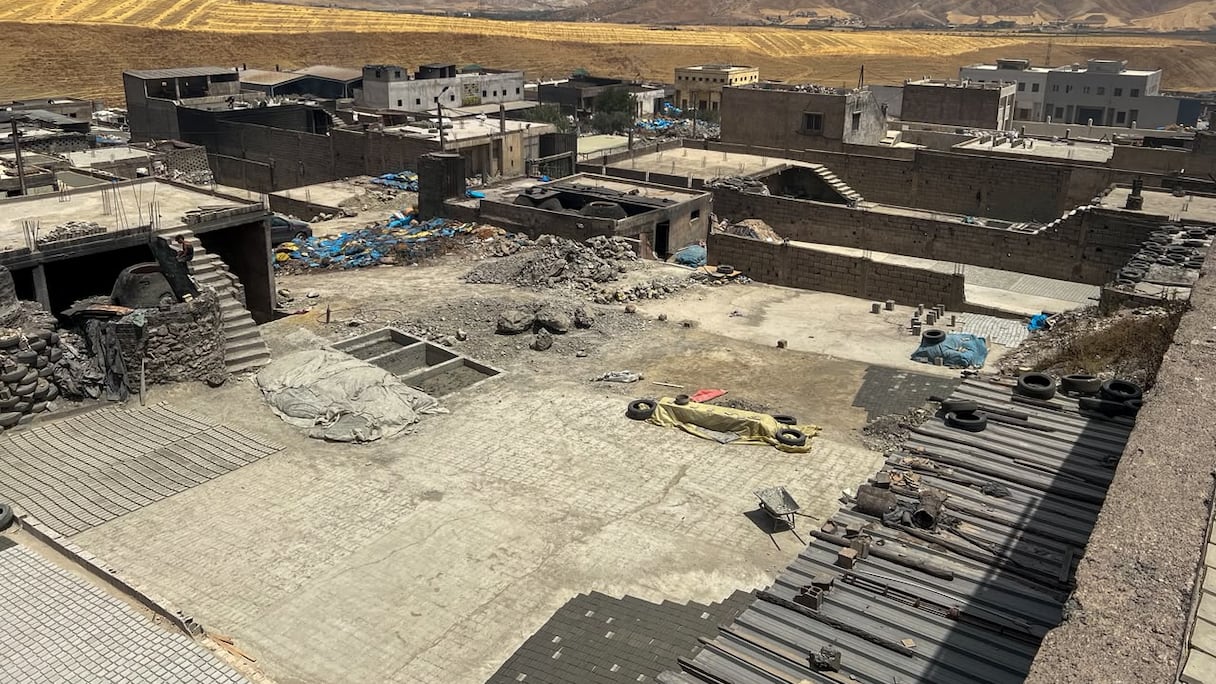
Another major challenge is the shortage of clay, the essential raw material used to produce zellige. The shortage is weakening traditional workshops, slowing production, and putting thousands of jobs at risk. Professionals are calling on the authorities to speed up the process of granting licenses for the exploitation of new clay quarries in the Benjellik region to ensure the continuity of the industry.
Hissouf said Fassi zellige is more than a handicraft product. It is a fundamental part of Morocco’s identity and a cultural heritage recognized internationally.
“Protecting zellige means preserving a part of ourselves,” he said, calling for a collective effort to safeguard this heritage in the face of current changes.
