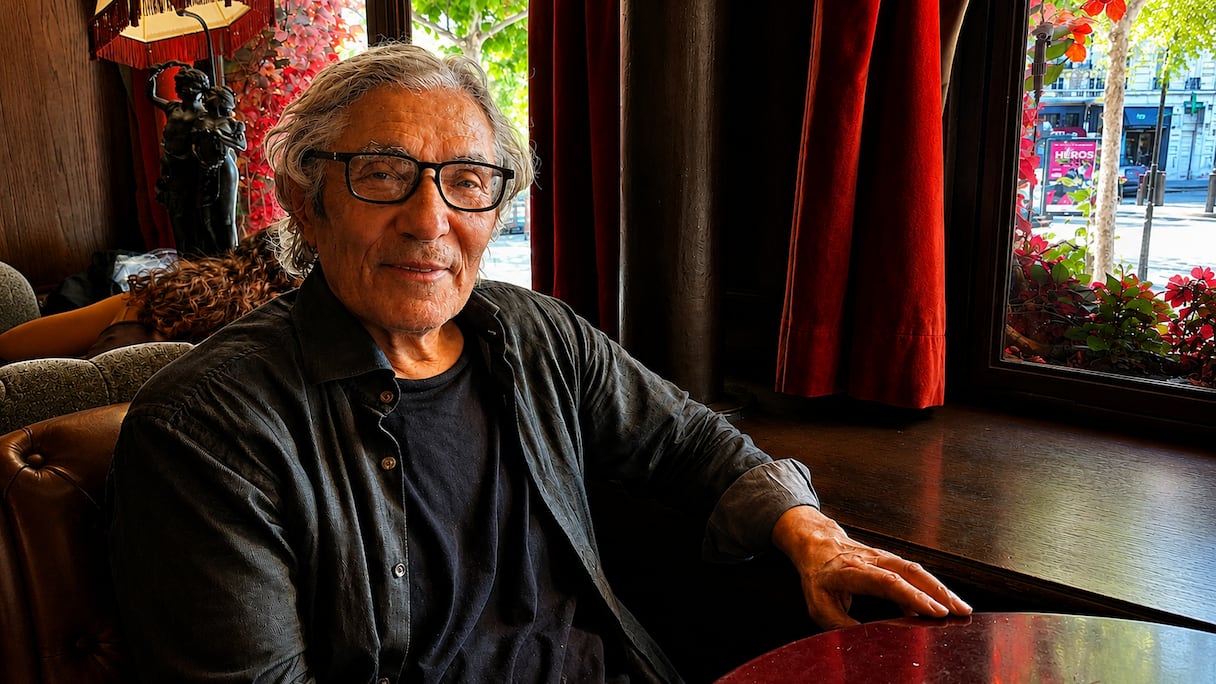
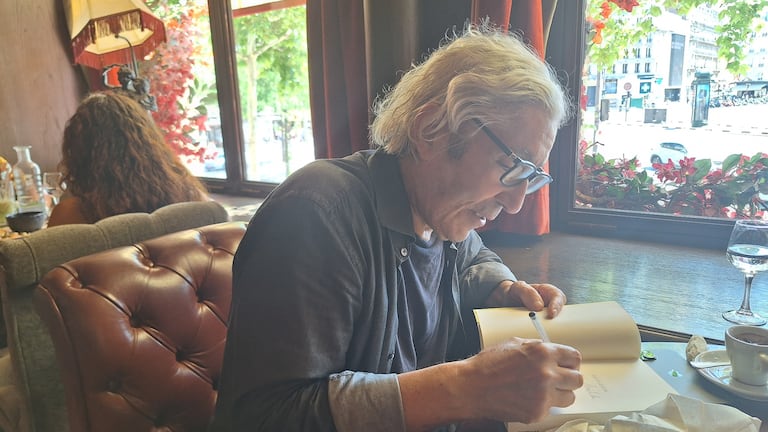
Boualem Sansal arranged to meet me on Saturday, July 11, at a restaurant in Paris’s Montparnasse district for a wide-ranging conversation. Remarkably generous with his time, he also revealed the man behind the public figure: charming and warm, gentle in manner, quick-witted, full of life and often very funny.
His ordeals have neither broken him nor deprived him of the freedom of expression that runs through all his work. Boualem Sansal remains standing, strong and dignified.
In this exclusive interview — the first he has ever granted to a Moroccan media outlet — Sansal speaks without restraint. He looks back on his clashes with the Algerian authorities, his detention and the narratives constructed around him. He describes prison, freedom regained and the outlines of a new life in France, without bitterness and without surrendering his humor.
For the first time, he also opens the chapter of his Moroccan connections, discussing his family roots, his memories of Taza, his view of the Kingdom and his desire to return. It is a way of renewing a conversation that political tensions have never entirely severed.
He also speaks about his election to the Académie française, his path as a writer and La Légende, his latest book, a story of truth, resistance and reconstruction that has ranked among France’s three bestselling books since its publication in June.
His is a free, serious and clear-eyed voice, often laced with irony, belonging to a man hardened by adversity who insists above all on his right to remain fully and uncompromisingly a writer.
Le360: Your latest account, La Légende, became a bestseller less than two months after its publication by Grasset. Why did you choose that title? Does it refer to the story fabricated by the authorities, the media narrative surrounding your detention or the public figure you became against your will?
All three at once. A legend is not simply a story people tell. It is a story that eventually replaces reality. The Algerian authorities turned me into a traitor to the nation, pro-French, pro-Moroccan and pro-Israeli. The media added dark colors and foul odors. My fellow inmates at Koléa prison created another legend around me. To them, I was this heroic, mad or naïve man who denounced dictatorship while continuing to live in Algeria and publicly stating his political views.
Yet amid all those narratives there was still a man—an elderly, sick and exhausted writer, convicted and gradually disappearing behind the many characters others had created for him. In writing La Légende, I wanted to recover that man as he faced his fate, to rediscover myself as I believe I truly am. Not to justify myself, but to restore the facts in their truth and reality.
It may be naïve and pretentious, but I believe a writer represents something in society. He is a kind of witness. He has a duty to speak clearly, to denounce, to name things, never to allow himself to be intimidated or manipulated and to fear nothing, neither threats nor controversy.
Today, everything is controversial, even silence. Everything is a threat. Tahar Djaout, another immense legend, once said, “If you speak, you die. If you remain silent, you die. So speak and die!” That is my philosophy.
When I criticize the Algerian regime, it is not merely out of resentment for what it did to me. It is because I believe it is fundamentally malevolent and dangerous to everyone — to Algeria and Algerians, to Morocco, Tunisia, Libya, Mali and France, not to mention those poor Sahrawis whom it has trapped in its outdated nationalist grandstanding and treats like ignorant minors and colonial subjects.
La Légende, both as a title and as a narrative, was born of that imperative: to prevent manufactured stories from ultimately erasing lived truth. Have I dispelled the misunderstandings? I do not know, and in the end that was not my objective. A writer’s duty is not to be believed. It is to say what he believes. The rest belongs to time.
Which part of that story do you believe was most distorted, appropriated or oversimplified?
My own person, quite simply. And this did not begin today. Ever since my first novel, Le Serment des barbares, was published in 1999, I have become the symbol of something that everyone wanted to claim for themselves. The Algerian regime needed a traitor. Some needed a victim. Others needed a naïve man, a Don Quixote. Others still portrayed me as a provocateur in the pay of the Jews, France, the pieds-noirs or Morocco. And then there were those who saw me as an heir to Camus, Solzhenitsyn, Voltaire or even Rabelais. Everyone wrote their own novel using my name for the main character.
The reality is both simpler and more complex. I am a writer who has always spoken freely and who tries to document what he says. My convictions were not born in prison. They led me there. If I denounce the Algerian regime, Islamism or the retreat of democracies, it is not because I went to prison. It is precisely because I had been denouncing them for years that I ended up there, demonized by some and turned into a hero by others.
I am not asking anyone to agree with me. I am simply asking people to read me before judging me and to debate my ideas rather than the legends built around my person.
How did you approach writing about your time in prison? Were you aiming for almost documentary precision, accepting the gaps in memory, or allowing literature to reconstruct what the experience had shattered?
Prison is a place where time stops flowing. One day becomes indistinguishable from the next. Your bearings disappear, your memory grows uncertain. You find yourself searching for words just as much as for memories.
Boualem Sansal quickly vanished from my own consciousness. I was simply one prisoner among six thousand others. I was No. 46,611 — my prison registration number. I was housed in Cell 18B, in the high-security wing reserved mainly for Islamists.
To the guards and the judges, however, I was not just another inmate. I was the president’s hostage. They did not always know how to deal with me.
I never set out to reconstruct every detail the way a court clerk or a historian might. I imposed one rule on myself: never to write anything I knew to be false or uncertain. That was not always easy. I had lost all sense of time and sometimes struggled to place events in their proper order.
Literature is not there to embellish facts or to correct them. It exists to restore their human truth.
La Légende stays as close to reality as possible, not because it claims to tell everything, but because it refuses to betray what was lived. Memory may hesitate and, at times, even fail. Conscience, however, must never lie. This was my story, my identity. I wanted them to remain true so that I would not lose myself in the unspeakable.
What did you choose not to tell in this book? Were those silences driven by discretion, by a desire to protect your loved ones, by political caution, or by the simple impossibility of putting certain experiences into words?
I left many things out. Not because I feared the authorities, nor to protect myself, but because a memoir of testimony and introspection is not an investigative case file. A writer does not tell everything. He chooses what best illuminates the truth he is trying to uncover. My aim was to show how the Algerian dictatorship functions from within—its courts, its prisons, its official rhetoric, its wooden language, that vast ideological prison where words themselves are used to lock people away.
I also wanted to protect certain individuals. Prison never strikes just one person. It reaches family members, friends and those who helped you, sometimes at great risk to their own safety. They never chose to become part of that story.
My wife did not want me to write about her in the book. Out of shyness, and out of modesty as well. Yet she occupied most of my thoughts throughout my imprisonment. In the end, she agreed to let me recount a few episodes from the ordeal we endured together.
There are also experiences that resist words. Not because they are impossible to describe, but because telling them too soon would diminish them. Perhaps they will return one day in another form, in a novel or a different kind of narrative. Every book has its own necessity. La Légende has found its own.
In truth, everything was difficult. I found my release extremely hard to live with because it came through a presidential pardon granted by President Tebboune. What I wanted was to return to Algeria and receive a genuine trial. I came under considerable pressure not to pursue that course. I was told I had to take account of the diplomatic and geopolitical realities of the moment. Being forced to remain silent and accept my fate left me in a state of profound intellectual confusion.
I nevertheless announced publicly that I intended to file a complaint against Mr. Tebboune, who had taken me hostage in violation of the law. My French lawyer, François Zimeray, was never even granted the visa that would have allowed him to visit me and represent my defense.
The ordeal became even more complicated when I parted ways with Gallimard. It happened at precisely the moment when I needed to tell the whole story in order to rebuild myself through the truth. Instead, everything around me seemed to encourage silence, to accept the prevailing orthodoxy, to enter into the lie. The message was simple: “You’re free now. Be grateful. Keep quiet.”
Did your imprisonment change your writing itself—your sentences, your irony, your humor, your anger or your faith in the power of words?
Yes, undoubtedly. Prison strips you of many things, beginning with your illusions. It teaches you the value of silence, of waiting and of using words sparingly. When every word you utter can be used against you, you learn to keep only what is essential.
I don’t believe I lost my sense of humor, my good spirits or even a certain naïveté that often helped me endure. You look at horror the way you look at the sun: every so often you have to close your eyes so you don’t go blind.
What has changed is that I feel the weight of words more acutely. I understand better than ever that words can save a person, but they can also condemn one when they are twisted or instrumentalized.
This experience has not weakened my faith in literature. It has made it more demanding. Today I write with fewer illusions, but with a deeper conviction that, in the face of fear and falsehood, the right words remain one of the last forms of freedom.
How would you describe your personal, intellectual, emotional and literary ties to Morocco?
Morocco has never been a foreign country to me. I do not hold Moroccan nationality, but I have always felt deeply Moroccan. Whatever touches Morocco touches me as well.
I am convinced that, were it not for the military dictatorship and its bleak political climate, Algeria would be a wonderful country. With an Algerian way of life to rival the Moroccan way of life admired around the world, it could emerge from its isolation and attract tens of millions of tourists. It could free itself from the curse of oil and from the rule of incompetence, incivility, wastefulness and oligarchs.
I hope the day will come when relations between our peoples are finally liberated from ideology, power struggles and cultivated hatred. Writers have a role to play in that process: exposing the military dictatorship in Algeria and defusing the time bombs it has planted. Those bombs have already caused far too much damage.
Much has been said—often contradictorily—about your family ties to Morocco. What is the truth? Do you have Moroccan ancestry?
Yes. I have family roots in Morocco through my mother’s side. My great-grandfather was Moroccan. He came to Algeria with his family at the end of the 19th century or the beginning of the 20th. He was from the Rif, from Taza. I remember going there once or twice during school holidays in the 1950s.
I find it revealing that this question keeps resurfacing. When people run out of arguments against a writer’s ideas, they often try to delegitimize him by questioning his origins, his family or his identity. It is a very old method.
Because I have a Moroccan great-grandfather, the Algerian authorities decreed that I was a Moroccan enemy. François Asselineau, leader of the UPR, who may well be Algerian—or an agent of Algiers—declared in one of his learned lectures that my father was Moroccan and my mother Jewish, saying it all in a tone that revealed more than enough about his intentions. Before long, someone will probably discover that I have a cousin on Mars and accuse me of colluding with artificial intelligence from another planet.
The truth, however, is very simple. I was born in Algeria. I grew up there, married there, worked there, wrote most of my books there and experienced prison, expulsion and public disgrace there. I am also a French citizen, though I have taken more than my share of blows from a certain segment of the French left, which has tried to saddle me with all manner of shameful associations because of friendships I have maintained for many years.
Would you like to visit Morocco if the opportunity arose? What meaning would you want such a trip to carry?
Morocco is a country with which I have maintained a constant dialogue. I hosted a regular program on Médi1 radio for five consecutive years in the 2000s.
If I return in the near future, it will be both a literary gesture and a political one—in the noblest sense of the word. A political gesture to tell Moroccans that free Algerians aspire to peace with Morocco and wholly reject the reckless policies pursued by the Algerian authorities in the region. It will also be a literary gesture toward Moroccan readers and writers, whom I very much look forward to seeing again.
I deeply believe that writers have a particular responsibility in all this. States may quarrel, but peoples need to keep talking to one another. Literature is one of the few places where that conversation can still take place. That is the spirit in which I would like to come to Morocco.
I’m waiting for Le360 to invite me... I’d come with great pleasure. (Laughs.)
What does your everyday life in France look like now?
It is looking more and more like the life of a writer, which is an extraordinary privilege.
I write, I read, I work and I meet readers, friends and publishers. Little by little, I am recovering the rhythm that Mr. Tebboune’s prison abruptly interrupted.
But I am no longer quite the same man. Imprisonment leaves visible and invisible scars. You rediscover simple things—walking, opening a door, deciding how to spend your day—with a new intensity. You come to understand the value of what you once assumed would always be yours.
Today I lead a simple, studious life. I have several books underway, many ideas I still want to explore and the feeling that time is more precious to me than ever before. At my age, every day is a gift. I try not to waste too many of them on sterile controversies.
I am also discovering that it is far easier to become French by decree than it is to live as a French citizen in everyday life, which requires navigating countless administrative procedures that I still have no idea how to tackle.
What have you had to relearn—walking alone, sleeping, working, trusting people or simply being able to decide how to use your own time?
I had to relearn freedom. It is far more difficult than people imagine. Prison strips away your habits, your bearings and your privacy. It leaves you vulnerable. Once you are released, you have to relearn the simplest gestures: closing a door without hearing it lock behind you, walking without an escort, sleeping without waiting to be woken, deciding how your day will unfold. It took me two months just to learn how to use a telephone and a computer again.
But perhaps the hardest thing of all is learning to trust again. Prison teaches you suspicion. Freedom requires you to believe once more—in other people, in the future, in work and in creation.
I was fortunate to be surrounded by my wife, my friends and my publishers. Their loyalty gradually helped me become the man I had been before. Prison deprived me of my freedom, but it never took away my desire to live, to write or to believe in humanity.
Has France now become your homeland, a place of exile or simply the country from which you can continue to write? Has this new reality changed the way you speak to Algerians?
France is my country now—my only country. I am in the process of being stripped of my Algerian nationality, and many Algerians have already stripped me of it in their own minds. Apart from Kamel Daoud and Kamel Bencheikh, not a single Algerian writer stood by me during my imprisonment.
But you cannot exile yourself from your memories, your inner language or your history. Algeria remains at the heart of my work because it remains at the heart of my life. I continue to speak to Algerians as I always have—with affection, with honesty and with the hope that one day our country will find its way back to freedom.
At the end of the day, my position has not changed. I do not write against a people, nor do I write for a government. I write in defense of a certain idea of freedom, truth and human dignity. That kind of fidelity knows no borders.
For many years your work has alternated between novels and essays. What does writing more directly in the first person change in your fight against the distortion of reality, arbitrariness and fear?
Using “I” grants me no special privilege. On the contrary, it imposes an even greater discipline.
When I write a novel, my characters carry part of my truth. When I write “I,” I no longer have that refuge, no longer have that screen between myself and the reader. I am directly accountable for every word.
In truth, I have been pursuing the same struggle ever since my first book: resisting the lies and slogans that disfigure reality, deceive people and distort history. The novel allows me to explore the human condition through imagination; the essay through carefully documented reasoning, and memoir through lived experience. They are simply three different paths leading toward the same imperative.
I do not believe literature exists to reassure. Quite the opposite. It exists to unsettle certainties and dismantle accepted narratives so that, ultimately, we may see more clearly.
When fear takes hold, silences society and organizes its regression, the writer’s first responsibility is to continue calling things by their proper names. That may be the simplest form of freedom, but it is also the hardest.
In 2084: The End of the World (winner of the Académie française’s Grand Prix du Roman in 2015) and Vivre (2025), you imagined societies dominated by fear, control and collapse. Did prison confirm your instincts as a novelist, or did it reveal that authoritarian reality functions differently from dystopian fiction?
Both. Prison confirmed some of my intuitions, which were already rooted in reality. But above all, it taught me that reality is less spectacular—and far more terrifying—than fiction.
In a novel, totalitarianism possesses an internal coherence, a logic of its own. In real life, it advances through improvisation, contradictions, petty acts of cowardice, suffocating bureaucratic routines and mechanical obedience.
You become a robot among other rusting robots in a bankrupt factory. A robot is aware of nothing. It obeys mediocre software—hardly sophisticated at all—in a world where everything is in short supply.
In prison, I did not encounter monsters. I encountered a system that turns ordinary men into cogs in a machine whose workings no one seems to understand anymore.
That is what struck me most: living in an unreal world governed by a Rulebook whose purpose no one can explain.
Ultimately, the system runs on ignorance.
I came away from that ordeal with an even stronger conviction: dictatorships survive not only through the fear they inspire, but also through the lies they impose and the compromises they extract. Shame disappears, moral boundaries dissolve and basic civility withers away. Little by little, society slides toward dehumanization.
The first act of freedom, therefore, is to keep questioning reality and to call it by its true name. When Ubu is naked, you must say he is naked—nothing else.
In Rue Darwin (2011), you wove together personal memory, family secrets and Algerian history. What changes when the story is no longer about childhood, but about a political ordeal that is still painfully fresh?
In Rue Darwin, I was looking back at a distant past. Time had done its work. The wounds were still there, but they had found their place within a broader story—that of a family, a society and a country.
La Légende is the exact opposite. The events are recent, the emotions remain raw and the consequences are still unfolding. You do not write in the same way about a childhood that has entered the realm of collective memory and about a prison whose heavy metal doors you can still hear slamming shut.
But ultimately, the question remains the same: how do you stay true to the human truth without giving in either to resentment or to oblivion?
It is that fidelity that connects all my books, whatever their subject or form. Time may transform memories, but it must never transform the truth.
Your election to the Académie française places you at the heart of an institution devoted to the French language. What does the French language represent to you—first as a writer, and then as a citizen of the world?
I do not merely inhabit a country; I inhabit a language.
French has always been the home in which I write, think and converse, both with the living and with the great writers who came before me. It is not a foreign language to me. It is my language as a writer.
I love French because of its extraordinary precision, but also because it carries a long tradition of freedom, doubt, reason and universalism. It allows us not only to name the world with rigor, but also to question it.
Being elected to the Académie française is an immense honor. I do not see it as the culmination of a journey, but as a responsibility. A language belongs to no one. It belongs to those who keep it alive. To write in French, wherever one is born, is to take part in an intellectual adventure that transcends borders and identities.
Do you see your election as symbolic reparation, literary recognition or the risk of institutionalizing the dissident writer?
I see it as none of those things.
It is not reparation. An election does not erase hardship or injustice. Nor is it a crowning achievement. A writer never reaches the end of the road. And it is certainly not institutionalization. An academy is not meant to tame writers.
Having come to know its members, I find it difficult to imagine anyone forcing them into such a role—or, even more so, them accepting such an absurdity. Defending a language is the work of free men and women, even rebellious ones.
Above all, I see it as a tremendous honor and an immense responsibility. The Académie française does not elect opinions. It elects a body of work and a demanding relationship with language.
As for the writer that I am, he will remain what he has always been: free.
Freedom does not depend on the chair you occupy. It depends on the fidelity you maintain to your own conscience. If one day I were forced to choose between an armchair at the Academy and that freedom, I would not hesitate for a single second.
Since your release, different political, media and intellectual camps have tried to claim you for their own narratives. What would you say to them?
They are wasting their time.
I have never written for a political party, a government or an ideology. For forty years, I have written according to my conscience. That has earned me attacks in Algeria and, at times, in France as well. The struggle has never discouraged me.
I understand why everyone wants to appropriate a story that suits their own agenda. It is a very contemporary reflex. People prefer symbols to human beings, labels to works, and ready-made narratives to the complexity of reality.
But a writer is not a flag to be planted on political territory.
I do not ask anyone to agree with me. I ask only that people read me before judging me, and debate my ideas instead of confining me to a category before they have even listened.
A writer’s freedom begins with refusing to belong to anyone.
What would you most like to preserve from your “legend”—your body of work, an idea, a single sentence or simply the right to be, once again, a writer whom no one can appropriate?
I have no wish to preserve a legend. Legends belong to other people. As for a writer’s work, once it is published, it belongs to its readers.
If there is one thing I would preserve, it is the freedom of the writer: the freedom to write without obeying a government, a political party, a passing trend or anyone’s expectations. The freedom to change, to doubt, even to be wrong at times, while remaining faithful to one’s conscience.
I am deeply grateful to everyone who stood by me during this ordeal.
But I would not want the man who was arrested, imprisoned and then released to eclipse the writer.
Prison is one chapter of my life. It must not become my entire identity.
My greatest wish is very simple: to go on writing.
If, in a few years’ time, people speak more about my books than about my imprisonment, then I will know I have recovered my true freedom.
