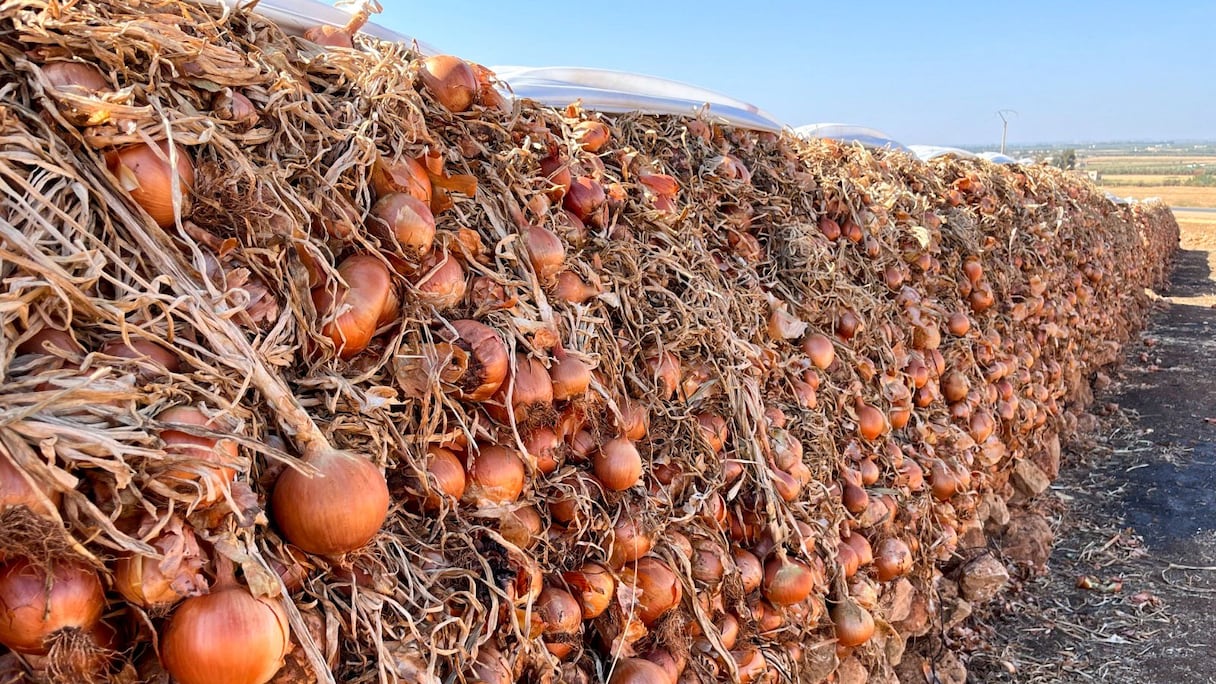
In El Hajeb, one of Morocco’s main onion-producing areas, storage of the new harvest began in early October. This stage is just as important as harvesting itself, as it determines the quality of the crop and how well it can be marketed throughout the year. Some of the surplus is also shipped to African and European markets.
In Bouderbala, a rural locality in El Hajeb province, Le360 observed a clear decline in the use of traditional storage warehouses, locally known as “grayer” or “chichouarat.” Refrigerated storage units are gradually replacing them, attracting an increasing number of farmers. Traditional methods, which leave onions exposed to weather conditions and humidity, have shown their limits, with significant losses in stored quantities.
Younes Souini, a farmer in the area, said demand for cold-storage facilities has risen sharply this year, making it difficult for some growers to secure space. He added that this season’s harvest is of better quality than last year’s crop, when onion quality declined noticeably.
He also pointed to the impact of weather conditions and rainfall during the rainy season on production. Water shortages remain a problem for some farmers, however, who have been unable to meet the irrigation needs of their farms.
According to Souini, onions are currently leaving farms at prices ranging from MAD 3 to MAD 4.70 per kilogram. As for storage methods, he estimates that around 80% of farmers in the area have switched to refrigerated facilities, while the remaining 20% continue to rely on traditional methods. Cold storage protects the crop from temperature fluctuations, wind and excessive cold. It also reduces the risk of spoilage and sprouting, allowing onions to retain their quality for longer.
Read also : Olive oil harvest in Moulay Yacoub expected to bring prices below MAD 30 per liter
Mohamed Ahrimech, an agricultural investor in the region, told Le360 that Bouderbala plays a leading role in Morocco’s national onion production. Harvesting usually takes place in late July and throughout August. The onions are then collected, dried and arranged in mats before storage begins in September.
He described how storage practices have changed in recent years. Farmers once relied mainly on “grayer” or “chichouarat,” traditional warehouses built with stone and straw and covered with insulating materials. Refrigerated units have gradually gained ground because they allow farmers to control storage conditions using equipment that removes moisture and preserves onion quality until the product reaches consumers.
Higher costs to reduce losses
The shift is primarily driven by the need to limit the losses associated with traditional storage methods, Ahrimech explained. Storage costs around MAD 1.70 per kilogram in refrigerated facilities, compared with approximately MAD 0.50 in traditional warehouses. However, the latter can lead to the loss of around two-thirds of the harvest, according to his estimate. Farmers therefore prefer to pay more to preserve a larger share of their crop.
As for prices, Ahrimech said onions initially fetched high prices before stabilizing. They are now selling at farm gates and in production centers for between MAD 3.50 and MAD 4.50 per kilogram. Farmers in Bouderbala are continuing to overhaul their storage practices in search of a balance between product quality, lower losses and production costs.
