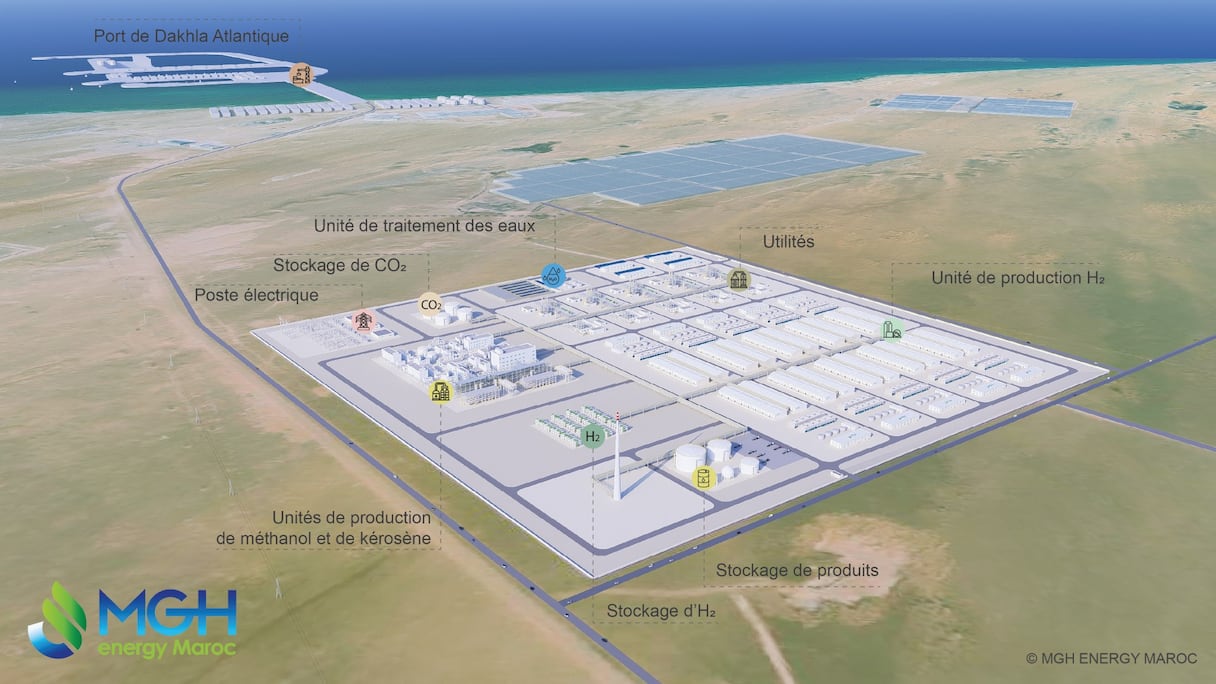
French company MGH Energy has reached a new milestone in its synthetic fuels business after the European Commission selected its industrial project in Laudun-l’Ardoise, southern France, for support under the Innovation Fund. The development also carries implications for the group’s plans in Morocco, where it is developing the Janassim project in the Dakhla-Oued Ed-Dahab region.
Janassim, developed by MGH Energy Maroc in partnership with Moroccan company HOLSATEK, the parent company of the PETROM brand, represents a planned investment of nearly €4.5 billion, equivalent to around MAD 50 billion.
The facility is designed to produce around 300,000 metric tons of synthetic fuels annually, mainly e-methanol and e-kerosene, for use in air and maritime transport.
The project is expected to rely on 2.2 gigawatts of renewable energy capacity, combining wind and solar power. Its planned industrial infrastructure will also include seawater desalination, green hydrogen production through electrolysis and fuel synthesis.
According to MGH Energy, Janassim could create more than 2,500 direct jobs during construction and around 600 permanent positions once operational. The company also estimates that replacing fossil fuels with the synthetic fuels produced at the facility could prevent 724,000 metric tons of CO₂ emissions annually.
Read also : Morocco’s 2027 budget: Dam, desalination and irrigation projects, region by region
The French project selected by the European Commission, located in Laudun-l’Ardoise, involves an estimated investment of €1.1 billion. It is designed to produce 70,000 metric tons of e-kerosene and 40,000 metric tons of e-methanol per year, with operations expected to begin around 2031.
Its selection under the Innovation Fund’s “Large-Scale Projects” category makes it eligible for European financial support, although no potential funding amount has been announced.
MGH Energy plans to draw on the engineering work, industrial and financial structuring, and partnerships developed around its French project to advance Janassim. Both facilities rely on similar processes to produce synthetic fuels using hydrogen and CO₂.
The company sees the experience gained in France as a way to support the development of its Moroccan project, particularly in engineering and industrial organization.
