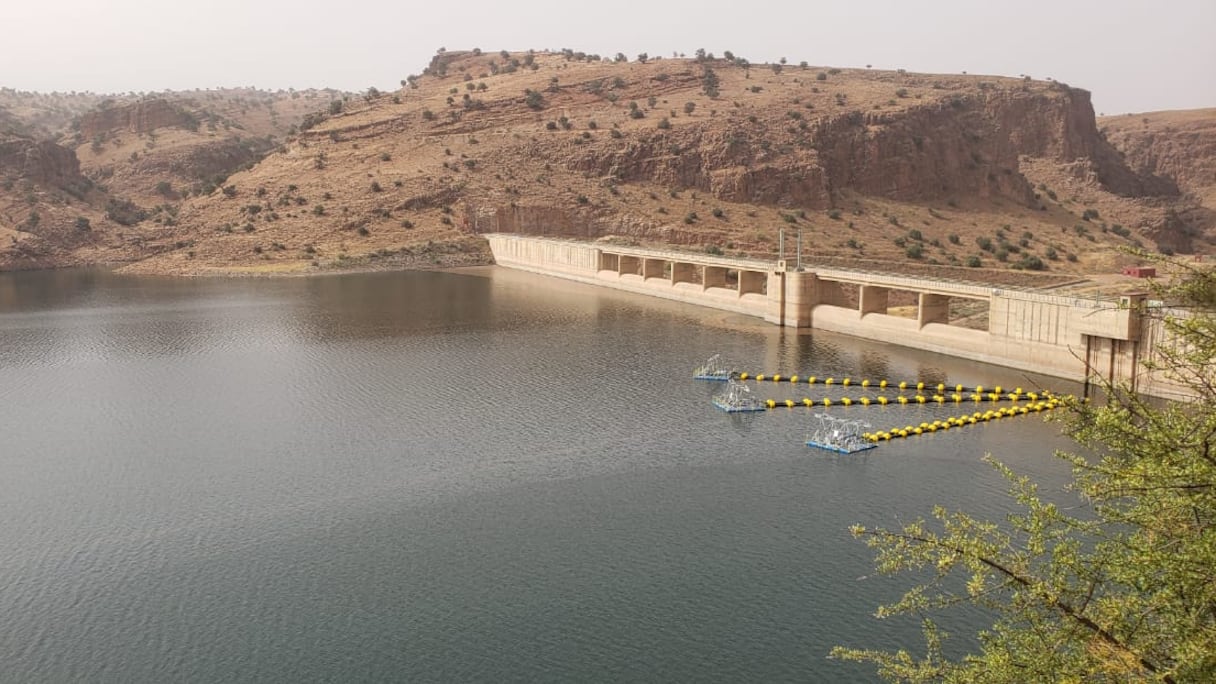
Following the latest rainfall, Morocco’s dams added 65.52 million cubic meters of water between November 11 and 13. Total reserves rose from 11,204.77 million to 11,270.29 million cubic meters over the period.
The national filling rate also edged up, from 65.80% to 66.19%. Dams gained 33.62 million cubic meters on November 12, followed by a further 31.90 million on November 13.
Of the country’s 69 dams, 38 recorded an increase in stored water, 17 saw their reserves decline and 14 remained unchanged. The dams that gained water added a combined 82 million cubic meters, while those recording losses shed 16.55 million.
Read also : Morocco’s dams hold 11.2 billion cubic meters, more than double last year’s reserves
Aoulouz, Moulay Abdallah and Ahmed El Hansali record biggest gains
Aoulouz Dam, in the Souss-Massa basin, recorded the largest increase. Its stored volume rose from 57.95 million to 71.27 million cubic meters, a gain of 13.32 million. Its filling rate climbed from 65.13% to 80.11%.
Moulay Abdallah Dam, also in the Souss-Massa basin, added 12.24 million cubic meters, bringing its filling rate to 96.40%, up from 81.47% two days earlier.
Ahmed El Hansali Dam, in the Oum Er-Rbia basin, gained 11.05 million cubic meters and reached a filling rate of 81.05%. Youssef Ben Tachfine added 8.07 million cubic meters, bringing its rate to 49.24%, while Abdelmoumen gained 6.57 million and reached 35.94%. Four of the five largest increases were therefore recorded in the Souss-Massa basin.
El Kansera Dam, in the Sebou basin, gained 4.12 million cubic meters, reaching 88.31% of capacity. In the Tensift basin, Lalla Takerkoust added 3.42 million cubic meters, with its filling rate rising from 58.70% to 65.48%. Moulay Abderrahmane gained 3.12 million and reached 84.12%.
Al Massira added 3.05 million cubic meters, bringing its filling rate to 41.64%, while Oued El Makhazine gained 2.41 million and reached 65.04%. Aït Messaoud added 2.31 million cubic meters, with its rate rising from 35.98% to 62.33%.
Six basins record gains, three see reserves decline
At the basin level, Souss-Massa gained 42.36 million cubic meters, accounting for nearly two-thirds of the national increase. Its filling rate rose by 5.86 percentage points, from 47.13% to 52.99%.
The Oum Er-Rbia basin added 17.53 million cubic meters, bringing its filling rate to 59.39%.
Tensift gained 6.14 million cubic meters, with its rate rising from 76.56% to 79.59%. Loukkos added 3.43 million and reached 72.19%, while Draa-Oued Noun gained 2.01 million, reaching 39.38%. Guir-Ziz-Ghéris added 1.27 million cubic meters and reached 59.63%.
Read also : Sebou basin: 12 dams on radar for floating solar panels
Three basins recorded declines. Bouregreg lost 4.82 million cubic meters, bringing its filling rate to 76.47%. The drop was largely driven by Tiddas Dam, which shed 4.67 million cubic meters and fell to 91.17%.
Moulouya lost 1.37 million cubic meters, with its rate falling to 72.88%, while Sebou declined by 1.04 million and reached 73.81%. Al Wahda, the country’s largest dam, lost another 7.13 million cubic meters, bringing its filling rate down to 75.22%.
Water reserves more than twice their level a year ago
As of November 13, the national dam filling rate stood at 66.19%, compared with 30.79% on the same date in 2025, a difference of more than 35 percentage points.
All basins remain above their levels from a year earlier. Oum Er-Rbia rose from 8.55% in November 2025 to 59.39%, Moulouya from 28.04% to 72.88%, and Souss-Massa from 16.23% to 52.99%.
The smallest differences were recorded in Draa-Oued Noun, where the rate increased from 28.25% to 39.38%, and Guir-Ziz-Ghéris, which rose from 46.48% to 59.63%.
The latest gains extend an upward trend that began earlier in the week. Reserves stood at 11,193.21 million cubic meters on November 9 and 11,200.93 million on November 10. Over the four days to November 13, they increased by 77.08 million cubic meters.
Current reserves are 63.90 million cubic meters above their October 31 level of 11,206.39 million cubic meters, when the national filling rate stood at 65.81%.
October ended with a net gain of 51.26 million cubic meters, after the filling rate stood at 65.51% on October 1. However, current reserves remain 65.32 million cubic meters below the level recorded on October 23, when they reached 11,335.61 million cubic meters, or 66.57% of capacity.
Storm Charles brings up to 110 mm of rain overnight
The latest inflows followed Storm Charles, which swept across Morocco. According to readings from the General Directorate of Meteorology (DGM), the heaviest rainfall between Wednesday, November 11, and 6 a.m. on Thursday, November 12, was recorded in the Souss region.
Imouzzer Ida Outanane recorded 110 mm of rain, followed by Tiqqi with 108 mm and Idmine with 105 mm, all in the Agadir-Ida-Ou-Tanane prefecture.
Read also : Morocco’s 2027 budget: Dam, desalination and irrigation projects, region by region
In Taroudant province, rainfall reached 91 mm in El Guerdane and 77 mm in Eddir. Further north, Taounate province recorded 77 mm in Aïn Aïcha and 68 mm in Taounate. Casablanca received just 7 mm.
Winds reached speeds of 107.4 km/h at Casablanca Airport, 94.5 km/h in Essaouira and 90.7 km/h in Meknes on Wednesday, November 11.
The DGM forecast further scattered rainfall on Friday, November 13, across the Rif, Loukkos and Saïss regions, followed by gradually stabilizing weather conditions from Saturday.
