The Economic and Financial Report puts cumulative national rainfall at 462 mm during the 2025-2026 agricultural season, 50% above the 2015-2020 average of 307.9 mm. The 2024-2025 season recorded just 293 mm, while the three seasons before that ranged between 223 and 271 mm.
Most of the rainfall came in winter. According to the General Directorate of Meteorology, cited in the report on compensation subsidies, national rainfall during the winter of 2025-2026 reached around 136 mm, compared with a normal level of 71 mm. It was the third-wettest winter since 1981, behind those of 2010 and 1996. The document also notes heavy snowfall and a record number of rainy days in several regions. Rainfall was distributed more evenly across time and space than in previous seasons.
A harvest that more than doubled
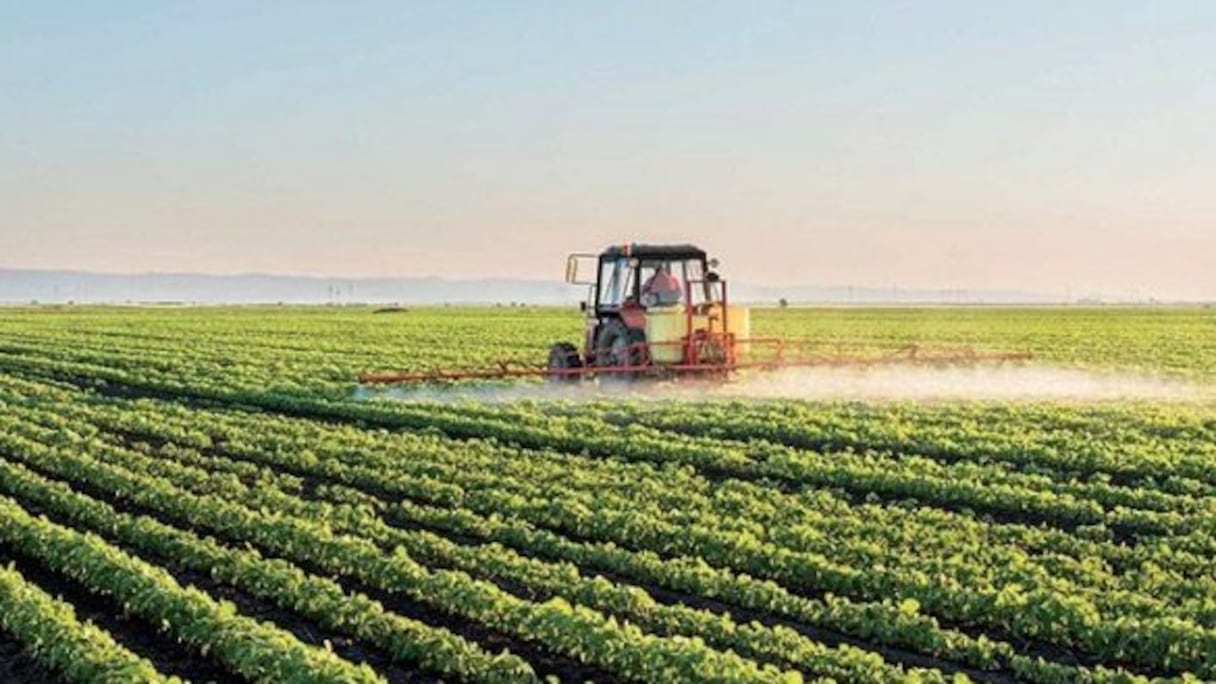
Farmland benefited from the rain. Cereal production for the 2025-2026 season is estimated at around 90 million quintals, including 44 million quintals of soft wheat, 21 million of durum wheat and 25 million of barley. The 2024-2025 season yielded only 43 million quintals, an increase of 109% year on year. Compared with the average of the previous 10 seasons, production rose by 50.6%. Yields increased from 16.4 quintals per hectare in 2024-2025 to 23.1 quintals in 2025-2026.
The harvest also reflects measures taken before sowing for the 2025-2026 season. The Finance Bill’s presentation note cites 1.5 million quintals of certified seeds, 650,000 tonnes of phosphate fertilizers sold at fixed prices and a direct-seeding program covering 400,600 hectares. The government aims to increase the share of domestically produced seeds from 20% to 50% and expand direct seeding to one million hectares.
Read also : Oases: How the Kaddoussa Dam is reviving farming in Boudnib
Other agricultural sectors also recorded gains during the 2025-2026 season. Olive production reached a record two million tonnes, up 111% from the previous season. Citrus production totaled 1.9 million tonnes, an increase of 25%. Date production rose to 160,000 tonnes, up 55% and the highest level ever recorded. Sugar production is expected to reach around 300,000 tonnes in 2026, compared with 280,000 tonnes in 2025 and 191,000 tonnes in 2024, following a 51% decline between 2021 and 2024.
Exports from the agricultural and agri-food sector rose by 8.3% in the first eight months of 2026, following a 4.6% increase over the same period in 2025. Growth has been in double digits every month since June 2026, reaching 25.9% in June, 19.4% in July and 21.1% in August. By the end of August 2026, sales of food industries had increased by 13.6%, while exports of agricultural, forestry and fishing products were up 3.6%.
Rainfall first boosted dam reserves. The overall filling rate stood at around 38% on December 29, 2025, compared with 28.5% a year earlier. The Economic and Financial Report provides a more recent update. On October 12, 2026, national water reserves reached 11.1 billion cubic meters, up 108% from October 12, 2025. The filling rate climbed to 65.7%, compared with 32.1% on the same date in 2025.
Read also : Desalination plants, dams and water transfers: What Morocco’s new govt program proposes
Pastures have also recovered. The report on compensation subsidies links this improvement to a drop in barley imports, which fell from 9.2 million quintals in the 2024-2025 season to 5.51 million in 2025-2026, a decrease of 40%. It also points to the end of programs linked to drought and livestock rebuilding. The latter program mobilized around 12 billion dirhams during 2025-2026 to support more than one million livestock farmers.
Cereal imports, however, did not decline. They reached around 105.7 million quintals during the 2025-2026 season, compared with 99 million in 2024-2025, an increase of 7%. Soft wheat remained the largest import category, at 51 million quintals, accounting for around 48% of the total, followed by corn at 36.7 million quintals.
An impact on economic growth
The Economic and Financial Report attributes a large share of economic growth to the rainfall. Agricultural value added increased by 8.2% in 2025. In 2026, it grew by 18.4% in the first quarter and 21.2% in the second quarter, compared with 8.3% in the second quarter of 2025. This brought average growth to 19.8% in the first half of 2026. For the full year, agricultural value added is expected to surge by 18%, lifting GDP growth to 4.7%, following 4.9% in 2025.
A reversal is forecast for 2027. With the harvest projected to fall to 70 million quintals under the scenario adopted, agricultural value added would grow by just 0.5% in 2027. Economic growth would then slow to 3.7%. The government is counting on non-agricultural activities, expected to grow by around 4%, to offset the decline.
Rainfall has also slowed some construction projects. Cement sales fell by 10.9% in the first quarter of 2026, partly due to the exceptional weather conditions in January and February. Sales subsequently recovered, posting a 1.2% increase by the end of September 2026.
The cost of flooding
The heavy rainfall has also come at a cost. Flooding affected northern and western Morocco during the winter of 2025-2026. Measures taken on royal instructions were among the reasons behind the decree of May 20, 2026, authorizing an additional 20 billion dirhams in spending. Of this amount, 2 billion dirhams cover flood-related expenses, 8 billion go to the compensation fund and 4 billion are allocated to strengthening the capital of state-owned companies.
The Treasury’s Special Fund for Natural Disasters transferred 500 million dirhams to the general budget to finance assistance for people affected by flooding in the north and west. The report on special accounts states that the fund financed 340 flood-prevention projects costing a total of 4.70 billion dirhams, of which 1.61 billion was covered by the fund. It also lists 192 applications submitted for 2026 that are still under review.
Read also : Sakia El Hamra Dam reconstruction reaches 99% completion
Roads have also been damaged. The road network preservation program provides for around 500 million dirhams in 2027. It covers repairs to damage caused by flooding between 2024 and 2026, as well as road rehabilitation in areas affected by the 2023 Al Haouz earthquake. The target is to bring 80% of the road network into good or very good condition by 2030.
To prepare for such events, the state is expanding its monitoring capacity. The national network has eight operational weather radars, with four more expected by the end of 2026, and more than 534 climate monitoring stations. A supercomputer named “Amtar” is expected to improve forecast accuracy. The government also plans to update the national master plan for flood forecasting to incorporate the effects of climate change.
In Casablanca, Mohammedia and Dar Bouazza, for example, a flood-protection program is allocated 461 million dirhams for 2027, according to the report on the regional distribution of investment.
