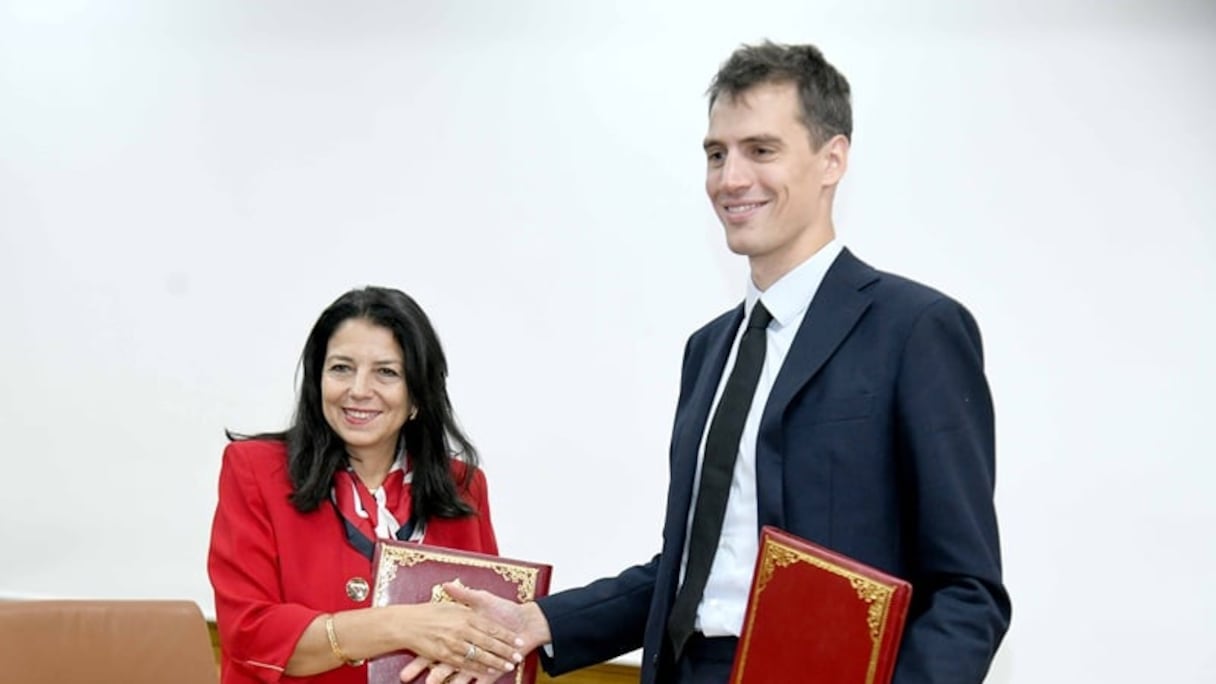
The Ministry of Digital Transition and Administrative Reform and Mistral AI announced Tuesday, September 29, in Rabat the launch of the first open-source technologies developed specifically for Morocco, as part of their strategic partnership.
The project is part of the Morocco Digital 2030 strategy and the “AI Made in Morocco” roadmap, with the aim of developing responsible and inclusive artificial intelligence tools adapted to Morocco’s cultural and linguistic context.
The first phase includes two main technological models. The first is a language identification classifier capable of recognizing and distinguishing several Arabic dialects, with particular accuracy in identifying Darija.
The second, “Voxtral,” is an automatic speech recognition model designed to transcribe everyday Moroccan speech while handling code-switching, or the spontaneous alternation between Darija, French and English.
The tools will soon be available as open-source technologies to Morocco’s wider ecosystem, including public administrations, start-ups, researchers, developers and private companies. Their deployment is expected to support practical applications in public services, education, customer support, media, document digitization, and multilingual data management.
The new tools will also add to a broader portfolio of solutions developed and trained internally by the ministry to support its own artificial intelligence marketplace for public-sector organizations.
“These first deliverables of the multi-year partnership between the MTNRA and Mistral are concrete achievements under our AI Made in Morocco roadmap, which aims to develop useful and sovereign artificial intelligence adapted to Morocco’s realities,” the ministry said in a statement.
“By enabling AI to better understand Darija and, progressively, the national languages, we are strengthening digital inclusion, the quality of public services and Morocco’s ability to control its technological choices,” the statement added.
The announcement marks the beginning of a long-term roadmap, with additional models and use cases currently being developed under the multi-year partnership, including generative artificial intelligence, natural language processing and the modernization of digital public services.
