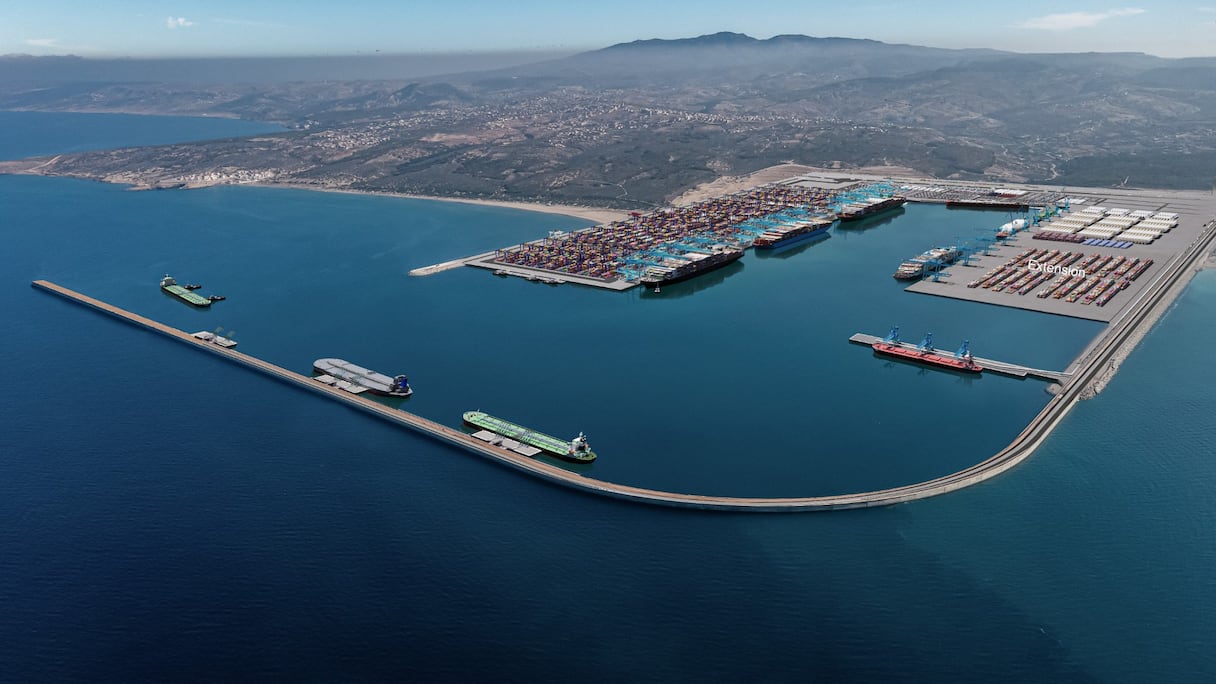
The expansion of Tanger Med, Nador West Med, Dakhla Atlantic Port, electricity interconnections, water infrastructure, and the high-speed rail network has significantly strengthened Morocco’s logistics and productive capacity. Simultaneously, it has increased the interdependence of the networks that keep the economy running. Disruption affecting energy, digital systems, or water infrastructure can now simultaneously impact several essential services.
Ports, power grids, water infrastructure, high-speed rail, and digital systems are becoming increasingly interconnected. For architect Mohammed Hakim Belkadi, protecting them requires moving beyond the technical robustness of individual facilities to anticipate climate, cyber, and technological risks across entire territories.
“The main source of vulnerability no longer comes from a single infrastructure asset but from the cascading effects between interconnected networks,” he explains.
Read also : Cliff reinforcement project moves ahead on Kenitra-Mehdia road
Ports, railways, pumping systems, telecommunications, and digital platforms are gradually forming a single territorial system whose continuity depends as much on the strength of their connections as on the resilience of the infrastructure itself.
His analysis is based on the Urban Systemic Entanglement Theory (TISU), a conceptual framework that focuses on the relationships between infrastructure, institutions, resources, and territories.
“The challenge is no longer simply to make each infrastructure asset more robust but to ensure the resilience of the entire interconnected territorial system,” he says.
Interconnected infrastructure improves efficiency by facilitating the movement of energy, water, goods, passengers, and information. However, it can also magnify the impact of a local disruption. A power outage, for example, could slow operations at a port terminal, interrupt water pumping systems, disrupt telecommunications, or affect railway services.
“The more interconnected a territory becomes, the more efficient it is, but also the more vulnerable it becomes to systemic disruptions,” Belkadi notes.
Read also : Morocco to build first waste-to-energy plant in Casablanca
In his view, interdependence is neither inherently a strength nor a weakness. Its contribution to resilience depends on backup solutions, redundancy, and the ability of infrastructure to continue operating, even in degraded conditions.
This makes the shift from sector-based management to cross-sector coordination increasingly important. Energy, water, transport, telecommunications, and logistics operators each manage their own control systems. Yet a crisis can spread across institutional and technical boundaries within minutes.
“It is no longer only the infrastructure itself that is vulnerable, but the interactions between infrastructure systems,” Belkadi stresses.
Climate-related risks further reinforce the need for greater coordination. Rising sea levels, prolonged droughts, floods, heatwaves, and strong winds can affect multiple networks during the same event. The response, he argues, cannot be limited to strengthening physical infrastructure. It must also ensure that systems can adapt, redirect flows, and maintain essential services.
From isolated risks to systemic crises
Morocco has significantly upgraded its strategic infrastructure over the past decade, but the changing nature of threats requires a new approach to prevention.
“Morocco is better prepared today than it was a decade ago,” says Belkadi, “but the nature of threats has fundamentally changed. They are now interconnected, simultaneous, and constantly evolving.”
For example, a cyberattack targeting an electricity operator could indirectly disrupt ports, railway networks, desalination plants, and logistics chains. Likewise, a maritime disruption combined with a technological failure or an extreme weather event could produce similar cascading effects. The priority, he says, is to prepare institutions for crises involving multiple overlapping factors rather than isolated scenarios.
“The question is no longer whether Morocco is prepared for today’s risks, but whether it can adapt to risks that evolve faster than the infrastructure itself,” Belkadi states.
Such adaptation requires simulation exercises, faster information sharing, and closer coordination among the state, regional authorities, and both public and private operators.
Read also : Tanger Med welcomes one of world’s largest container ships
Maintenance practices must also evolve. While corrective maintenance responds after equipment fails, predictive maintenance continuously monitors infrastructure to detect early signs of deterioration. Sensors, satellite imagery, weather data, and monitoring systems can help schedule interventions before failures compromise operations.
Turning data into decision-making capacity
Territorial intelligence forms the second pillar of Belkadi’s approach. He argues that the concept extends beyond digitalizing administrative procedures or merely collecting more data. “Territorial intelligence is a territory’s ability to understand, anticipate, and manage the interactions between all the systems that compose it,” he states.
Currently, data is often fragmented across government departments, local authorities, infrastructure operators, and sector-specific platforms. Integrating this information would enable the analysis of connections between energy consumption, water availability, mobility, industrial activity, climate risks, and demographic trends. The value, he argues, lies not in the volume of data collected, but in transforming it into actionable information for decision-makers.
Advanced regionalization, the digital transformation of local authorities, and the use of geospatial data could all facilitate this shift. Regional governance brings decision-making closer to local realities, while satellite imagery, sensors, and mapping technologies enhance territorial monitoring. Their effectiveness, however, hinges on interoperability and institutions’ capacity to exchange reliable information.
Belkadi proposes developing territorial digital twins capable of modeling infrastructure, natural resources, economic flows, and region-specific risks. These digital models would allow decision-makers to test the impact of investments, development projects, or crises across multiple sectors before implementation.
Such an approach would shift planning from periodic assessments to continuous monitoring.
“A territory only becomes truly intelligent when it can anticipate the consequences of its decisions before those consequences occur,” he says.
Artificial intelligence as a tool, not the decision-maker
Artificial intelligence can strengthen this capacity for anticipation by analyzing data from energy networks, transport systems, weather stations, satellites, and logistics flows. It can identify anomalies difficult to detect manually and assess how failures might propagate across interconnected infrastructure.
“Artificial intelligence does not predict crises; it identifies the conditions that make them more likely to occur,” Belkadi explains.
Combined with digital twins, AI can simulate prolonged droughts, power outages, cyberattacks, or disruptions to maritime corridors, then compare different response scenarios.
The expert cautions, however, against viewing these technologies as infallible. Their effectiveness depends on data quality, system compatibility, cybersecurity, and the expertise of the people interpreting the results.
“Artificial intelligence improves the assessment of plausible scenarios and reduces uncertainty, but it does not eliminate it,” he says, emphasizing that final decisions must remain an institutional and political responsibility.
Belkadi also argues that the evaluation methods for major infrastructure projects must evolve. Economic returns, environmental impact, and social benefits alone are no longer sufficient if infrastructure cannot maintain essential services during disruptions.
“High-performing infrastructure is no longer infrastructure that functions perfectly when everything is going well, but infrastructure that continues to create value when the territory is facing disruptions,” he states.
He contends that the cost of resilience should be weighed against the potential losses caused by prolonged disruptions affecting ports, railway lines, power grids, or water infrastructure.
Belkadi ultimately calls for investment decisions to include criteria such as redundancy, service continuity, adaptability, and the ability to limit cascading failures. He also proposes creating a national predictive territorial intelligence system linking observation, modeling, simulation, and decision support.
