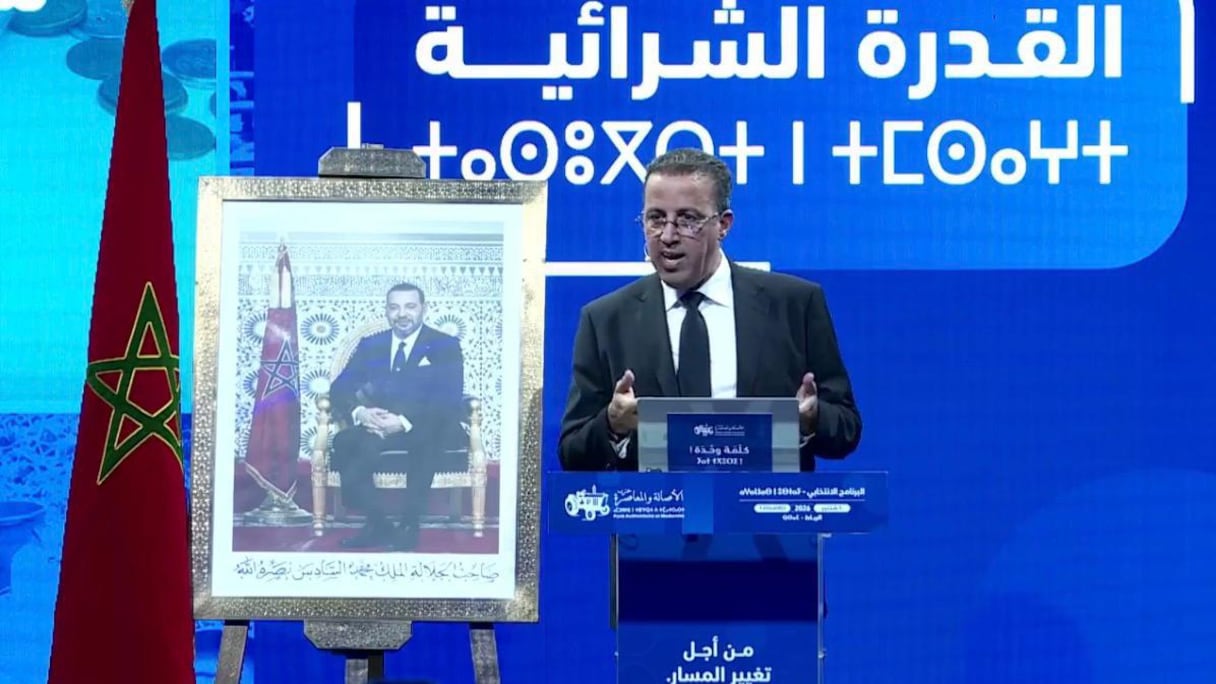
PAM is promising to eliminate income tax on gross monthly salaries below MAD 15,000 and double the minimum direct social aid payment to MAD 1,000 per household as part of its platform for the 2026 legislative elections.
Unveiled in Rabat on Tuesday, the party’s “Purchasing Power Pact” sets out five commitments targeting wages, pensions, electricity bills and food prices.
PAM argues that pressure on household budgets has been aggravated by structural problems in distribution networks, speculation and record agricultural exports at the expense of domestic supply.
The party also pointed to the MAD 1 billion allocated to support meat imports in 2025, arguing that the measure failed to stop prices from rising.
No income tax below MAD 15,000
One of the biggest proposed changes would overhaul the income-tax system, reducing the current six brackets and maximum rate of 37% to three brackets with a top rate of 20%.
Under the PAM proposal, gross monthly salaries below MAD 15,000 — around MAD 12,500 net, according to the party — would be fully exempt from income tax.
Gross salaries between MAD 15,000 and MAD 46,000 would be taxed at 10%, while those above MAD 46,000 would face a 20% rate.
Free electricity bills below MAD 100
PAM is also promising to scrap electricity bills worth less than MAD 100 for low-income households consuming under 100 kWh a month.
The party proposes financing the measure through a 12% solidarity contribution on each additional kilowatt-hour consumed above 200 kWh per month.
It estimates the additional cost for high-consumption households at less than MAD 30 a month on average.
Minimum pension of MAD 3,000
All pensions below MAD 3,000 a month would be raised to that level by the second year of a PAM-led government, under another commitment in the program.
The party also wants widows to receive 100% of their deceased spouse’s pension.
PAM cited figures showing that more than 116,000 public-sector retirees and 134,000 beneficiaries receive payments below the minimum wage, while around 30% of private-sector retirees receive pensions of less than MAD 1,500.
Direct aid doubled to MAD 1,000
The minimum payment under the Direct Social Aid program would gradually rise from MAD 500 to MAD 1,000 per household each month.
Around four million households currently benefit from the program.
PAM also wants to overhaul the Unified Social Registry system used to determine eligibility, replacing statistical scoring with a model based on actual declared income.
Its target is to reduce what it describes as targeting errors from 30% to 5% by 2030 through greater data-sharing between public institutions and updated financial checks.
Food prices: fewer middlemen, tighter export controls
The fifth major component—and the most extensive—targets the prices of staples including tomatoes, potatoes, onions, sardines and red meat.
PAM proposes creating six regional agricultural distribution companies in Souss, Tadla, Gharb, Loukkos, Doukkala-Abda and the Oriental. They would buy directly from farmers and sell to retailers, cutting out intermediaries that the party says account for between 60% and 80% of final prices.
Wholesale markets would be converted into logistics platforms covering vegetables, meat and fish, with cold-storage facilities and digital traceability.
Public cold-storage units would also be built at fishing ports in Larache, Al Hoceima, Safi, Tan-Tan, Laâyoune and Dakhla, allowing fishermen to store their catch rather than sell immediately under price pressure.
Agricultural subsidies for irrigation, machinery and seeds would, meanwhile, be tied to commitments to supply specified quantities to the domestic market.
PAM also proposes making agricultural exports subject to prior authorization, with domestic demand given priority before surpluses are exported.
For red meat, the party wants to continue the MAD 11 billion livestock-rebuilding program covering 2025 and 2026, rehabilitate slaughterhouses and regulate profit margins once herd numbers have recovered.
A specialized mechanism working with the Competition Council would also be created to target what the party describes as parasitic intermediation, with powers to impose sanctions and publish decisions against offenders.
