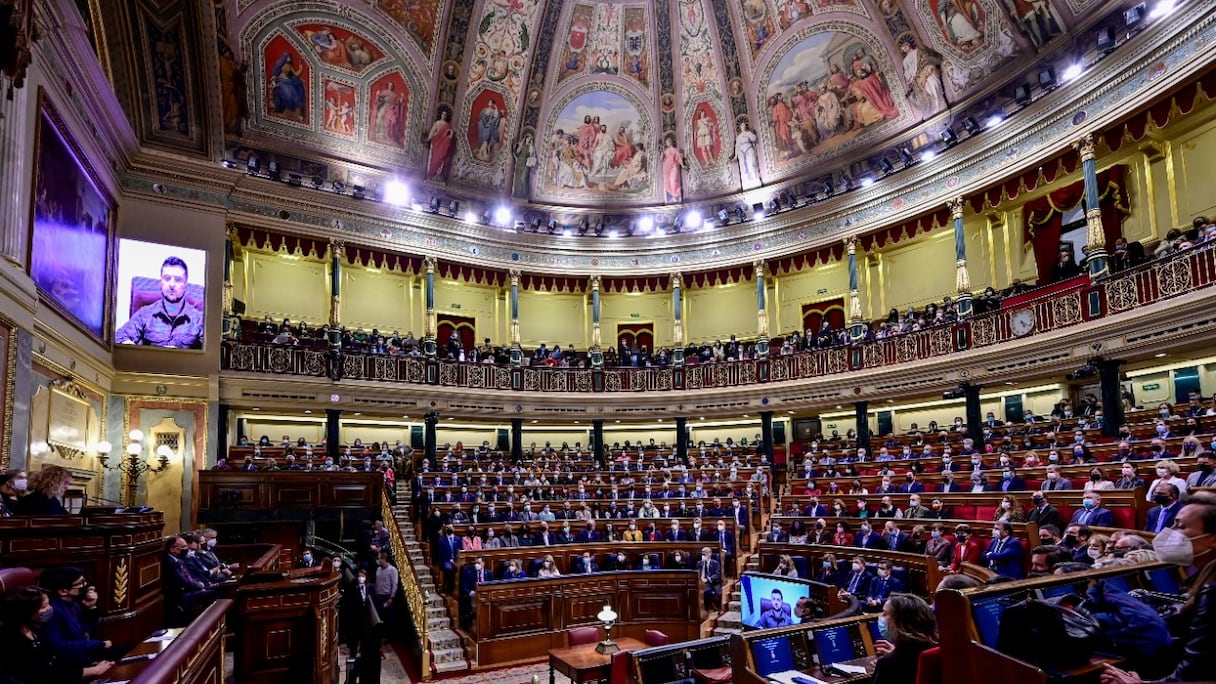
Spain’s Congress of Deputies on Thursday adopted a bill that, under the guise of “historical reparation,” allows Madrid to intervene directly in one of the most sensitive issues concerning Morocco’s territorial integrity. The text was approved by 168 votes in favor, 31 against and 145 abstentions. It must now be examined by the Senate before it can be definitively adopted.
The PSOE, Sumar and their parliamentary allies backed the initiative, while Vox voted against it and the People’s Party and Junts abstained. The Polisario Front’s representative in Spain attended the vote.
Half a century after leaving the territory, Madrid is once again arrogating to itself the right to define identities in the Moroccan Sahara.
A Law That Is Anything but Politically Neutral
Granting citizenship falls within Spain’s sovereign powers. But the exercise of that power ceases to be politically neutral when it rests on the territorial identity of a third party, extends to people residing in another country and is presented from the floor of Parliament as an act of “courage in the face of Morocco.”
Tesh Sidi, a Más Madrid lawmaker sitting with Sumar and the principal architect of the bill, herself declared that abstaining or voting against the proposal amounted to “siding with Morocco.” That statement alone dispels any pretense that the measure is exclusively humanitarian.
Read also : Morocco-Spain relations: Morocco refuses to be made a scapegoat in political score-settling
If voting in favor means opposing Morocco and abstaining means taking its side, then Spanish citizenship has explicitly been turned into an instrument of political confrontation.
The proposal does not limit its scope to stateless people, nor to those living in Spain or in the Tindouf camps. The adopted text allows anyone able to prove that they were born in the territory before September 29, 1977, to apply for Spanish citizenship, even if they have never legally resided in Spain. It also allows their first-degree descendants to opt for Spanish citizenship within five years of one of their parents being registered as a Spanish national. The text does not, however, make it possible to determine how many potential beneficiaries will apply or how many will ultimately obtain citizenship.
When Colonialism Becomes Useful Again
The most striking contradiction appears in the proposal’s own preamble. The text acknowledges that the Franco regime turned its African colonies into provinces in an attempt to circumvent the decolonization process launched by the United Nations. It therefore concedes that the provincialization of the Sahara was a maneuver by the dictatorship designed to disguise a colony as metropolitan territory.
Yet a few lines later, that very provincialization serves as the basis for granting Spanish citizenship. The supposed 53rd province is thus a colonial fiction when it comes to condemning Francoism, but becomes an indisputable legal reality when it provides a path to a European Union passport.
The colonial artifice denounced for half a century suddenly re-emerges as a source of law.
They Call It “Restoration,” but the Law Creates a New Acquisition
Supporters of the law argue that Spain is not granting citizenship but “restoring” it. The argument is politically effective, but it is far from an indisputable legal truth. Royal Decree 2258/1976 recognized the right of certain people from the Sahara to opt for Spanish citizenship for a period of one year. The procedure was restricted to holders of documents issued by Spain and required an explicit declaration of intent before the civil registry or a consulate. Once that deadline expired, the passports and documents of those who had not exercised the option ceased to be valid.
That decree did indeed exist. It shows that the Spanish state itself had not recognized the automatic and collective retention of citizenship.
Nor has Spanish case law established that everyone born in the former Sahara was Spanish by birth simply by virtue of having been born there.
The procedure chosen by Congress confirms this fragility. The text resorts to an exceptional naturalization procedure reserved for special circumstances. If citizenship still legally belonged to all the beneficiaries, there would be no need to create an exceptional mechanism to grant it to them half a century later. The rhetoric speaks of “restoration”; the text itself provides for a new acquisition.
Will Madrid Decide Who Is “Sahrawi”?
This is no longer simply about remedying the personal circumstances of those who lived under Spain’s former administration. The benefit is extended to a generation that never experienced Spanish rule and whose members may have been born, grown up and lived their entire lives in Morocco, Algeria or any other country.
Read also : Ceuta affair: Documents meant to shed light only add to the confusion
The text also accepts as evidence a registration receipt from the census drawn up for the United Nations referendum that never took place. A list associated with a political process stalled for decades is thus being given legal effect under Spanish law.
Far from being a mere technical detail, this choice amounts to giving legal value to an obsolete classification with no legal force and then incorporating it into Spanish domestic law. Madrid is thus claiming the authority to decide who belongs to a distinct population within the Moroccan Sahara.
This power of identification is all the more problematic because estimates of the number of beneficiaries vary considerably. Figures range from 70,000 to 80,000, or even 110,000 and as many as 200,000 people when descendants are included. Congress has therefore approved a collective pathway to citizenship without even having a precise estimate of how many people could benefit from it.
Spanish Citizenship, Complete With an Oath to the King
The text also amends Article 22 of the Civil Code to reduce the legal-residence requirement for people from the Sahara and their descendants from ten years to two. They would thus be placed on the same footing as nationals of Ibero-American countries, Andorra, the Philippines, Equatorial Guinea and Portugal, as well as Sephardic Jews.
Applicants will be able to establish their eligibility using an old Spanish identity card, documents issued by the colonial administration, birth certificates, family record books or a registration receipt from the census drawn up for the proposed referendum in the Sahara. School or hospital records, driving licenses, pension documents and other administrative records may also be considered together.
Applications will have to be submitted within three years of the future law’s entry into force, with the possibility of extending that period by one additional year. The Justice Ministry will have 12 months to issue a decision. No response will be deemed a rejection.
Citizenship will become effective only after the applicant has sworn or pledged allegiance to the King of Spain and obedience to the Spanish Constitution and laws. That detail, expressly stated in the adopted text, perhaps sums up its singularity better than all the speeches surrounding it. Those who denounce decades of Spanish colonialism are presenting as an act of liberation the acquisition of Spanish citizenship and an oath of allegiance to the head of state of the former colonial power.
The PSOE’s Opportunism
The PSOE eventually joined the celebrations after having voted against consideration of the very same proposal in February 2025. The initiative remained stalled for more than a year, until the Socialists and Sumar reached an agreement to put it back on the table.
Socialist lawmaker Artemi Rallo on Thursday called it a “historic milestone” and proclaimed his party’s commitment to the measure. He did not explain why a debt presented as urgent could wait for as long as the PSOE opposed the text, nor what had suddenly transformed a proposal once deemed unacceptable into an indispensable act of reparation.
During the debates, the party even tried to tone down references to people from the Sahara. It ultimately voted for the text before seeking to claim “leadership” of an initiative it had initially blocked.
The PP has been no less prone to reversals. It initially allowed the proposal to be considered, then rejected the text in committee before ultimately abstaining. The conservatives support reducing to two years the period of residence required to apply for citizenship, but oppose its collective granting through an exceptional procedure.
Read also : Spain to open Ceuta files with Morocco already in the dock
Only Vox maintained its opposition. Ignacio Hoces argued that Spanish citizenship “cannot today be used, through the Official State Gazette, to compensate for an injustice committed yesterday” and called for stricter scrutiny of the documents submitted.
A Decision With Obvious Political Implications
For many residents of the Tindouf camps, a Spanish passport will offer a way out to Europe, access to universities, greater professional mobility and an individual means of escaping dependence on the separatist structures. The measure also once again highlights the situation created by Algeria, which has hosted this population for half a century without fully integrating it or granting it Algerian citizenship.
Spanish citizenship could therefore end up serving less to build the separatist entity than to enable people to leave camps whose political survival depends precisely on retaining their population.
This is the ultimate paradox of a law built on a succession of contradictions. Spain claims to be repairing the consequences of its colonialism by invoking the legal bond created by that very colonialism. Half a century later, the decolonization envisioned by part of the Spanish Congress ultimately leads to a Justice Ministry counter and a passport issued by the former colonial power.