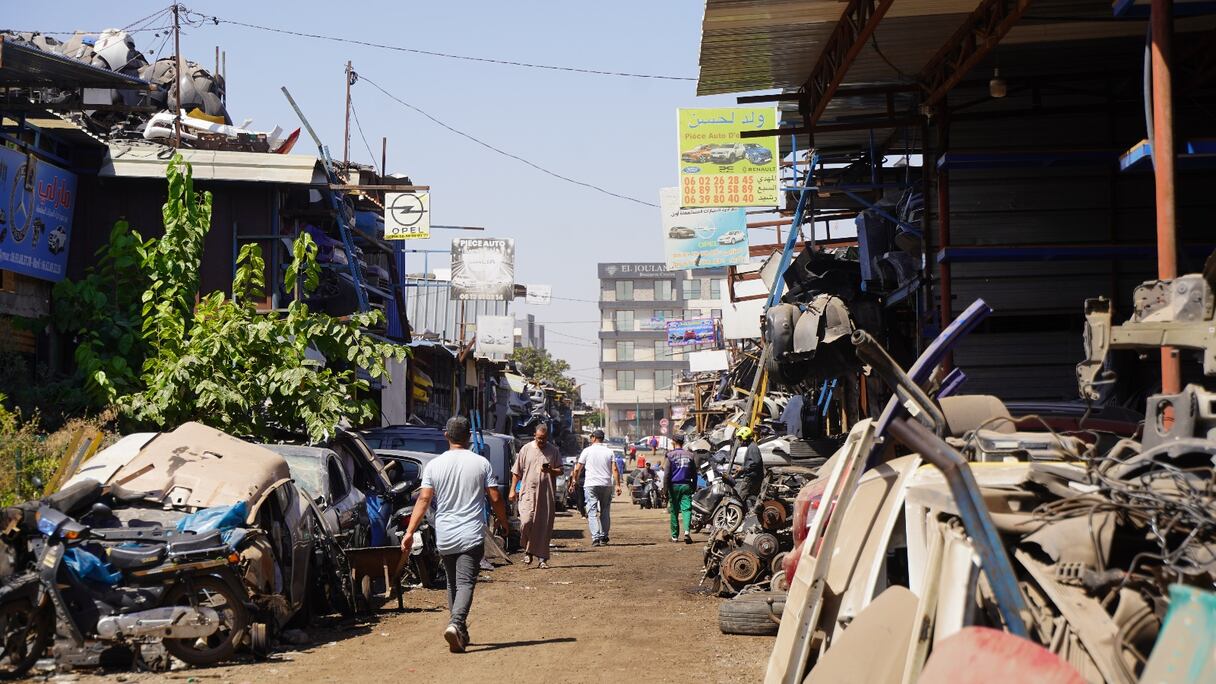
After several rounds of negotiations between local authorities and industry representatives, the long-running plan to relocate the Salmia scrapyard market—one of Africa’s largest hubs for used auto parts—has reached a decisive stage. An agreement in principle has been approved to move the market to a new 20-hectare site near the Mediouna landfill.
For the thousands of families who depend on what many describe as one of Casablanca’s economic lifelines, the project marks a major turning point. The Salmia site currently hosts more than 1,000 businesses spread across 18 blocks.
Although the market plays a vital role in the local economy, where workers typically earn between MAD 120 and MAD 200 a day, it continues to operate under difficult conditions. “There is neither running water nor electricity here. The future site in Mediouna will finally allow us to work in decent conditions while supporting our growth,” said Soufiane Aziz, president of the Regional Federation of Importers and Dealers of Used Auto Parts.
The authorities’ objective is to transform this largely informal economic ecosystem into a structured, modern commercial zone that complies with urban planning standards. The Casablanca-Settat Regional Council has committed to financing the development and servicing of the new site.
The goal is to integrate these businesses more fully into the metropolitan economy by providing them with the visibility and legal security they have long lacked.
The prospect of relocation, however, is accompanied by lingering uncertainty over the timetable. While the transfer has been approved in principle, no official date has been announced for the start of construction, demolition work or the actual relocation of businesses. That lack of clarity has fueled growing anxiety among traders.
Aziz urged traders to rely on official information rather than online speculation.
“Everything currently circulating on social media is unfounded at this stage. Nothing has been finalized yet,” he said, calling on merchants to remain patient.
On the ground, some traders are reluctant to replenish their inventories for fear of an imminent move, while others worry the relocation could still be months away.
“Everyone is waiting. No one knows when it will begin,” one trader said.
Until construction officially gets underway, the Salmia market will continue operating at its current location despite the uncertainty surrounding its planned relocation.
