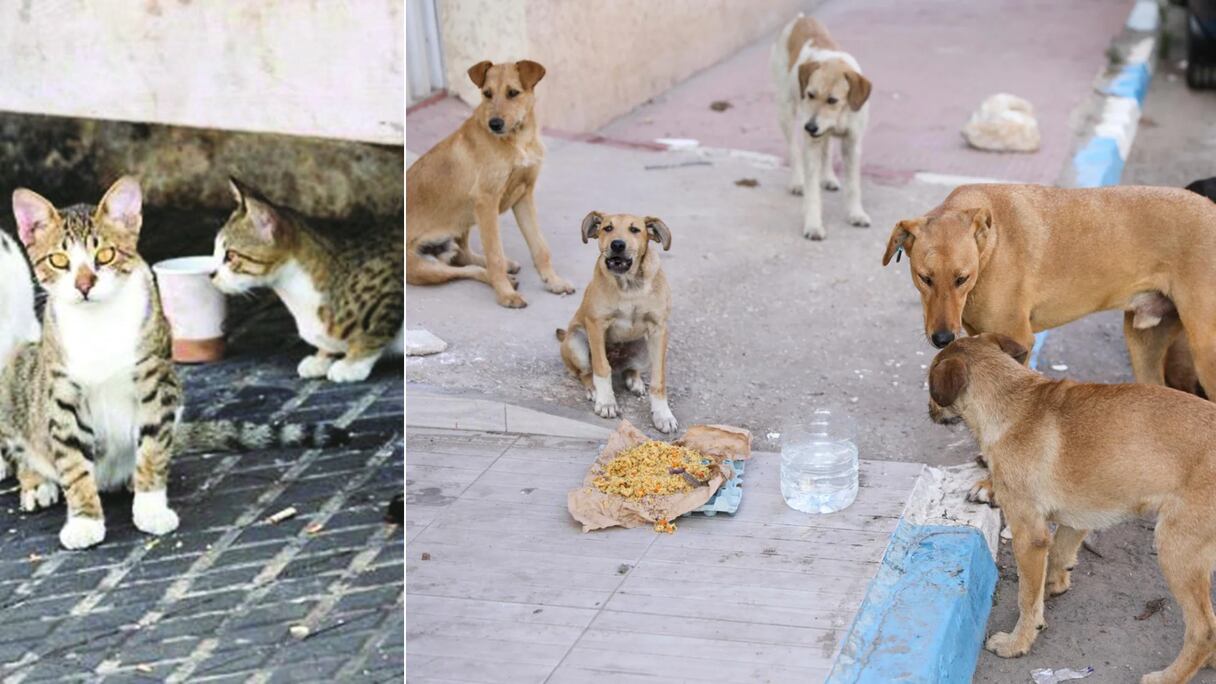
Morocco has approved its first comprehensive law governing stray animals, creating a nationwide system of regulated care centers while triggering criticism from animal welfare groups over provisions that restrict citizens from feeding or caring for stray animals outside authorized facilities.
The House of Councillors, the parliament’s second chamber, approved Bill No. 19.25 on Tuesday, July 7, 2026, by 25 votes to one, with six abstentions, concluding years of debate over how Morocco should manage its stray animal population.
The legislation seeks to address two longstanding challenges at once: improving public safety and strengthening animal welfare. It introduces tougher penalties for animal abuse, establishes a formal network of veterinary care centers, and places new legal obligations on owners of companion animals.
The law’s most controversial provision concerns assistance provided to stray animals.
The government says restricting the feeding, sheltering, or treatment of stray animals outside licensed facilities is intended to channel care through an organized institutional system rather than informal individual initiatives. Authorities argue the approach will help control breeding, improve veterinary monitoring, and strengthen efforts to combat rabies.
Animal welfare organizations, however, see the issue very differently.
The Humane Society of Morocco (SPA du Maroc), which has led opposition to the legislation, argues that the measure could discourage citizens from helping abandoned dogs and cats.
“The law amounts to an explicit criminalization of compassion and human solidarity,” the association said.
It warned that preventing people from feeding stray animals could force dogs and cats to forage more aggressively for food, potentially increasing public health risks rather than reducing them.
Regulated care replaces informal initiatives
Under the new framework, local authorities will establish public care centers staffed by veterinarians and equipped to receive stray animals.
Licensed private facilities will also be authorized to operate under government supervision.
Animals brought to the centers will undergo veterinary examinations, vaccination, and sterilization before receiving electronic identification microchips linked to a national digital database that will record their medical history.
Authorities say the system is designed to replace fragmented individual efforts with standardized veterinary care and long-term population management.
Tougher penalties for abuse and abandonment
The legislation also significantly expands legal protections for stray animals.
Anyone convicted of intentionally killing, torturing, or abusing a stray animal faces prison sentences of between two and six months and fines ranging from 5,000 to 20,000 Moroccan dirhams, or both.
The law also targets one of the principal sources of the stray population: abandoned pets.
Owners of companion animals will be required to register their animals, obtain health records, provide appropriate living conditions, and prevent them from roaming unsupervised in public spaces. Every registered animal will receive a unique electronic identification number linked to its owner through a national digital platform.
Those wishing to surrender ownership must hand the animal over to an authorized center.
Owners who fail to register their animals or obtain the required health documentation face fines of between 5,000 and 15,000 dirhams. Abandoning an animal carries fines ranging from 10,000 to 20,000 dirhams.
Welfare groups call for a different model
Animal welfare advocates argue that the legislation remains focused on managing public nuisance rather than adopting internationally recognized methods of population control.
They are calling instead for wider use of the trap-neuter-vaccinate-return (TNVR) model, under which stray animals are captured, sterilized, vaccinated, and returned to their territory to stabilize populations over time.
SPA du Maroc has also urged authorities to adopt a broader national strategy combining responsible pet ownership, regulation of breeding and animal sales, public education, and long-term population management.
