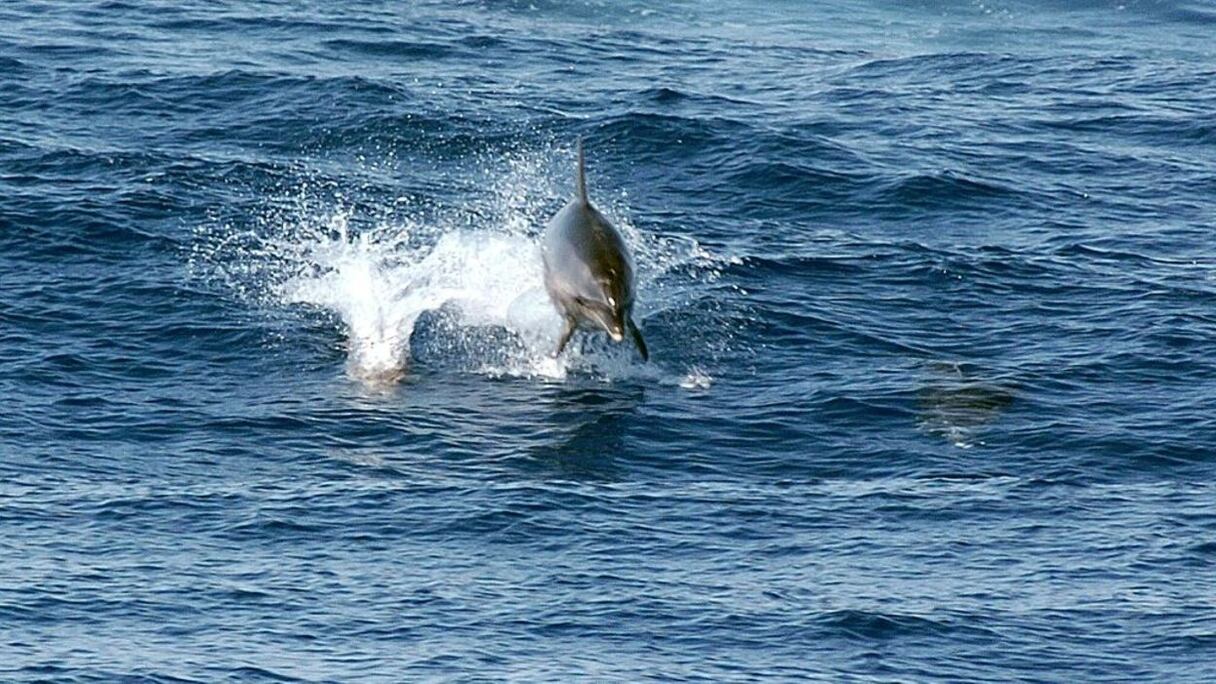
Morocco has begun testing reinforced fishing nets designed to reduce losses caused by bottlenose dolphins off its Mediterranean coast, offering new hope to fishing crews whose nets and catches have been repeatedly damaged.
The pilot phase was launched this week in Al Hoceima, a Mediterranean port city about 300 kilometers east of Tangier. It will initially equip three sardine fishing vessels operating from Al Hoceima, Jebha, and Ras El Ma with strengthened purse-seine nets.
The dolphins, known locally as “Negro” and scientifically as Tursiops truncatus, often tear through nets while pursuing sardines and other small pelagic fish.
Although the species is protected under the Agreement on the Conservation of Cetaceans of the Black Sea, Mediterranean Sea, and Contiguous Atlantic Area, known as ACCOBAMS, its growing interaction with fishing vessels has created mounting economic pressure on coastal communities.
The new equipment is intended to protect catches without harming the dolphins.
A 90 million-dirham program
The trial forms part of a partnership agreement signed in 2024 by the ministries of agriculture and fisheries, interior, and economy and finance, alongside the Tangier-Tetouan-Al Hoceima Regional Council, the National Institute for Fisheries Research, and the National Fisheries Office.
The program has a budget of 90 million Moroccan dirhams and is expected to finance the acquisition of new nets for fishing vessels operating along the Mediterranean coast.
Mounir Derraz, president of the Mediterranean Chamber of Maritime Fisheries, said the pilot followed extensive consultations with fishing professionals.
Three sardine boats will receive the reinforced nets during the first stage, he said, before the system is gradually expanded if technical evaluations prove successful.
Abdenbi Mansouri, the maritime fisheries delegate in Al Hoceima, said the tests would measure whether the new nets can withstand dolphin attacks before they are rolled out more widely.
One month of testing
The first phase in Al Hoceima will last one month, according to Mohammed Malouli Idrissi, the project coordinator at the National Institute for Fisheries Research.
Testing will then continue in Jebha, in Chefchaouen province, and Ras El Ma, in Nador province, under the supervision of institute experts.
Researchers will assess the nets’ durability, their impact on fishing operations, and their effectiveness in limiting damage caused by dolphins.
Malouli Idrissi urged fishing crews to participate closely in the trial so researchers can gather accurate data and identify any technical adjustments needed.
The broader program aims to install around 60 reinforced nets over two years, at a rate of three nets per month.
Losses spread beyond fishing crews
Dolphin attacks have become a serious threat to sardine fishing and other small pelagic fisheries along Morocco’s Mediterranean coast.
Some vessels have relocated to Atlantic ports, while other boat owners have sold their vessels and shifted investments into different sectors after repeated losses.
Fishing professionals say the damage extends beyond torn nets and lost catches. It affects crews, fish markets, transporters, and other businesses tied to the local maritime economy.
Adil Znaki, president of the Al Hoceima Port Fishermen’s Association, described the pilot as an important step after years of research and experimentation.
He said the sector is hoping the reinforced nets can reduce economic losses while allowing Morocco to continue protecting bottlenose dolphins.
The program has already attracted strong interest from vessel owners, with dozens applying for support to acquire the new equipment.
