
The pace of Morocco’s fertility decline has accelerated significantly over the past decade. Between 2014 and 2024 alone, the total fertility rate (TFR) fell by 0.24 children per woman, a drop of 11%, representing an average annual decline of nearly 2%, according to the HCP’s Population Projections for Morocco 2024–2060.
As a result, Morocco has fallen below the replacement level of 2.1 children per woman. The HCP notes that this decline is occurring “despite the fact that a significant share of the Moroccan population still lives in rural areas, where fertility levels have traditionally remained higher.”
Urban fertility, which was already close to replacement level in 2014, has continued to decline. The TFR dropped from 2.01 to 1.77 children per woman between 2014 and 2024, a decrease of 12%, exceeding the national average.
The HCP sees this as evidence of an “advanced demographic transition in urban areas,” driven by changing lifestyles, improved female education and broader access to reproductive healthcare and family-planning services. The institution also highlights the role of economic constraints and “changing family aspirations,” which are contributing to smaller family sizes in cities.
A slower decline in rural areas
Fertility remains historically higher in rural Morocco, reflecting what the HCP describes as “distinct socioeconomic and cultural conditions.” Nevertheless, rural fertility also declined by 7% between 2014 and 2024, thanks to improvements in healthcare access, the wider availability of contraception and the gradual transformation of social norms.
The fertility gap between urban and rural areas has narrowed considerably over time, falling from 2.3 children in 1982 to just 0.6 in 2024. The HCP attributes this convergence to the “harmonization of reproductive behavior,” likely linked to better healthcare infrastructure, family-planning policies and evolving social norms in rural communities.

The TFR recorded in the latest census was projected through 2060 using the United Nations’ 2011 empirical model, based on three scenarios: a rapid decline in fertility, a medium or trend-based decline, and a slower decline. The age-specific fertility structure used in the projections mirrors that observed in Morocco’s 2024 census.
Its evolution will follow the pattern proposed by the United Nations for Arab countries, which anticipates “a gradual transformation in age-specific fertility rates.” In practical terms, “this evolution will result in shifts in the relative weight of different age groups and a movement of the fertility peak toward older ages.”
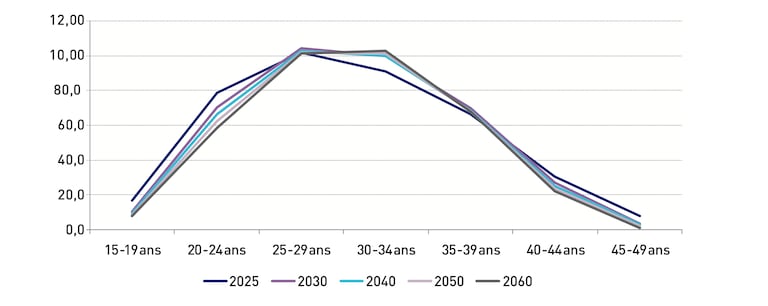
Demographic transition is generally accompanied by a sharper decline in fertility among younger age groups, combined with a gradual shift in peak fertility toward women aged 25–29 and, increasingly, 30–34, as postponing childbirth becomes the dominant trend.
Baseline scenario: A gradual decline to 1.81 children per woman
The baseline scenario extends the trends observed over the past two decades, which have been marked by a slow but steady decline in fertility. Under this projection, the total fertility rate (TFR) is expected to fall to 1.81 children per woman by 2060, down from 1.97 in 2024. Continued urbanization is seen as a key driver of this trend, creating greater educational and professional opportunities.
According to the HCP, urban lifestyles “encourage later motherhood and contribute to a decline in the average number of children per woman.” Rising education levels—particularly women’s access to higher education—combined with their growing participation in the labor market “also lead to delayed first pregnancies and smaller family sizes.”
The HCP also points to economic pressures, notably “the high cost of housing and education, which encourage young households to limit the size of their families.” These factors are compounded by broader sociocultural shifts, including the rise of individualistic values and a growing emphasis on quality of life. Couples are increasingly prioritizing living standards, education and the attention devoted to their children over the number of children they have.
High-fertility scenario: Toward near-stabilization at 2.06 children per woman
The high-growth scenario envisages a modest rebound in fertility over the projection period, bringing the total fertility rate close to the replacement level by 2060. According to the HCP, “this assumption is based on the idea that stronger family policies, combined with sustained improvements in socio-economic conditions, could support and stimulate birth rates.”
Under this scenario, the introduction of affordable childcare services, targeted financial incentives, accessible housing programs and policies aimed at helping families balance work and private life would encourage the formation of medium-sized households.
The scenario also takes into account a catch-up effect in delayed births, with some women choosing to have children later in life after initially postponing motherhood. The HCP further notes that “the persistence of rural areas with higher fertility rates and the contribution of younger migrant populations would reinforce this dynamic.” Under these conditions, the total fertility rate would reach 2.06 children per woman by 2060.
The low-fertility scenario: A sharp decline to 1.50 children per woman
“The low-growth scenario projects a sharp decline in fertility, leading to a level well below the replacement threshold, with a total fertility rate estimated at 1.50 children per woman by 2060—a figure already recorded in some European countries in the early 2000s,” the HCP writes.
Such an evolution would result from a combination of economic factors, including the rising cost of housing and education, which discourages larger families. According to the report, “it would also take place in a context of greater female empowerment, marked by women’s stronger integration into the labor market and rapid changes in lifestyles.”
Consumer aspirations, the increasing cost of raising children and a growing desire for personal freedom would further reinforce this trend. On the sociocultural front, family models would gradually shift toward structures centered around one or two children—or even childlessness—while motherhood would increasingly be postponed to later ages, “without any subsequent catch-up effect.”
Morocco’s fertility projections, based on the United Nations’ 2024 revision and the HCP’s medium-growth scenario published in 2025, show notable differences in the short term but gradually converge over the longer horizon. In 2025, the United Nations estimates the total fertility rate at 2.18 children per woman, compared with 1.97 in the HCP projections, a gap of 0.22 points.
For urban areas, only one fertility assumption was retained, corresponding to the medium-growth scenario for Morocco’s overall population, given the already relatively low fertility rate observed in cities.
Between 2024 and 2060, urban fertility is expected to continue its slow but steady decline, falling from 1.77 to 1.66 children per woman. The HCP describes this moderate decrease as evidence of “the consolidation of a family model that remains durably oriented toward low fertility levels,” without any major disruption to the pace of demographic transition.
The same underlying factors—advanced urbanization, high housing and service costs, women’s growing participation in the labor market, rapidly changing lifestyles and the spread of smaller family models—are expected to remain in place throughout the projection period.
Over the period covered by the forecasts, both institutions anticipate a continued decline in fertility, albeit at different rates. The United Nations projects a drop of 0.38 points, from 2.18 to 1.80 children per woman, while the HCP expects a more moderate decline of just 0.15 points, bringing the figure to 1.81. According to the HCP, this reflects a belief that fertility in Morocco will stabilize more quickly under the national projections.
“Despite these initial differences, the two trajectories converge by 2060, reaching almost identical levels—1.80 according to the United Nations and 1.81 according to the HCP. This convergence suggests that the uncertainty lies less in the eventual level of fertility in Morocco than in the pace at which it will be reached,” the institution notes.
Whatever the scenario, Morocco appears to be heading toward fertility levels that will remain permanently below the replacement threshold.
