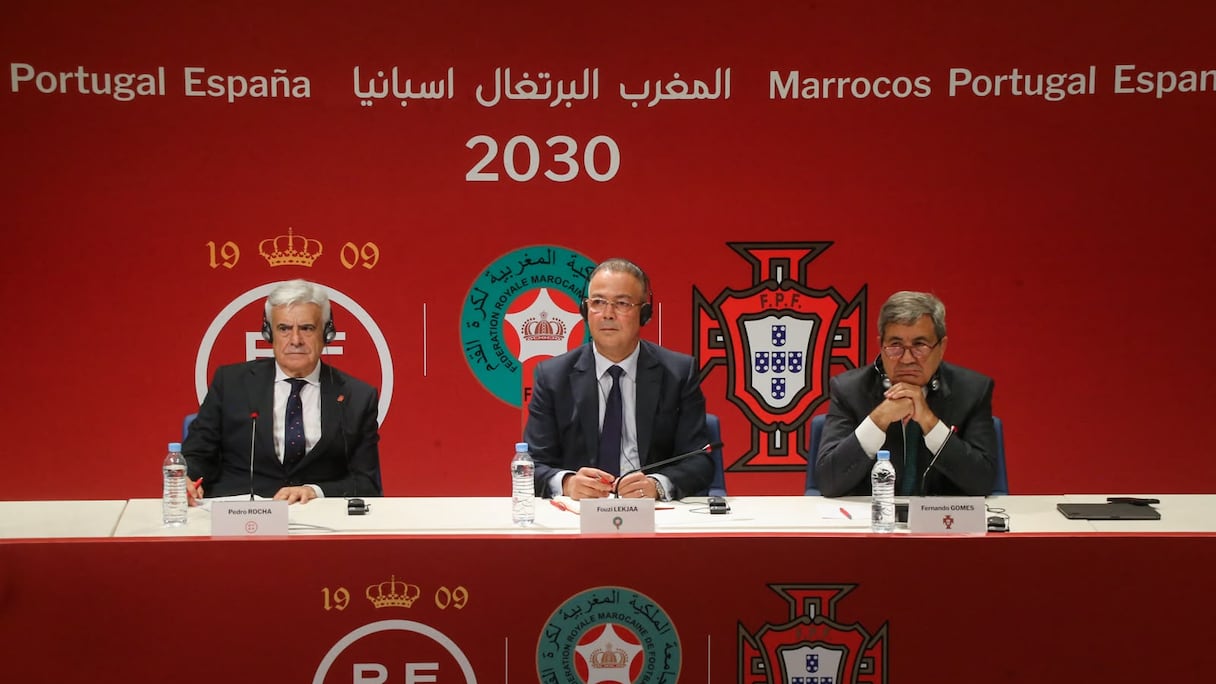
In an opinion piece published by Spanish newspaper AS Diario titled “Marruecos siempre miró por sus intereses” (“Morocco always looked after its own interests”), former 2030 World Cup bid consultant João Gabriel questioned Morocco’s role in the joint bid with Spain and Portugal, making a series of allegations that Moroccan journalist Amine Birouk described as unfounded.
Gabriel argued that Morocco “never truly committed to a shared project” and instead “prioritized the promotion of its own strategic interests, even if it meant undermining the credibility of the joint bid.”
The Portuguese consultant also criticized what he described as an overly close relationship between FIFA and Morocco, claiming that world football’s governing body had “systematically favored the positions defended by Morocco.”
Read also : 2030 World Cup: FIFA calls The Times’ claims about the final “false and misleading”
As political and media debate intensified in Spain over whether the 2030 World Cup final should be staged in Casablanca or Madrid, Birouk responded with his own opinion piece, contending that Gabriel’s accusations are unfounded and, in fact, weaken Spain’s own position.
Published in AS Diario under the headline “2030 World Cup: Morocco never scores an own goal,” Birouk’s article addresses Gabriel’s arguments point by point.
He first argues that Gabriel’s account does not reflect the facts. Although Morocco officially joined the Iberian bid in 2024, Birouk states the project dates back to 2018, when he attended the first meeting in Rabat between then-President of the Royal Spanish Football Federation Luis Rubiales and Royal Moroccan Football Federation President Fouzi Lekjaa.
While Gabriel contends that Morocco pursued its own interests, Birouk argues that the 2030 bid “was not born from an improvised decision, but from dialogue that led to a shared project between Spain, Portugal and Morocco.” He adds that every country naturally defends its own interests, but that doing so does not equate to “weakening the collective project.”
Responding to Gabriel’s claims of an unusually close relationship between FIFA and the Royal Moroccan Football Federation (FRMF), Birouk says the relationship is the result of “years of sustained work.” He points to Morocco’s efforts since 2014 to develop football through investment in infrastructure, training, and the growth of different disciplines, before highlighting the Atlas Lions’ performances at the 2022 and 2026 FIFA World Cups.
Read also : FIFA says Rabat meeting was ‘positive and constructive’ after scrapping FFE proposal
Birouk also writes that allegations that FIFA “systematically intervenes” in Morocco’s favor “require concrete evidence.” He notes that recent speculation by The Times suggesting the 2030 World Cup final had already been awarded to Morocco was denied by FIFA.
“Morocco has never made a fatal mistake. It has defended its interests, like any partner, but always within the framework of a collective ambition,” Birouk wrote in response to Gabriel’s portrayal of Morocco. He concluded by saying that “controversies will fade, but the legacy will endure for future generations.”
