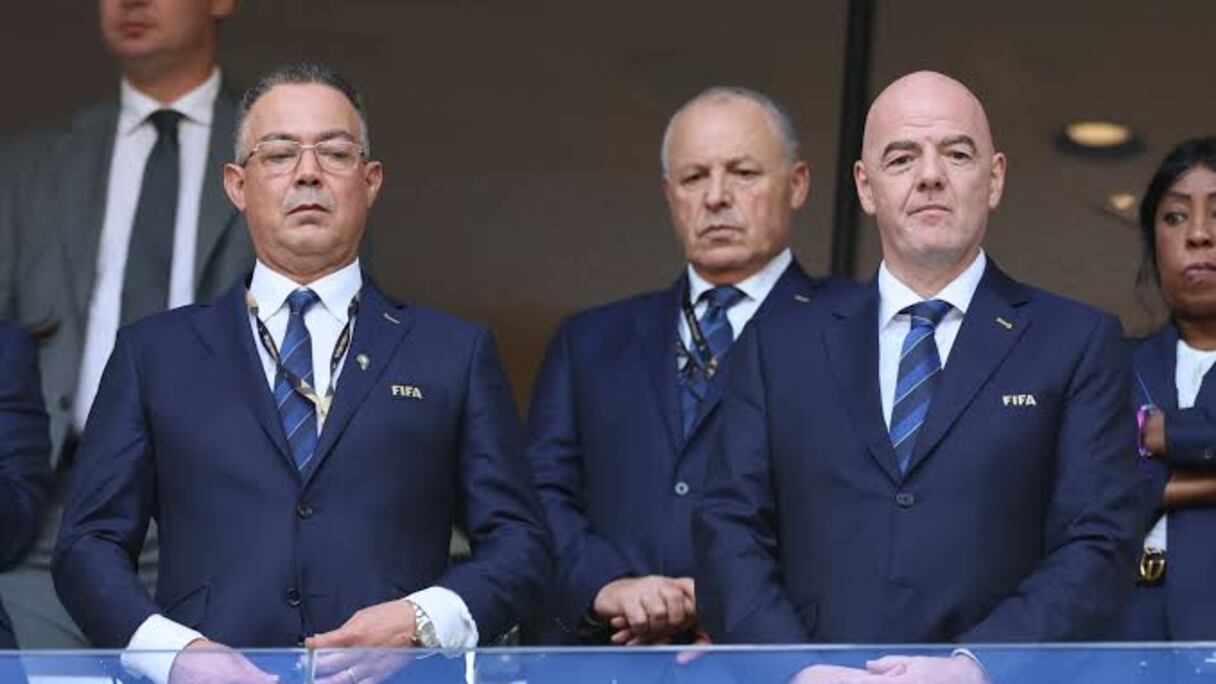
Six presidents of Arab football federations, including Fouzi Lekjaa, president of the Royal Moroccan Football Federation (FRMF), publicly backed Gianni Infantino on Thursday, August 13. The show of support comes as the FIFA president faces a particularly difficult period following the controversy surrounding the now-abandoned FIFA Forward Enterprise (FFE) project.
In a joint statement published Thursday on the social media accounts of the Egyptian Football Association, the presidents of the football federations of Morocco, Qatar, Egypt, Lebanon, Sudan and Mauritania publicly expressed their support for the head of world football.
“Recognizing the important role of Arab football in bringing people together and strengthening cooperation between football federations across the Arab world, we express our full support for Mr. Gianni Infantino and reaffirm our confidence in his leadership and his continued commitment to the development of football worldwide,” the six officials said.
Alongside Fouzi Lekjaa, the signatories include Qatar Football Association President Sheikh Hamad bin Khalifa Al Thani, his Egyptian counterpart Hany Abo Rida, as well as the presidents of the Lebanese, Sudanese and Mauritanian federations.
The six officials also praised Infantino’s record since he took charge of the international governing body.
“We deeply appreciate Mr. Infantino’s sustained efforts to advance football worldwide, expand opportunities across all regions and strengthen the role of the sport in bringing people and communities together,” they added.
They concluded their statement by reaffirming their commitment to continued cooperation: “We look forward to continuing our close collaboration with him toward a stronger and more prosperous future for world football.”
Read also : Motsepe says FIFA members should decide Infantino’s future at 2027 election
Infantino under pressure
The statement comes amid a particularly tense period for Gianni Infantino. The FIFA president has faced strong criticism since the presentation of the FIFA Forward Enterprise project, which proposed bringing the governing body’s commercial and event-related activities, including those linked to its various competitions, under a new subsidiary.
The project included plans to raise up to $4.2 billion from private investors based on an initial valuation of $20 billion. FIFA said it would retain control of the new structure and that the operation would allow it to significantly increase the funds distributed to its 211 member associations.
The initiative, however, triggered significant opposition across world football. UEFA, the Asian Football Confederation (AFC) and Concacaf were among those to strongly criticize the way the project had been handled and called on Infantino to step down.
Faced with mounting opposition, the project was eventually withdrawn.
Crisis meeting in Rabat
Days after the project was withdrawn, Gianni Infantino held a meeting in Rabat on Wednesday, August 5, with FIFA Secretary General Mattias Grafström and several senior officials to review the events surrounding the proposal.
During the meeting, FIFA’s leadership acknowledged that mistakes had been made in handling the FIFA Forward Enterprise proposal, particularly in the way the process had been conducted and communicated. The governing body also apologized to its member associations and said it would review its procedures to prevent a similar situation from happening again.
Read also : FIFA condemns ‘concerted and ongoing effort’ to weaken Infantino
Following the meeting, the secretary general and several members of FIFA’s leadership reaffirmed their support for Gianni Infantino. At the same time, FIFA stressed the need to improve its internal processes, communication and coordination between its presidency, administration and various bodies.
The support expressed Thursday by the six Arab football federation presidents adds to backing already voiced by several African football leaders. The Confederation of African Football (CAF) also expressed its support for Infantino in the aftermath of the crisis, while stressing the importance of governance and transparency.
