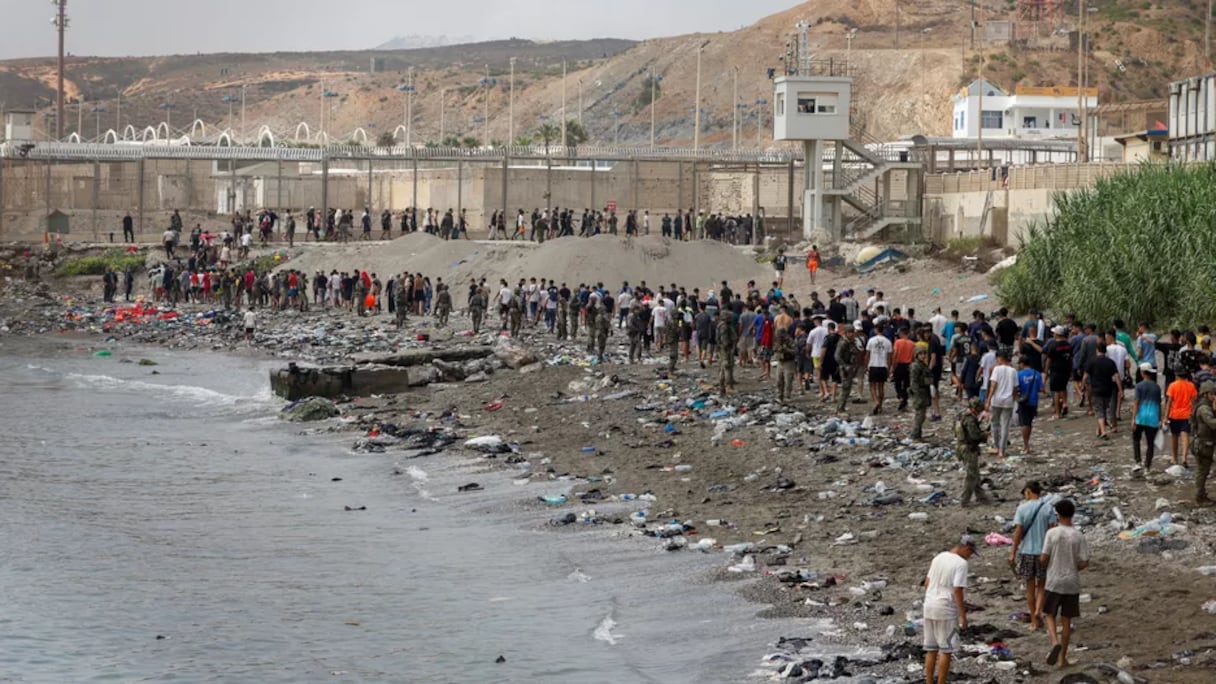
How many people actually entered Ceuta? Was it 40,000, 60,000, 72,000, or 80,000? How many have returned to Morocco? Are there still 2,000, 2,500, or 6,000 people in the city?
Nearly a week after the migration crisis began, Spain remains unable to produce a single, stable accounting of what happened.
Since Thursday, July 30, estimates have been issued, revised, and then contradicted. Madrid has put forward one set of figures, while Juan Jesús Vivas, the president of Ceuta, has presented another, with discrepancies sometimes reaching tens of thousands of people. The resulting cacophony is difficult to comprehend from the outside and, almost a week later, still prevents any clear and broadly accepted reading of the crisis.
Thursday: From a Few Thousand to More Than 40,000
The day of July 30 began with an official tally of between 1,500 and 2,000 irregular entries recorded over the previous ten days. But pressure suddenly intensified, and for several hours the authorities limited themselves to referring to “thousands” of people crossing the border by land and sea.
Read also : Report: Evidence shows the Ceuta and Melilla assault was directed from Algeria
The first estimates from the security forces, released on Friday morning while events were still unfolding and arrivals were continuing, spoke of more than 40,000 people. The rapidly evolving situation at the time may have explained the absence of a precise count. But it also marked the beginning of a succession of contradictory figures that would continue over the following days.
Friday: 50,000 for Madrid, 60,000 for Vivas
The first major public contradiction emerged on Friday. Spain’s Interior Ministry estimated that approximately 49,000 to 50,000 people had entered Ceuta. Juan Jesús Vivas, however, put the figure at 60,000—a discrepancy of 10,000 people between the two official estimates.
The confusion deepened with the figures on returns to Morocco. The Interior Ministry first announced that 25,000 people had left by 1:00 p.m., then raised the figure to 37,500 at 3:30 p.m., and finally to 48,300 by 6:00 p.m. According to Madrid’s calculations, fewer than 2,000 people remained in Ceuta.
That calculation, however, no longer held if Vivas’s figure was accepted. If 60,000 people had entered and 48,300 had returned to Morocco, nearly 12,000 people remained unaccounted for. No authority explained where they were or why such a large discrepancy existed.
The Weekend Did Little to Clear the Confusion
On Saturday, Madrid maintained its estimate of around 50,000 entries and more than 48,000 returns. Vivas, meanwhile, continued to speak of 60,000 arrivals. The situation on the ground was beginning to stabilize, but the figures remained trapped in what appeared to be an incomprehensible institutional tug-of-war.
Read also : How the rush to Ceuta shattered the illusion of a European Eldorado
A fresh contradiction emerged on Monday, August 3. The central government estimated that around 2,500 people remained in Ceuta, while figures released by the city authorities ranged from 3,000 to 5,000. Even the death toll differed: Madrid spoke of 74 fatalities, while Ceuta reported 88.
Marlaska Adds 22,000 More Arrivals
On Tuesday, August 4, Spanish Interior Minister Fernando Grande-Marlaska once again altered the official narrative of the crisis. He raised the number of people who had entered Ceuta irregularly to 72,000, stating that 70,000 of them had already returned to Morocco.
Madrid had thus added 22,000 arrivals to its previous estimate of 50,000 without publicly explaining the basis for the revision. Under this new calculation, around 2,000 people still remained in Ceuta. Marlaska presented these figures to his European Union counterparts while insisting that the situation was under control and that the Schengen Area had not been endangered.
Vivas Counters With 80,000 Arrivals and 6,000 People Still in the City
One day later, Juan Jesús Vivas once again challenged Madrid’s figures. On Wednesday, August 5, he estimated the total number of arrivals at 80,000 and said that approximately 6,000 people were still wandering around the city.
The gap with the Interior Ministry’s data is considerable: 8,000 additional arrivals and 4,000 more people still present. In other words, according to Vivas, Ceuta was still hosting three times as many people as Marlaska acknowledged.
“How is it possible that we still do not know how many people are in Ceuta?” Vivas asked during an interview with Spain’s public broadcaster TVE.
He also lamented that those still in the city had not yet been identified and that the corresponding deportation procedures had not been initiated. His remarks ultimately confirmed that, six days after the crisis began, the Spanish authorities themselves still did not know its true scale.
Morocco Provides a Different Set of Figures
Adding to the confusion is the official tally released by Morocco on August 2, 2026. Morocco’s Ministry of the Interior stated that around 40,000 people had taken part in attempts to cross irregularly into Ceuta, compared with 1,135 attempts toward Melilla. It added that everyone who succeeded in reaching Melilla had been immediately returned.
Read also : Official: Attempted crossings to Ceuta and Melilla explained by the Interior Ministry
Rabat explained that its figures were based on technical monitoring and surveillance systems deployed on the ground and presented them as the “official reference,” in contrast to other estimates that, according to the ministry, lacked any objective basis.
Morocco also reported 11 deaths on its territory: 10 people who drowned and one person who died after an accidental fall from a rocky area near Ceuta. Regarding the deaths recorded inside the city, the ministry said it was continuing to work with the Spanish authorities to establish the exact number of victims, as well as their identities and nationalities.