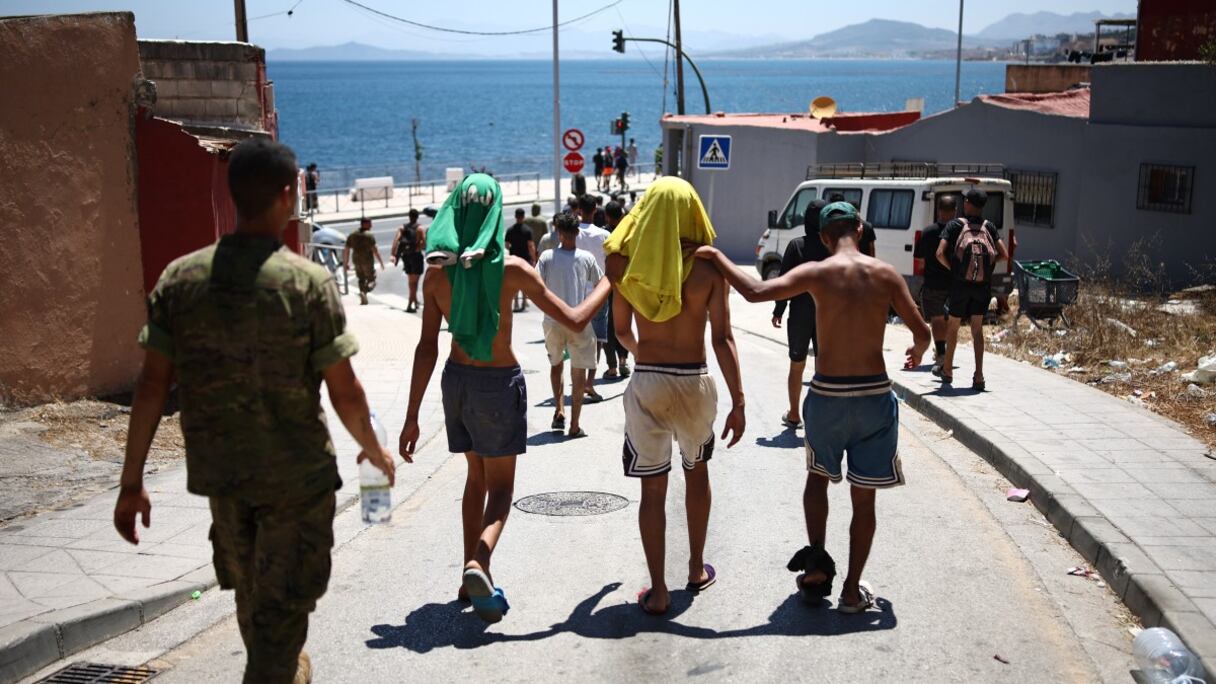
The figure officially released by the Spanish authorities carries unprecedented political and symbolic significance: 95% of those who entered Ceuta over the past week have already left the city of their own accord. This unprecedented rate of voluntary departure must be the indispensable starting point for any rigorous analysis. Its true nature deserves to be clearly understood: this large-scale return was brought about neither by a major police operation nor by waves of coercive pushbacks carried out by the Spanish security apparatus. It was a spontaneous movement, driven by both individual and collective realization.
The migrants saw for themselves, experienced the reality firsthand, and turned back of their own free will. From their very first steps inside the enclave, the collision between the imagined Eldorado—nurtured by social media and misinformation—and the reality on the ground triggered an immediate awakening. Faced with a dead end, a lack of prospects, and precarious reception conditions, the mirage collapsed. The speed and spontaneity with which these young people decided to return to Morocco are revealing. Their decision was not forced upon them; it was a choice born of pragmatism and lucidity, following an undeniable shock.
Disillusionment
This chain reaction provides empirical confirmation of the position Morocco has long maintained. As a government source recently recalled, echoing the return figures released by the Spanish authorities, “there is no exclusively security-based answer to the migration issue.”
The voluntary return of these young people demonstrates that migration management cannot be measured solely by the scale of police deployments at the borders, but by the maturity of the socio-economic opportunities available to citizens.
Read also : How a Spanish court ruling helped trigger the Ceuta migration crisis
By choosing to return to their country, these young people have concretely disproved the notion of a one-way exodus. Their decision underscores the significance of the structural projects undertaken by Mohammed VI’s Morocco, from the modernization of port and industrial infrastructure to the revitalization of the regional economy. Some still fail to see it, and public policies are certainly not yet inclusive enough, but the place to be is Morocco, far more than the uncertainty that comes with the status of an undocumented immigrant in Europe.
The lesson of this crisis is that the future of Morocco’s youth is built in Morocco. Certainly, much remains to be done, but everything remains possible. The country’s development efforts also directly challenge the European Union to rethink its partnership with the Kingdom. Europe must stop prioritizing border-lockdown policies while adopting trade and regulatory decisions that undermine Moroccan industries, including the automotive sector, port logistics, services, offshoring, and transport. A mature Euro-Moroccan partnership requires sincere—and mutually beneficial—support for Morocco’s development efforts, the cornerstone of regional stability.
Pandora’s Box
Instead, Europe is offering a lesson in sterile identity-based retreat. Here again, the events in Ceuta provided an unflattering illustration for Spain. Even as the crisis was naturally subsiding on the ground thanks to the mass voluntary return of migrants, it became the pretext for a virulent xenophobic campaign.
At the Port of Algeciras, during Operation Marhaba, far-right groups targeted Moroccan diaspora families transiting to the Kingdom, greeting them with hostile placards reading “Moroccans Out.” What these groups fail to mention is that this annual transit generates substantial economic benefits for Spain.
In Ceuta, political agitators such as Alvise Pérez, leader of Se Acabó La Fiesta, together with activists from the far-right group Núcleo Nacional, traveled to the enclave to reinforce the narrative of a supposed “invasion,” even though the overwhelming majority of those who had entered had already left the city. Rather than responding to any genuine emergency, their presence sought to transform a crisis already resolved by events into an identity-driven spectacle. It was a maneuver rejected by Ceuta’s own residents, who jeered them and forced them to leave under police escort.
Read also : Anti-Moroccan hatred gains alarming ground in Spain
The agitation quickly spread to Spain’s major cities, resulting in hate rallies outside the Moroccan Embassy in Madrid, attended by around 1,200 people, as well as demonstrations outside the Moroccan consulates in Almería and Palma. Alongside attacks on migration policy came openly Islamophobic slogans—“A Christian Spain, Not a Muslim One”—and repeated Nazi salutes by far-right figures already convicted of inciting hatred, including Isabel Peralta.
These events form part of a deeper trend reflected in Spain’s own official statistics: a 23.6% increase in hate crimes in 2025, reaching 2,417 recorded cases, alongside a dramatic 133% surge in Islamophobic incidents, including a 450% increase online. This strategy of dramatization seeks to entrench in public debate the notion of a civilizational clash while permanently stigmatizing the Moroccan community.
Faced with this wave of hostility, these Nazi salutes beneath the windows of Moroccan diplomatic missions, and these placards calling for rejection, one question imposes itself with striking clarity: is this truly the climate of hatred and racism in which Moroccans would wish to live and build their future?
The answer is already contained in the lucid decision made by those 95% of young people who returned from Ceuta. By dismantling the European mirage through their voluntary return, they demonstrated that no supposed Eldorado justifies exchanging one’s dignity for daily stigmatization. Freed from the illusions of a continent grappling with its own identity demons, the future is now being written with heads held high, on Moroccan soil.
