Algeciras Port, Sunday, August 2, 2026. Ferries bound for Ceuta and Tangier line the docks as Operation Marhaba enters full swing. Hundreds of Moroccans traveling from France, the Netherlands, and other European countries pass through the port on their way home. Among the crowds, several young people wear bracelets in the colors of the Spanish flag and carry backpacks, flags, and placards bearing slogans such as “Enemies of Spain” and “Moroccans Out.”
The scene reflects a climate that has taken hold in parts of Spain since the Ceuta migration crisis. While tens of thousands of Moroccan families cross the country to return home, a handful of far-right groups have sought to turn a border emergency into an identity-based confrontation. Their attacks are no longer directed solely at migration policy—they now openly target Moroccans.
The day before, similar tensions had already reached Ceuta. Alvise Pérez, leader of the far-right movement Se Acabó La Fiesta (SALF), along with around 20 members of the extremist group Núcleo Nacional, arrived in the city claiming they had come to “defend Spain.”
By then, however, most of the people who had entered the city irregularly had already left. Their arrival therefore responded to no immediate situation on the ground. Instead, it appeared aimed at capitalizing on public emotion surrounding the crisis, promoting the narrative of a supposed “invasion,” and turning Ceuta into a showcase for the far right.
The reception they received was far from what they had expected. While Alvise Pérez was inside a local establishment with online activist Vito Quiles, several residents confronted him, accusing him of “going after the weakest” and exploiting an especially painful situation.
As counter-demonstrators gathered, Spain’s National Police escorted Pérez back to the port. The approximately 20 members of Núcleo Nacional, who had planned to rally in Plaza de los Reyes, met the same fate. They were also escorted away under police protection, followed to the port by a convoy of motorcycles and cars whose drivers jeered them by repeatedly sounding their horns.
From political protest to the stigmatization of an entire community
The demonstrations extended beyond Ceuta. Over the weekend, rallies were held outside the Moroccan Embassy in Madrid as well as Moroccan consulates in several Spanish cities, including Palma and Almería.
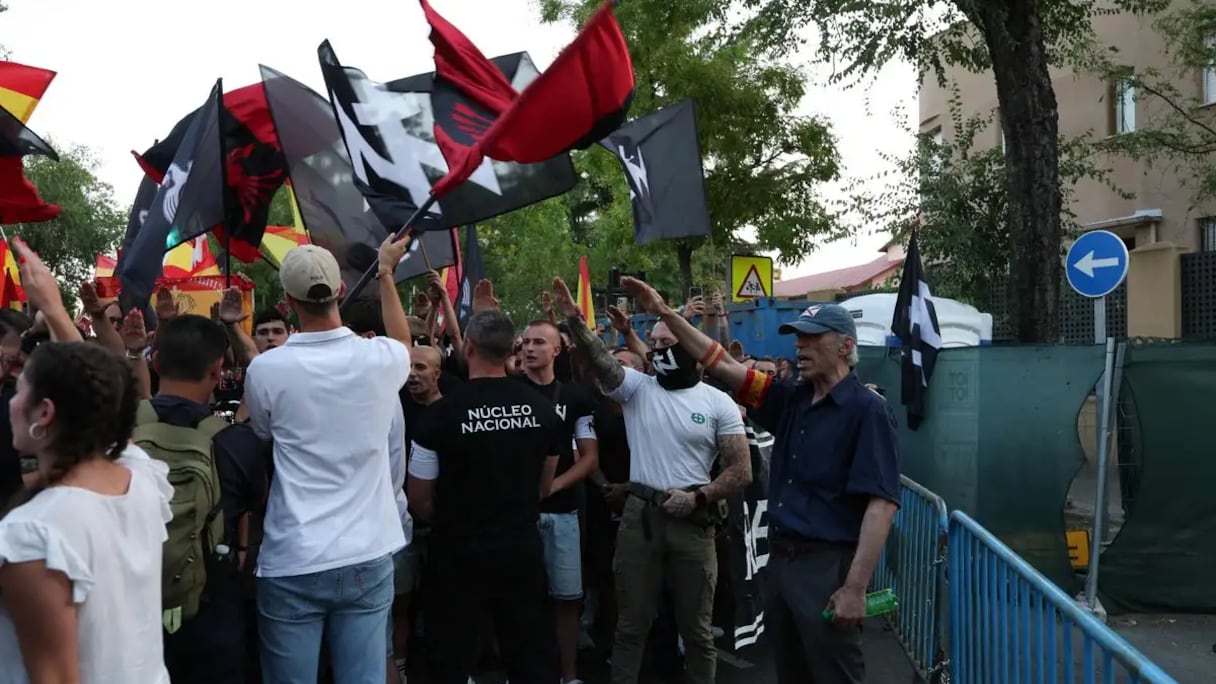
According to Spain’s Government Delegation, around 1,200 people gathered outside the Moroccan Embassy in Madrid. Alongside criticism of the handling of the migration crisis, demonstrators chanted slogans such as, “A Christian Spain, not a Muslim one.” Such rhetoric goes beyond opposing migration policy and instead questions the place of millions of Muslim citizens and residents within Spanish society.
Read also : Spain’s FM praises Morocco’s swift cooperation during Ceuta migration crisis
Neo-Nazi activist Isabel Peralta also took part in the demonstration, even performing a Nazi salute outside the embassy. Her presence carried particular significance. In 2025, she was sentenced to one year in prison for hate speech delivered during another protest outside the same embassy in May 2021, when she called for fighting “the invader,” directly targeting Moroccans and Muslims.
Five years later, that same rhetoric has resurfaced in the streets, fueled by a new migration crisis and amplified through social media.
In Palma, several hundred demonstrators also gathered outside the Moroccan consulate, chanting anti-government and identity-based slogans. In Almería, nearly 100 people protested outside the Moroccan diplomatic mission. Through viral videos, online posts, and activist accounts, these mobilizations have increasingly portrayed the crisis not as a humanitarian or border management issue, but as the latest chapter in an alleged confrontation between Spain, Morocco, and Islam.
Figures point to a growing trend
The events surrounding the Ceuta crisis are not isolated. In 2025, Spain recorded 2,417 hate crimes and hate-related incidents, an increase of 23.6% compared with the previous year and the highest figure since official records began. Racism and xenophobia remained the leading motives, accounting for 934 cases, up 16.1% from 2024.
The rise in Islamophobia has been particularly striking. Islamophobia-related incidents increased by 133% in one year, while online cases surged by 450%. Moroccan nationals are also among the foreign communities most frequently targeted by hate-related acts.
The Spanish Observatory on Racism and Xenophobia also found that 85% of hate messages targeting immigrants in April 2026 sought to discredit them. In 55% of cases, immigrants were portrayed as a threat, while 30% of the messages explicitly called for their expulsion.
The pattern has become increasingly familiar: a crime, the arrival of migrants, or a border incident is enough to place an entire community under suspicion. Images taken out of context circulate online, rumors become indistinguishable from facts, and individuals disappear behind labels portrayed as threats: “Moroccans,” “Muslims,” or “immigrants.”
Spain’s exception under pressure
For many years, Spain stood apart from much of Europe. Unlike several neighboring countries, the arrival of millions of immigrants did not immediately lead to the emergence of a major xenophobic political force. Memories of Spain’s own history of emigration, everyday integration, and a relatively open society helped contain the most radical narratives.
As recently as 2024, Spain ranked among Europe’s most immigration-friendly countries. Some 80% of Spaniards believed that an active integration policy represented a worthwhile long-term investment—11 percentage points above the European average.
Read also : ‘It Was Hell’: Returnees describe harrowing ordeal in Ceuta
That consensus, however, remains fragile. In September 2024, 30.4% of respondents in a survey by Spain’s Center for Sociological Research identified immigration as the country’s biggest problem, compared with just 16.9% two months earlier. The sharp increase illustrates how rapidly public opinion can shift when political and media discourse frames immigration primarily in terms of “invasion,” “chaos,” or “threat.”
The entry of Vox into Spain’s political institutions had already marked the end of the country’s political exceptionalism. Now, even more radical movements are attempting to pull the debate toward openly racist positions. Their influence is measured not only by election results or the size of their demonstrations, but also by their ability to shape the language and themes adopted by larger political forces, bringing ideas once confined to the fringes into mainstream public debate.
When “Moroccan” becomes synonymous with criminality, when Muslim identity is portrayed as incompatible with Spanish identity, and when a migration emergency is framed as a racial conflict, the far right has already secured an important victory.