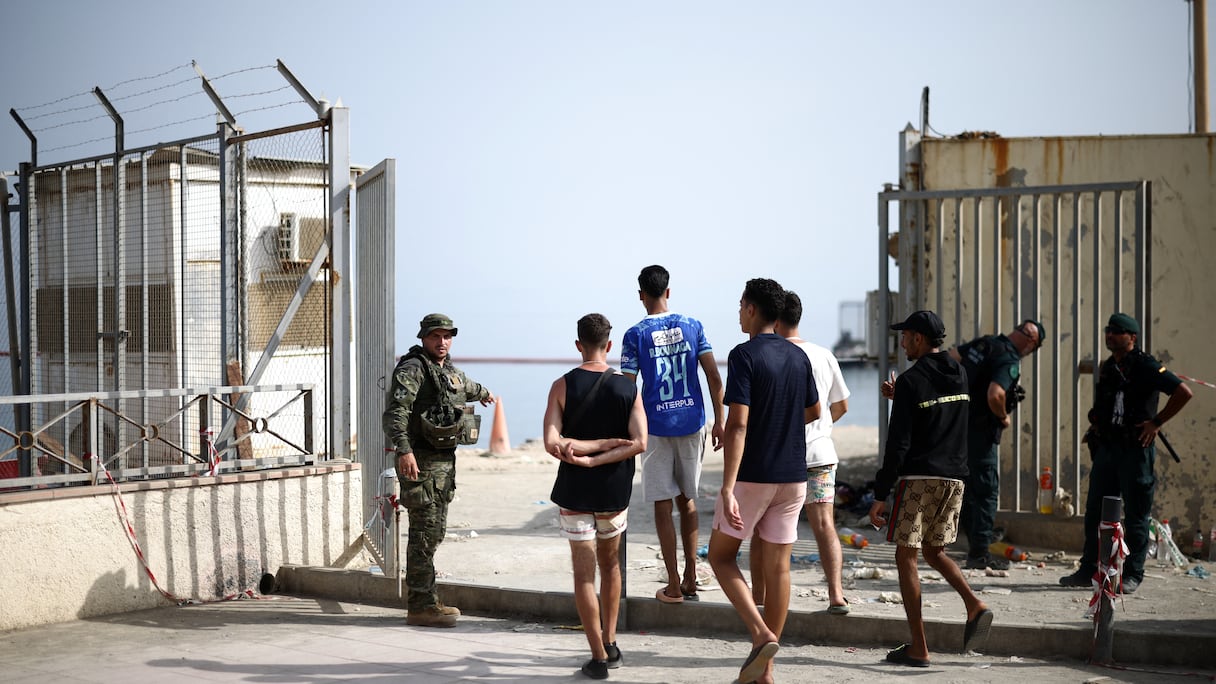
In the weeks leading up to the July 30 migration crisis, Spain’s National Intelligence Centre (CNI) reportedly issued multiple warnings to the Interior Ministry regarding the risk of a mass influx of migrants into Ceuta. This information was revealed on Monday by Cadena SER, citing sources close to Spain’s state security services.
While the CNI could not predict the exact date of the arrivals, its warnings highlighted a very real risk. Intelligence officials were particularly concerned about the implications of a recent Supreme Court ruling. This ruling prohibited the immediate return to Morocco of individuals intercepted at sea while attempting to reach Ceuta or Melilla by swimming.
This assessment was echoed in Rabat by a Moroccan government source, who, on the same Monday, attributed the crisis to the Spanish court’s decision and the authorities’ failure to anticipate its consequences.
“A Spanish judge cannot dismantle the system for combating illegal migration and expect the Kingdom of Morocco to bear the consequences,” the source stated.
Read also : Migration management is a ‘shared responsibility’ and Morocco has ‘always shouldered its share’
According to the same source, traffickers, migrant smugglers, and aspiring irregular migrants viewed the July 8 ruling as having “effectively granted immunity to illegal entry by sea.” They believed it removed the primary deterrent by preventing automatic returns in such cases.
The source added that Morocco had not been alerted to prepare for these “entirely foreseeable" consequences, insisting that the Kingdom “has never failed” to honor its commitments and responsibilities.
These revelations undermine the account provided by Spanish Interior Minister Fernando Grande-Marlaska. The minister had previously stated that his department received no report from the CNI that would have enabled it to anticipate the events of July 30. His ministry continues to maintain that it received “no warning or alert” indicating imminent arrivals on such a scale.
Nevertheless, Spain’s Interior Ministry acknowledged that, from mid-July onwards, it had observed an increase in attempted sea crossings and had informed the minister of this trend. Eight days before the crisis, it had also warned the Ministry of Migration that the Temporary Immigrant Stay Centre (CETI) was at risk of reaching a “critical” situation due to overcrowding.
Read also : A Spanish judge cannot dismantle illegal migration controls and expect Morocco to bear the consequences
According to sources cited by Cadena SER, these warning signs did not lead to a sufficient reinforcement of resources at what was described as an “under-equipped” border. Spain’s Interior Ministry claims it gradually increased its deployment as arrivals rose, though it has not specified the nature or scale of these reinforcements. Evidently, however, they proved far from sufficient.
Concurrently, the Spanish authorities did not deem it necessary to involve their Moroccan counterparts.
“Did anyone alert Morocco so it could prepare? No. Did anyone anticipate consequences that were entirely foreseeable? No,” the Moroccan government source reiterated.
An Algerian migrant’s appeal
Spain’s Supreme Court issued a ruling on June 29, 2026, made public on July 8 by the General Council of the Judiciary, that alters the legal framework for “hot returns.” The decision clarifies that these immediate returns cannot be applied to individuals intercepted at sea while attempting to reach the territory by swimming, though it does not invalidate all such returns.
This case originated on November 14, 2024, when an Algerian national was intercepted at sea attempting to reach Ceuta. He was immediately handed over to Moroccan authorities without identification or an individual return procedure.
The man challenged this decision in Spanish courts, and a Ceuta court ruled in his favor, determining that his immediate transfer to Moroccan authorities lacked legal basis.
Read also : Is the current migration management model still fit for today’s realities?
In defense of the procedure, lawyers for the Spanish state argued that the legal regime for “border return” should extend to maritime interceptions. They contended that surveillance equipment like cameras and drones served the same purpose as physical barriers at the land border.
The Supreme Court rejected this argument. The 10th additional provision of Spain’s immigration law permits the return of individuals detected at the Ceuta or Melilla border “while attempting to cross the border containment structures.” The court interpreted “wording” as referring to physical obstacles, such as border fences, not surveillance equipment.
Consequently, individuals intercepted at sea without having crossed a physical barrier must now undergo the ordinary return procedure. This requires identification, legal assistance, the opportunity to apply for international protection, and an examination of individual circumstances. Their immediate return to Morocco is therefore no longer permissible.
This ruling does not impede Spain’s ability to monitor its maritime border or to return irregular migrants at a later stage. It simply mandates that authorities adhere to the procedures and safeguards outlined in Spain’s immigration legislation before executing any return.
Read also : Spain’s FM praises Morocco’s swift cooperation during Ceuta migration crisis
How smuggling networks exploited the ruling
The consequences on the ground were immediate. Until then, many people intercepted near the coast had been handed directly over to the Moroccan authorities. Since the ruling, however, they must be taken into custody, identified, and subjected to an administrative procedure before any return order can be issued.
According to the CNI, this change created a “pull factor.” Migrant smuggling networks are believed to have spread the message that anyone who managed to reach Ceuta by swimming could no longer be returned to Morocco.
That interpretation, however, misrepresents the ruling. It does not grant an automatic right to remain in Spain but merely prohibits immediate returns carried out without due process or an individual assessment.
Moroccan authorities have also pointed the finger at migrant trafficking networks and the disinformation circulated online. According to Rabat, criminal organizations deliberately distorted the content of the ruling to convince thousands of young people that reaching Ceuta by sea was now free of any legal obstacle.
Spain’s Interior Ministry reached a similar conclusion, accusing migrant smuggling networks of exploiting the court ruling to encourage crossings. Following the crisis, Rabat and Madrid agreed to strengthen their coordination and review the procedures allowing the return, in accordance with the law, of people who entered Ceuta irregularly.
‘Hot returns,’ a practice regulated since 2015
The immediate return of migrants at the borders of Ceuta and Melilla is not a new practice. For years, it was carried out without a specific legal framework, mainly during mass attempts to scale the border fences. In 2015, the government of Mariano Rajoy provided a legal basis for the practice by amending Spain’s immigration law through the Citizen Security Law.
The reform introduced a special regime authorizing the return of foreign nationals caught attempting to cross border containment structures to enter Spanish territory irregularly. It also stipulates that such operations must comply with Spain’s international commitments on human rights and international protection.
Since then, the system has been examined by both the European Court of Human Rights and Spain’s Constitutional Court. In February 2020, the Grand Chamber of the Strasbourg court upheld the immediate return of two migrants who had participated in a mass attempt to scale the Melilla border fence in 2014. The judges specifically noted that these individuals had attempted to enter as part of a group, through an unauthorized crossing point, and without utilizing existing legal channels.
That same year, Spain’s Constitutional Court ruled that the system was consistent with the Constitution, while imposing three conditions: each case must be examined individually, the measure must be subject to full judicial review, and Spain’s international obligations must be respected. Protection must also be afforded to minors, asylum seekers, and other vulnerable individuals.
The ruling handed down in June 2026 does not necessarily call these two decisions into question. The Strasbourg court and the Constitutional Court addressed attempts to enter Spain by land involving the crossing of a physical fence. The Supreme Court, by contrast, examined a different situation: that of a person arriving by sea without crossing any physical obstacle.
Read also : EU praises Morocco’s ‘swift’ cooperation in response to Ceuta migration crisis
The precedent of the minors returned in 2021
Another precedent illustrates the limits placed on Spanish authorities. In August 2021, after several thousand people arrived in Ceuta, Spain returned 55 unaccompanied minors to Morocco.
In January 2024, Spain’s Supreme Court confirmed that those returns had been unlawful. The procedure outlined in Spain’s immigration law had not been followed, and authorities had failed to examine the personal circumstances or best interests of each minor concerned.
The case did not involve returns at the border fence or people intercepted at sea, but rather minors who were already under the responsibility of Spanish authorities. Nevertheless, it reaffirmed a fundamental principle: neither the urgency of the situation nor the scale of arrivals permits authorities to disregard the safeguards afforded to vulnerable individuals.
A floating barrier to remove the legal obstacle
Following the July 30 crisis, the Spanish government installed a floating barrier, approximately 500 meters long, near the Tarajal breakwater, complemented by a line of buoys. This measure aims to impede sea crossings while physically delineating that section of the maritime border.
The measure appears to be a direct response to the Supreme Court’s reasoning. If a physical barrier exists and a person attempts to cross it, Spain’s Interior Ministry could argue that the special border return regime applies. Any intervention, however, would still need to comply with the limits set by the Constitutional Court and international law.
The controversy, however, extends beyond the interpretation of the ruling itself. Revelations surrounding the CNI’s warnings have now raised a central political question: why was the border not reinforced sooner when the Interior Ministry was aware of the steady increase in arrivals, the risk of the Temporary Immigrant Stay Centre (CETI) reaching saturation, and the possibility that migrant smuggling networks would exploit the court ruling?
