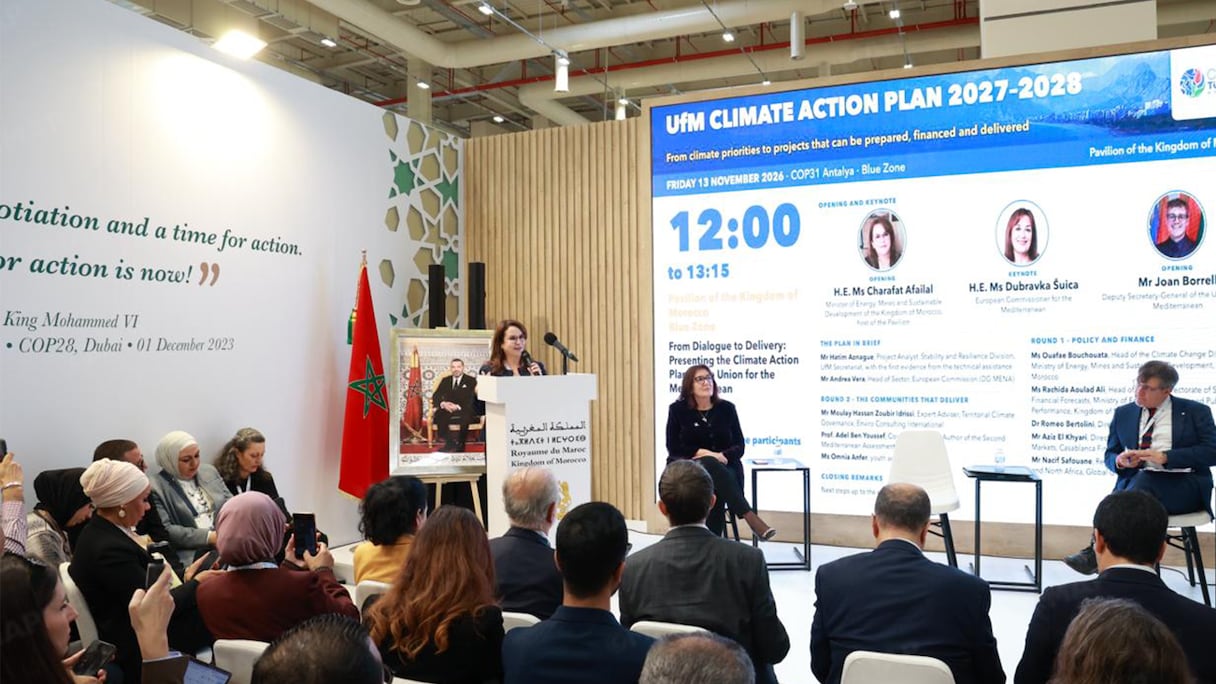
The Union for the Mediterranean (UfM) launched its 2027-2028 Climate Action Plan on Friday, November 13, during a meeting held at the Moroccan pavilion at the 31st Conference of the Parties to the United Nations Framework Convention on Climate Change (COP31), taking place in Antalya, Türkiye.
The launch was attended by Minister of Energy, Mines and Sustainable Development Charafat Afailal, European Commissioner for the Mediterranean Dubravka Šuica, UfM Deputy Secretary General Joan Borrell, as well as several Moroccan and international experts and researchers.
The plan is built around four integrated strategic priorities: strengthening climate ambition and accelerating the implementation of related commitments; improving adaptation capacities and resilience to climate risks; mobilizing climate finance and developing a portfolio of projects capable of attracting investment; and establishing the frameworks and mechanisms needed to create favorable conditions for achieving these priorities.
The initiative also aims to move beyond setting priorities and broad guidelines toward developing concrete projects based on scientific data and technical expertise, tailored to the specific needs of countries across the region. It also seeks to strengthen coordination between governments, financial institutions, scientific institutes and technical partners.
Read also : UN warns world is on track for 2.6°C of warming, but says action is still possible
Speaking at the meeting, Afailal reaffirmed Morocco’s readiness to contribute actively to collective efforts to implement the UfM Climate Action Plan. She stressed the need to translate its priorities into programs, investments and projects that deliver tangible results for people across the Mediterranean region.
She explained that achieving the plan’s objectives requires effective coordination between national priorities and opportunities at the regional level, as well as the mobilization of the partnerships and resources needed for its implementation.
The minister also stressed the importance of ensuring that the different stakeholders involved in climate action play complementary roles. Governments set strategic priorities, while financial institutions help mobilize the necessary resources. Cities, regions, researchers, businesses and young people also play an essential role in turning climate commitments into concrete action.
For his part, the UfM deputy secretary general said the ambitious plan was primarily intended to turn initiatives into concrete and visible results. He stressed the importance of pooling efforts and strengthening the exchange of experience and expertise to achieve satisfactory outcomes.
In a statement to Morocco’s state news agency MAP, Borrell emphasized the importance of making the most of COP31, which is being held for the first time in a coastal city, to accelerate the implementation of commitments and achieve urgent climate goals.
Held under the theme “From Dialogue to Implementation: Presenting the UfM Climate Action Plan,” the meeting provided an opportunity to present the plan’s main priorities. It is intended to turn climate priorities shared by countries across the region into operational projects that can be developed, financed and implemented, while strengthening regional cooperation in addressing the effects of climate change.
The event is part of broader efforts to strengthen joint climate action across the Mediterranean basin, as the region faces increasingly severe climate challenges and remains among the areas most vulnerable to the effects of global warming.
The UfM launched consultations on the development of the plan during the third Mediterranean Green Week, held last July, with the initial participation of eight member countries. Its design was intended to draw on a shared scientific foundation, in cooperation with the Mediterranean Experts on Climate and Environmental Change (MedECC) network.
