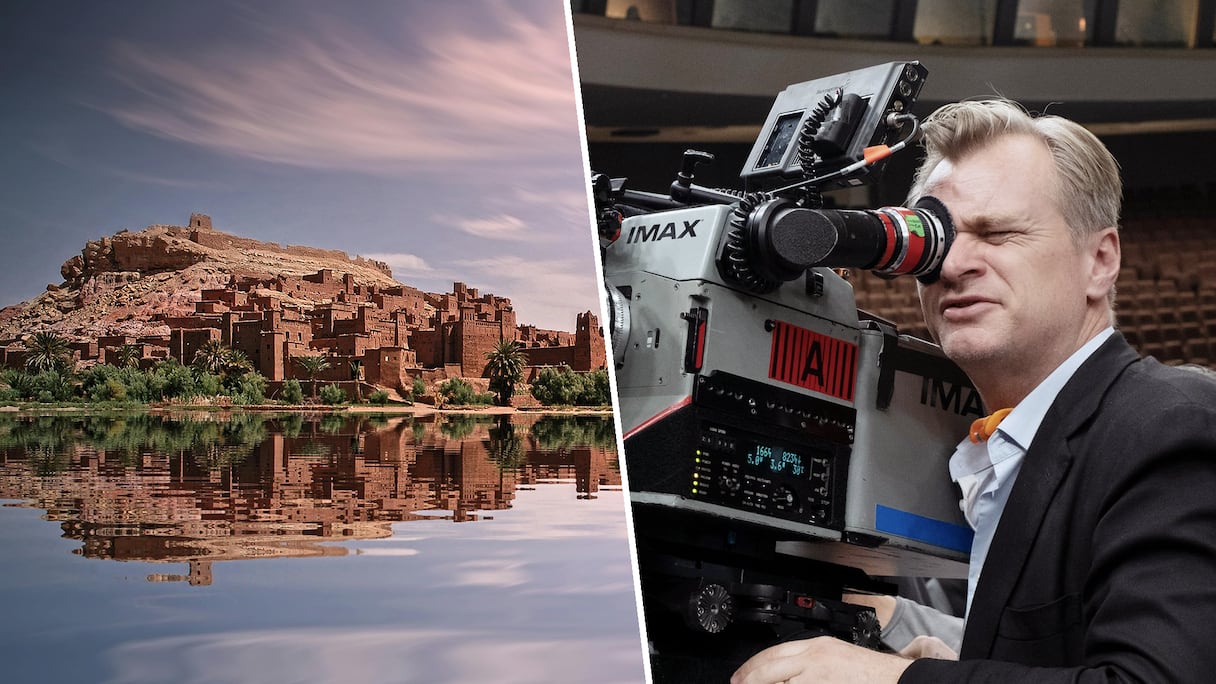
Following in the footsteps of Gladiator, The Mummy, Kingdom of Heaven, and Game of Thrones, Ouarzazate continues to attract Hollywood’s biggest filmmakers, adding new chapters to global cinema history.
The filming of The Odyssey, directed by British-American filmmaker Christopher Nolan, further solidifies Ouarzazate’s reputation as a premier destination for major international film productions. This strengthens the global standing of the “City of a Thousand and One Kasbahs" as a leading hub for the film industry.
For this latest adaptation of Homer’s epic, the historic Ksar of Aït Ben Haddou—an architectural landmark and UNESCO World Heritage Site since 1987—was chosen to portray the mythical city of Troy. This adds another cinematic milestone to the fortified village.
With its earthen walls, ancient alleyways, and towering kasbahs, Aït Ben Haddou provided an exceptional setting for what is considered one of Christopher Nolan’s most ambitious productions. Released on July 15, the film opened with a record-breaking global debut of $264 million in its first weekend. In just two weeks, it has surpassed $640 million in worldwide box office revenue, ranking among the year’s biggest successes.
Industry analysts now believe the film—parts of which were also shot in Essaouira, Marrakech, and Dakhla—could exceed the $1 billion mark at the global box office, driven by strong demand for IMAX 70mm screenings.
Read also : “The Odyssey” draws 40,000 moviegoers in Morocco during its first week
Christopher Nolan’s choice continues a long tradition that has made Ouarzazate and Aït Ben Haddou iconic locations in world cinema. Numerous major productions have been filmed there, helping to establish the region’s international reputation as the “Hollywood of Africa.”
Beyond its artistic and cinematic significance, the production also represents a significant economic opportunity for Ouarzazate and the surrounding region. Large-scale film shoots support a broad local ecosystem, including logistics, accommodation, catering, transport, handicrafts, and technical professions linked to the film industry.
For civil society activist Abdelmoula Amekassou, Ouarzazate’s cinematic reputation is not solely due to the beauty of its landscapes. Beyond its exceptional natural heritage, Morocco—and Ouarzazate in particular—has developed a highly skilled workforce and technical expertise that are now internationally recognized, along with a level of professionalism that meets the highest standards of the global film industry.
“These Moroccan talents have become a major asset for leading international production companies, which increasingly choose Morocco as a filming destination,” he told MAP.
He also recalled that actors Tom Holland and Matt Damon both praised the professionalism of Moroccan crews during their stay in Ouarzazate, noting that filming often involved nearly 1,000 people working with a high level of professionalism, from production teams to support staff.
Among the local professionals who contributed to the film is Zineb El Idrissi, whose work on the production reflects the quality of Moroccan expertise in the technical and artistic professions of cinema.
Read also : ‘The Odyssey,’ filmed partly in Morocco, opens to $264 million worldwide
Having worked in the costume department, she stated that Ouarzazate’s professionals are fully capable of meeting the demands of the world’s largest productions. She added that “the city’s reputation is built as much on the quality of its human resources as on the richness of its natural scenery.”
“Working on a production of this scale required strict discipline and great attention to detail. Every costume was carefully inspected and checked before appearing on screen,” she explained.
Ouarzazate continues to strengthen its position as a filmmaking destination, steadily consolidating its role as a leading audiovisual hub at both national and international levels.
Ouarzazate’s International Cinema City
To build on Ouarzazate’s reputation as a major filmmaking hub, construction has begun on the International Cinema City project. This large-scale initiative seeks to provide the city with integrated infrastructure designed to bolster its long-term appeal, enhance its human and technical capabilities, and offer national and international productions an ecosystem that adheres to the highest standards of the audiovisual industry.
Aziz Jilaou, Provincial Director of Culture for Ouarzazate-Zagora-Tinghir, underscored the efforts of the relevant authorities and their commitment to implementing policies that promote the creative and film industries, positioning cinema as a key driver of the region’s development.
He emphasized that the International Cinema City embodies an ambitious strategic vision to strengthen Ouarzazate’s status as Morocco’s cinema capital and a leading center for the film industry in Africa and the Mediterranean region.
The Minister of Youth, Culture and Communication recently officially launched the project’s construction. It aims to modernize the region’s film infrastructure while keeping pace with technological and artistic advancements in international film and television production.
Spanning 10.49 hectares, the future International Cinema City is a flagship project supported by a total investment of MAD 240 million, Jilaou noted.