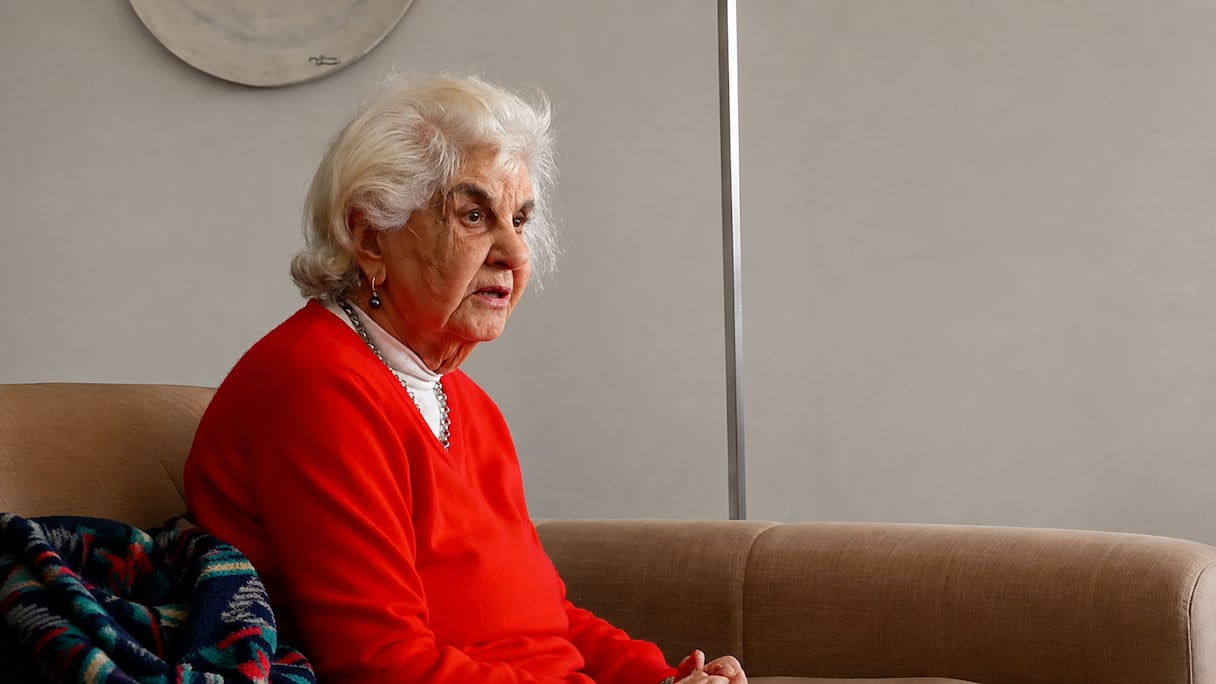
Leïla Faraoui, founder of Galerie Nadar and a pioneering figure in Morocco’s art market, died on the night of September 1, 2026, at the age of 86. Her death marks the passing of a gallerist who, for more than half a century, supported several generations of visual artists and helped bring some of the major names of modern and contemporary Moroccan art to prominence.
The story of Nadar began in Casablanca in July 1974. At the time, private galleries were still rare and Morocco’s art market was in its infancy. Faraoui took a chance on creating a space dedicated to a vibrant Moroccan artistic scene, particularly the artists associated with the Casablanca Art School. Over the decades, more than 100 artists would exhibit at Nadar, which would host more than 200 exhibitions and events.
Yet nothing had truly prepared Leïla Faraoui for a career as a gallerist. The wife of architect Abdesslam Faraoui, a graduate of the École Spéciale d’Architecture in Paris who had been authorized to practice in Morocco from 1961, she was immersed in a milieu where architecture and visual arts were engaged in a fruitful dialogue.
Read also : Mostafa Derkaoui, a pioneer of modern Moroccan cinema, dies at 82
Together with architect Patrice de Mazières, Abdesslam Faraoui worked with Mohammed Chabâa and Mohamed Melehi on projects integrating art into architecture. These exchanges brought Leïla Faraoui into direct contact with a generation of artists seeking to renew artistic forms and visual language in Morocco.
She initially considered going into publishing. Her close ties with Melehi and Chabâa eventually redirected her plans toward the visual arts. The premises she had available became a gallery, and Mohamed Melehi designed its visual identity: an eye placed above the “D” in Nadar, a name chosen in reference to an Arabic notion associated with sight and opinion.
Years later, she recalled with amusement how quickly she had to learn about this world: “I knew absolutely nothing about Moroccan painting. Gouache, watercolor, screen printing, oil painting, all of that was Chinese to me.”
A talent scout
What could have remained a personal venture quickly became a long-term commitment. Leïla Faraoui did not simply hang artworks; she fully embraced the role, still in its infancy in Morocco, of intermediary between artists, collectors and the public. She discovered, exhibited, supported and defended young creators, gradually helping to structure a market for Moroccan art.
Mohamed Kacimi, Mohamed Melehi, Mohammed Chabâa, Farid Belkahia, Malika Agueznay and Abderrahmane Rahoule were among the many artists whose works were presented at Nadar. The gallery also opened its doors early on to foreign artists and a wide range of media, from painting and sculpture to printmaking and ceramics, and later photography.
“This gesture may have seemed at the time like a risky personal venture. In reality, it was much more than that. It was an act of confidence in Moroccan artists,” art critic Kacem Gharba wrote in a tribute published after her death.
This confidence was precisely the common thread running through Leïla Faraoui’s career. At a time when the economic status of artists remained fragile and distribution channels were still poorly structured, she took the risk of betting on emerging artists rather than limiting her program to already established names.
“I wanted the artist to become sought after and recognized through my role as a skilled mediator. And that is what happened: those who made the history of contemporary art in Morocco passed through Galerie Nadar at the beginning of their careers,” she explained in 2007 to Tzveti Tocheva, an artist and visual arts teacher.
Visual artist Zine El Abidine El Amine also recalled her philosophy: “Leïla was a woman who gave an enormous amount to art and artists. She supported, defended and helped sustain artistic creation with passion and conviction. Behind her name are so many stories, encounters, memories and artistic journeys that she helped bring to the public’s attention.”
From gallery to the memory of Moroccan art
Later located on Al Manaziz Street in the Maârif district, Galerie Nadar went through different periods of activity and closure before continuing its story with a new generation of the Faraoui family. Its current historic address is 5 Al Manaziz Street in Casablanca.
But Leïla Faraoui’s legacy is not limited to a succession of exhibitions. Fifty years of activity produced a considerable collection of catalogs, photographs, correspondence, documents and artworks that trace, in fragments, the evolution of Morocco’s artistic scene.
It is this memory that her family has undertaken to preserve and document. Since 2023, her daughters Amina and Zineb, accompanied by her granddaughter Nihel, have taken up the torch, ushering Nadar into a new chapter of its history.
The work carried out on the family archives notably fed into the heritage exhibition “Impressions à Nadar,” presented in 2025 to mark the gallery’s 50th anniversary. Through artworks and archival documents, it traced five decades of artistic creation and highlighted Nadar’s importance in the history of contemporary Moroccan art.
This generational transmission extends the intuition behind the gallery’s creation: not simply to display artworks, but to support those who create them. “My grandmother was committed to introducing young artists to the public and helping them grow. Some made it, others less so. But she always gave many of them a chance,” Nihel told Le360 on the occasion of Nadar’s 50th anniversary.
Read also : Moroccan writer, poet and critic Mohamed Serghini dies at 96
For Kacem Gharba, this may be where the gallerist’s most tangible legacy lies: “Perhaps the most beautiful part of this story is that this memory did not end with Leïla. It was passed on. Her daughters took up the torch. Then a new generation became involved in preserving and researching Nadar’s archives.”
More than 50 years after Nadar opened its doors, Leïla Faraoui’s gamble lives on. It was a gamble on believing in Moroccan artists before the market recognized them, giving them gallery walls when there were few available to them and, above all, turning the gallery into a place of discovery, transmission and memory.
