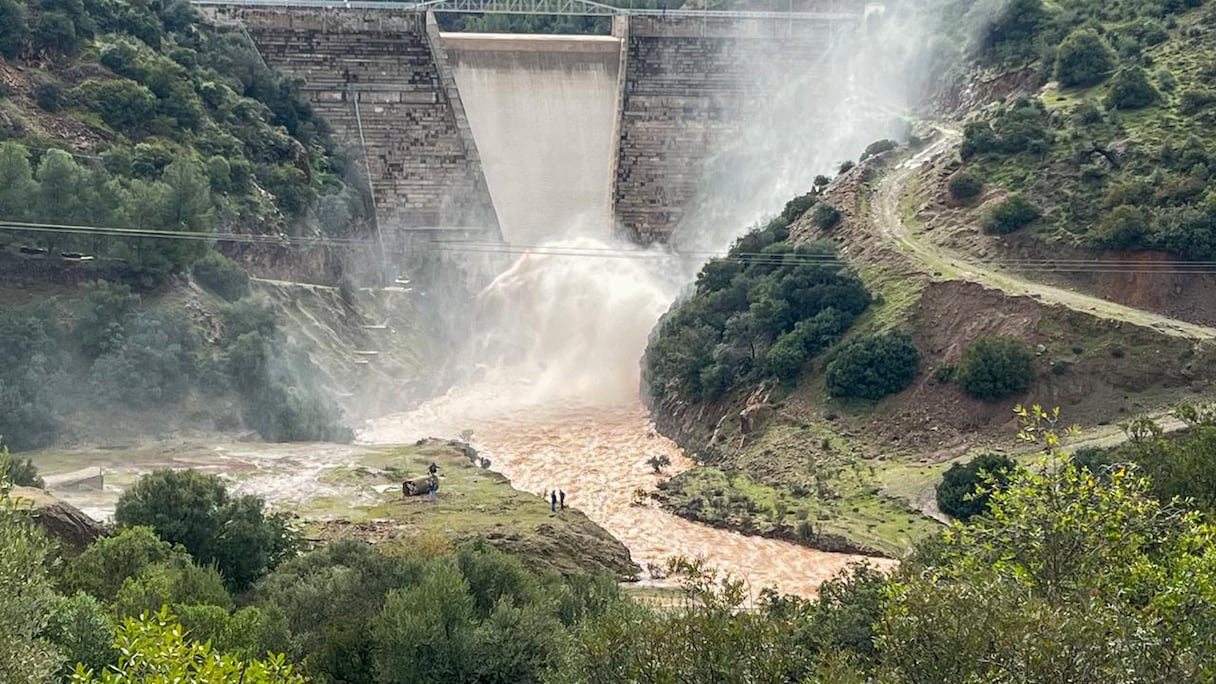
After an exceptional rainy season that brought around 3.8 billion cubic meters of water into Al Wahda Dam, equivalent to 169% of the average in a normal year, the reservoir is entering the new rainy season with more than 2.82 billion cubic meters currently in storage, or more than 82% of its capacity. Managing incoming water and maintaining a safety margin in the reservoir are therefore among the main priorities as rainfall approaches.
Preparations for the next rainy season involve continuous monitoring of the dam, including daily tracking of reservoir levels and water inflows, as well as regular inspections and maintenance of its various facilities. Water releases may also be carried out depending on inflows and water levels, allowing operators to maintain a safety margin and anticipate any sharp increase in incoming water.
In this context, Mustapha Tantawi, director of Al Wahda Dam, told Le360 that the reservoir currently holds more than 2.82 billion cubic meters of water, with a filling rate of over 82%. He said the dam releases around 3 million cubic meters of water every day to meet irrigation needs downstream of the Ouergha River and in the Gharb plain. The same volume is also used to generate electricity.
Preparations are not limited to monitoring water levels and expected inflows. They also include updating data on the reservoir’s storage capacity through bathymetric surveys, which measure the depths and areas of different parts of the reservoir and assess the shape of its bed and the volume of accumulated sediment and silt. The results are then compared with previous data to update elevation-area-volume curves. This makes it possible to determine the reservoir’s actual available storage capacity and provide technical teams with accurate data to help manage future inflows.


With more than 2.82 billion cubic meters in storage, how Morocco’s largest dam is being managed ahead of the next rainy season.
According to the official, this process is particularly important for Al Wahda Dam given the size of its reservoir and the length of time it has been in operation. The accumulation of sediment and silt on the reservoir floor gradually reduces the space available for storing water, making regular updates on its actual capacity an important part of proactive water-resource management, especially ahead of a new rainy season.
These preparations come after an exceptional season during which Al Wahda Dam received around 4 billion cubic meters of water, equivalent to 169% of the average in a normal year. This required careful management of the reservoir and continuous monitoring of water levels, along with releases when necessary, to maintain a safety margin and make room for new inflows.
As part of this proactive approach, the agencies responsible for managing Morocco’s water basins are moving to update storage-capacity data for 10 major dams: Oued El Makhazine, Idriss I, Nakhla, Al Wahda, Mansour Eddahbi, Ghiss, Mohammed V, Oued Za, Mechraa Hammadi and Hassan Addakhil. The aim is to more accurately assess the amount of accumulated sediment and determine each reservoir’s actual capacity to accommodate incoming water during the coming seasons.
