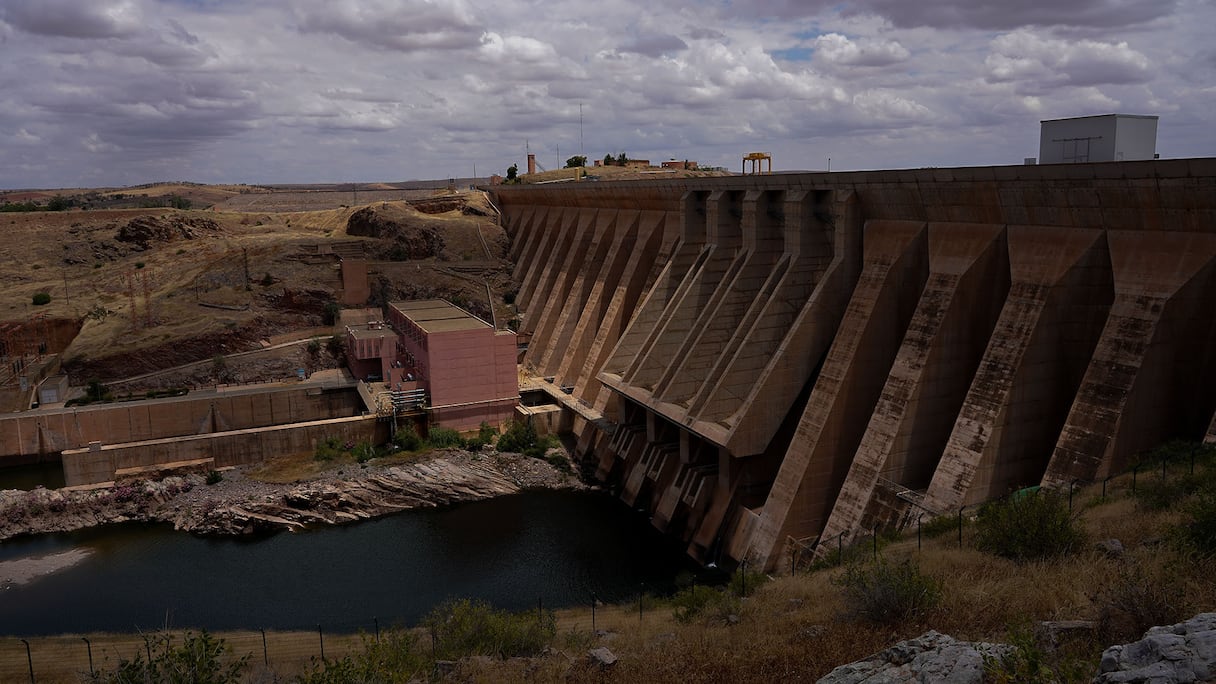
For nearly half a century, Morocco has prioritized dams as part of its water policy. According to the Ministry of Equipment and Water, the country’s total dam storage capacity has grown from 9.5 billion cubic meters in 1979 to 20.8 billion cubic meters in 2025.
It reached 9.8 billion cubic meters in 1985, 10 billion in 1990, and 11 billion in 1995. The pace of development then accelerated. By 2004, storage capacity had reached 16.2 billion cubic meters, over 5 billion more than less than a decade earlier. It rose to 17.7 billion cubic meters in 2014 and to 18.6 billion cubic meters in 2020.
The increase has continued in recent years. Mobilizable water storage reached 19.9 billion cubic meters in 2022, 20 billion in 2024, and 20.8 billion in 2025.
The number of dams has also grown steadily. Morocco had 26 dams in 1979, 39 in 1985, 68 in 1990, and 89 in 1995. It surpassed 100 in the early 2000s, reaching 115 in 2004, 139 in 2014, 145 in 2020, 152 in 2022, and 154 in 2024. The national network now totals 156 dams.
Another 42 major dams are planned in Morocco by 2050. This program includes raising the height of the Mohammed V Dam in the Oriental region, the Mokhtar Soussi Dam in Taroudant, and rebuilding the Sakia El Hamra Dam in Laayoune.
Alongside these major projects, Morocco is diversifying its water resources in response to recurring drought cycles by investing in seawater desalination and water transfer pipelines. Four medium-sized dams are under construction: Tassa Ouirgane, Msalit, Ain Ksob, and Sidi Yakoub.
The program also includes smaller infrastructure projects. The program for 155 small dams, which runs from 2022 to 2027, is progressing on several fronts. Twelve have already been completed, 45 are under construction, and 30 more are scheduled for completion in 2026. Additionally, 68 more are being studied for construction in 2027.
