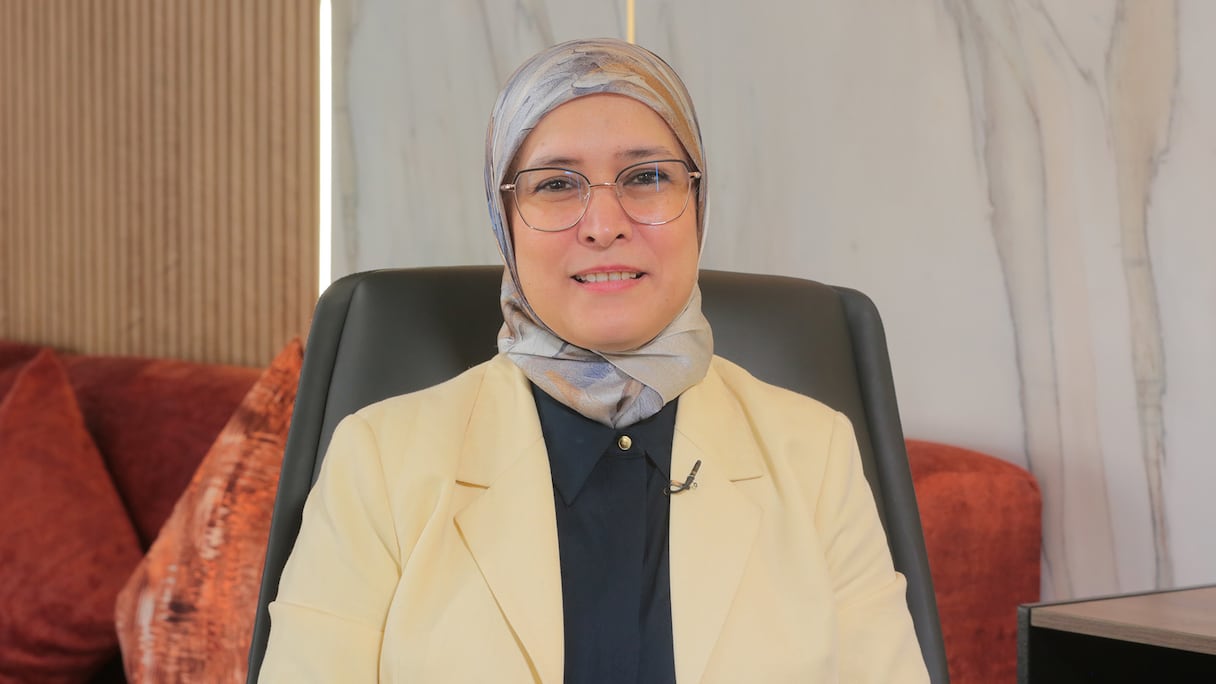
Manal Badil, president of the Berrechid Municipal Council, outlined the projects undertaken by the municipality to improve the city’s infrastructure and enhance its attractiveness in an interview with Le360.
According to the elected official, the problem of water cuts is not new. She pointed to joint efforts with the Casablanca-Settat Regional Multiservice Company (SRM) to address the issue.
The partnership aims to equip the city with high-capacity storage reservoirs, she explained, adding that work is also underway to renew the drinking water connection network. Combined, these two measures are expected to provide what the council president described as a “radical solution” to the recurring water cuts.
Regarding wastewater management, another contentious issue in Berrechid, Badil said coordinated efforts with the SRM are underway to strengthen the network and pipelines following the launch of a 70-million-dirham contract dedicated to the sector. The company is also currently renewing the main pumping network at a cost of 10 million dirhams, she added.
On road infrastructure, the official said the municipal council had launched a study for the rehabilitation and redevelopment of Brahim Roudani Street over a distance of 2.5 kilometers, at a cost of 10 million dirhams.
She also reported ongoing maintenance and rehabilitation work on a number of main streets, roads, neighborhoods and alleyways following the launch of two contracts with a combined value of 1.44 million dirhams. A third contract is being prepared to improve roads in neighborhoods not covered by the first two.
The municipal council has also completed the technical studies for the second phase of a project to upgrade the city’s entrances, covering four main entry routes, according to the council president. These include the roads to Bouskoura, Mediouna, Oulad Saïd and Kaâria, with a budget of 70 million dirhams.
As for roads serving rural villages, she announced a project covering 6.8 kilometers at a cost of 5 million dirhams. With the study phase now complete, the project is moving into the tendering phase.
Badil stressed the importance of the project in opening up a number of rural villages, saying it would be carried out in coordination between the Berrechid Provincial Council and the Casablanca-Settat Regional Council.
She also announced the launch of geotechnical studies for the construction of a bridge on Abdellah El Kadiri Street, at a cost of 40 million dirhams. The project is intended to improve access to the western part of the city, according to Badil.
Public lighting: Expanding LED coverage
On public lighting, Badil said it was a key pillar of the city’s infrastructure. Despite the difficulties facing the sector, she said significant financial resources had been mobilized, with funding doubled from 1 million to 2 million dirhams. According to her, the measure will provide an important boost to the sector and contribute to its development across the city.
The municipal official said conventional streetlights had been replaced with LED lighting because of its energy efficiency, lower electricity consumption and the savings it generates for the municipality.
She added that a program to extend LED coverage across the entire city had been launched. Several neighborhoods have already benefited from the replacement of 422 lights, while a new contract has been launched to acquire a further 450 units, with the aim of expanding coverage citywide in the near future.
Read also : Morocco lost 1.2 billion cubic meters of dam water in three months, but remain twice 2025 levels
Badil said all these projects would help strengthen the city’s attractiveness by consolidating Berrechid’s position as an emerging and competitive urban hub while preparing for the demands of urban expansion and the city’s economic growth.
Regarding urban transport, the municipal council president said the project to introduce buses in the city had reached an advanced stage. She explained that the first phase of the studies had determined the number of buses to be put into service, with 19 buses planned in total.
The next stage, she said, will involve a series of in-depth consultations with the relevant ministry to finalize operational details, select the precise locations of bus stops and determine the site of the bus depot.
According to the official, this phase will also cover the administrative organization of the project through the completion of all technical and organizational requirements needed for its effective launch. It will take into account the city’s geographical and social characteristics and the expectations of local residents while ensuring the efficiency, safety and quality of the service.
Badil said the strategic project aims to establish a modern transport service capable of meeting the needs created by the city’s population growth and rapid development. She added that urban transport would be an important driver of local development by improving mobility, providing practical and efficient solutions for residents’ daily travel within the city, and helping improve living conditions and quality of life through a safe transport service.
From the RNI to the PAM: An openly embraced political transition
Badil also addressed the controversy surrounding her departure from the National Rally of Independents (RNI) to join the Authenticity and Modernity Party (PAM).
According to her, the decision is part of “the continuity of a coherent political journey, guided by personal convictions and the constant search for the path best suited to serving Berrechid and its province.”
Read also : Have Morocco’s largest dams withstood this summer’s heatwave? Here’s what the latest data show
She said her decision to run under the PAM banner in the upcoming parliamentary elections “was not born out of a moment or a hasty and improvised decision, but is the result of deep reflection and a mature reading of the political landscape.”
She argued that “serving the public interest requires a coherent political environment,” a condition that had become, according to her, “impossible and nonexistent” within the RNI.
“The PAM has offered me a genuine space to express my convictions, and its program fully aligns with my priorities for local governance,” she concluded.