Morocco has moved ahead of South Africa to rank fourth among Africa’s most attractive investment destinations in the latest Where to Invest in Africa report by Rand Merchant Bank (RMB), a subsidiary of South Africa’s FirstRand Group. The findings were reported by Bloomberg.
In its report published on Tuesday, October 27, RMB attributed Morocco’s rise to years of industrialization, a more diversified export base and sustained infrastructure investment, according to Bloomberg. The country has emerged as one of Africa’s leading manufacturing hubs, particularly through the expansion of its automotive industry, while maintaining macroeconomic stability and attracting substantial foreign direct investment.
The automotive sector offers perhaps the clearest illustration of that transformation. In 2024, Morocco became Africa’s largest vehicle producer for the first time, manufacturing nearly 614,000 vehicles compared with approximately 591,000 in South Africa, according to figures attributed to Fitch Solutions.
The shift is the result of an industrial strategy pursued over more than 15 years. Morocco has built an automotive manufacturing ecosystem around two major carmakers—Renault, with operations in Casablanca and Tangier, and Stellantis in Kenitra—supported by a network of suppliers producing wiring systems, mechanical components, engines and interior equipment. Expansion plans by both manufacturers, alongside projects linked to vehicle electrification, are expected to provide further opportunities for growth.
Morocco leads in vehicle exports
South Africa’s automotive industry, by contrast, faces persistent logistical difficulties, particularly at ports and across the rail freight network, as well as growing competition from imported vehicles. These pressures have weighed on the competitiveness of its manufacturing base.
Morocco’s lead is also evident in export figures. In 2025, it shipped 454,443 vehicles abroad, compared with South Africa’s 414,271. The two countries remained Africa’s leading vehicle exporters, accounting for 52.31% and 47.69%, respectively, of their combined export volumes.
Morocco exported 90.53% of the vehicles it produced, compared with 67.02% for South Africa. Its automotive industry is therefore heavily geared towards overseas markets, particularly Europe, which accounts for approximately 80% of Moroccan vehicle shipments.
Moroccan-made vehicles are sold in more than 70 countries. Models manufactured locally include the Dacia Sandero and Logan, Renault Kardian, Peugeot 208 and the small electric Citroën Ami and Opel Rocks-e.
This export-oriented model has helped Morocco diversify its international markets.
Read also : How Morocco attracted over $70 million in private investment for startups
Automotive manufacturing is Morocco’s largest export industry. In 2025, overseas sales reached MAD 154.4 billion, accounting for 32.94% of the country’s total exports of MAD 469.07 billion.
The sector ranked ahead of phosphates and derivatives, which generated MAD 99.8 billion in exports, and the food processing industry, at MAD 86.83 billion.
The breakdown of automotive exports highlights the breadth of Morocco’s manufacturing base. Finished vehicles accounted for MAD 61.3 billion, while wiring systems generated MAD 57.8 billion. Powertrain systems and engine components contributed MAD 25.8 billion, with interior equipment and seating accounting for another MAD 9.6 billion.
This diversity sets Morocco’s automotive industry apart from a model based solely on final vehicle assembly. It gives component manufacturers a greater role in the value chain and supports deeper integration across the country’s industrial base.
Several structural advantages underpin this growth. Morocco’s proximity to the European Union, its free trade agreements with numerous partners and its logistics infrastructure have made the country an attractive location for carmakers and automotive suppliers.
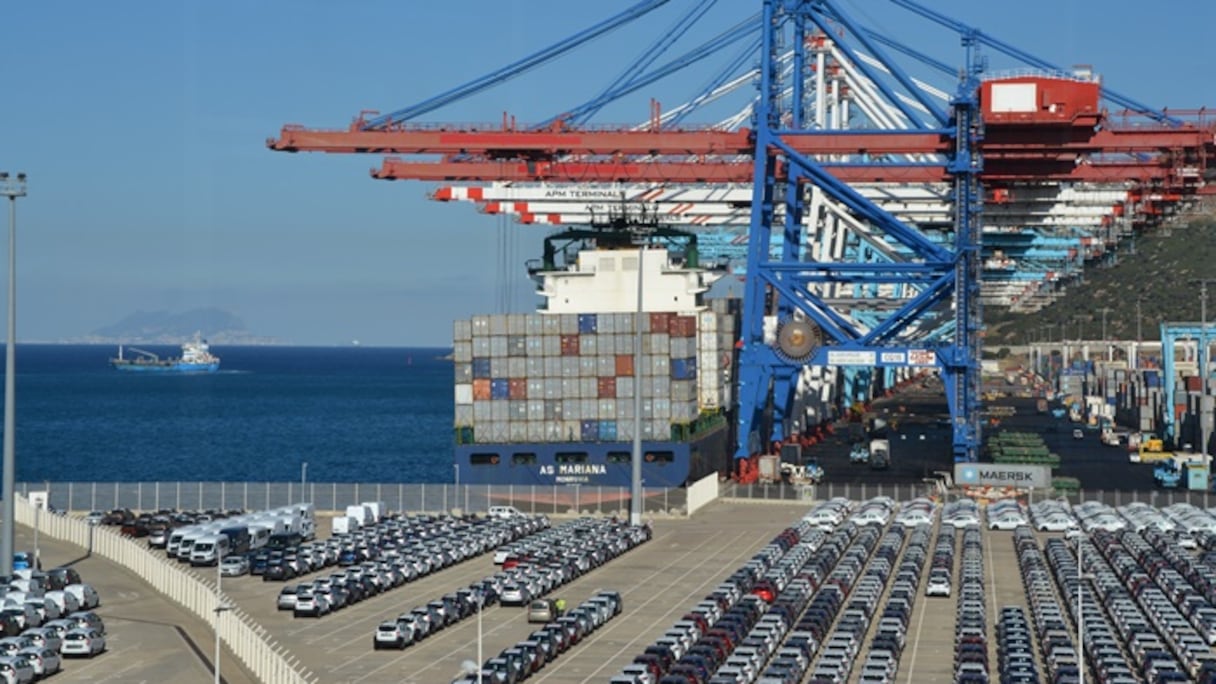
Tanger Med port plays a central role in this network. In 2025, its two dedicated vehicle terminals handled 327,569 Renault vehicles and 126,874 Stellantis vehicles.
Automotive exports rebound in 2026
Investment incentives and a stable industrial environment add to those advantages. Expanding electric vehicle production capacity has also become a strategic priority as manufacturers accelerate the transition towards electrified model ranges.
After Moroccan vehicle exports declined in 2025, amid sluggish global demand and technical problems at Stellantis, figures for the first eight months of 2026 point to a recovery.
By the end of August 2026, automotive exports had risen 14.5% to MAD 116.14 billion, driven mainly by stronger sales in vehicle manufacturing, up 19%; wiring systems, up 13.9%; and exterior components, up 43.6%.
The recovery comes as Morocco has installed production capacity of approximately one million vehicles a year and developed an industrial ecosystem spanning vehicle manufacturing, wiring systems, mechanical components and interior equipment.
RMB’s ranking underscores the role this industrial transformation has played in strengthening Morocco’s appeal to investors. Maintaining that position will depend on the country’s ability to build on its achievements, manage the transition to electric vehicles and keep its exports competitive in international markets.
