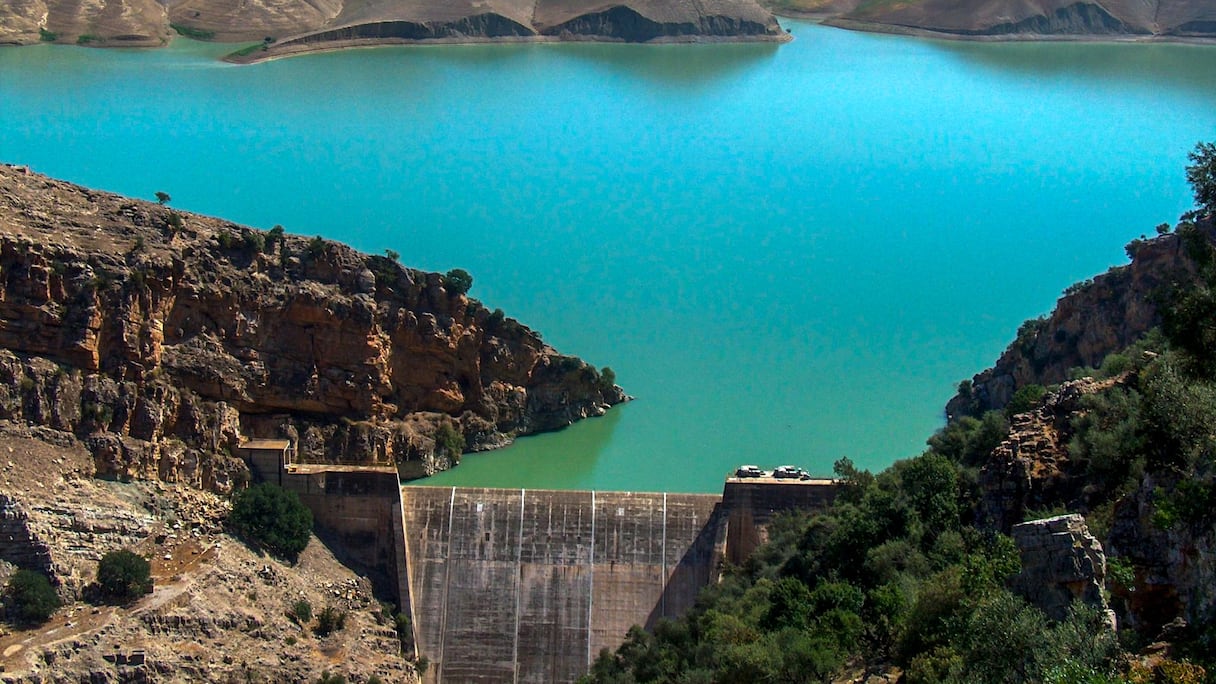
According to the latest official data published on Monday, July 13, 2026, by the Ministry of Equipment and Water’s “Maa Dialna” platform, Morocco’s dams currently hold around 12.29 billion cubic meters of water, representing a fill rate of 72.1%. By comparison, reservoirs contained just 6.2 billion cubic meters during the same period in 2025, when the fill rate stood at only 37%, marking an increase of nearly 98% in national water reserves.
The figures underscore the dramatic improvement in the country’s water situation over the past year, following several consecutive drought seasons that had severely affected dam storage levels and water-dependent economic and social sectors.
The Sebou basin remains Morocco’s most water-rich region, with reserves reaching about 4.58 billion cubic meters and a fill rate of 85.2%. The Al Wahda dam alone accounts for more than 3 billion cubic meters, with reservoirs 88% full. Several other dams in the basin—including Allal El Fassi, Sahla, Bab Louta, and Mdez—have exceeded 90% capacity.
The Oum Er-Rbia basin, Morocco’s largest water reservoir, currently stores nearly 3.16 billion cubic meters, with a fill rate of 63.2%. Several major dams in the basin have posted comfortable levels, including Bin El Ouidane at 89%, Ahmed El Hansali at 83%, and Hassan I at 96%. Al Massira, one of the country’s most important dams, stands at 42% capacity, with reserves exceeding 1.11 billion cubic meters.
According to the same source, the Loukkos basin continues to rank among Morocco’s most water-abundant regions, with reservoirs 85.9% full and total reserves of 1.68 billion cubic meters. Several dams—including Dar Khrofa, Cherif Al Idrissi, Smir, Tangier Med, and Kharroub—have surpassed the 90% mark.
The Bouregreg basin has also recorded positive results, with a fill rate of 84.5% and reserves approaching 1.25 billion cubic meters. Meanwhile, the Tensift basin has reached 89.3% capacity—one of the highest rates nationwide—strengthening water supplies for both households and agriculture.
In eastern Morocco, the Moulouya basin holds approximately 427.3 million cubic meters of water, corresponding to a fill rate of 60.9%. The basin has benefited from the Ali Ouad Za dam reaching full capacity, while the Safsif dam is nearly 98% full. Fill rates at the Hassan II and Mohammed V dams stand at 58% and 33%, respectively.
Further south and southeast, some regions continue to face relative water stress despite marked improvements compared with previous years. The Guir-Ziz-Ghris basin is 43.5% full, with reserves of nearly 238.5 million cubic meters, while the Drâa-Oued Noun basin stands at 37.9%, storing around 398 million cubic meters. The Souss-Massa basin has reached a fill rate of 51.6%, with reserves exceeding 373 million cubic meters. Several dams in the region, including Moulay Abdellah and Aoulouz, have performed particularly well, reaching 91% and 76% capacity, respectively.
According to experts, these indicators show that Morocco is entering the second half of summer in a far stronger water position than last year, providing greater flexibility to manage demand in the coming months. At the same time, they stress the need to rationalize consumption and preserve water resources amid the growing challenges posed by climate change and increasingly frequent droughts across the region.
