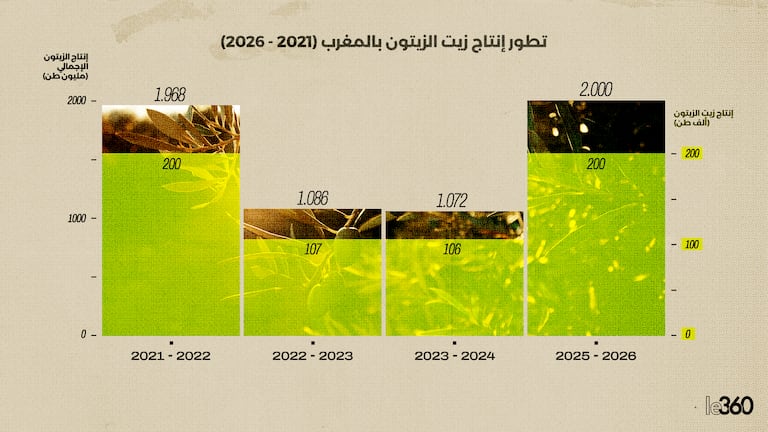
Morocco’s olive harvest is expected to reach nearly 2 million tonnes in the 2025-2026 agricultural season, an increase of around 111% compared with the previous season.
However, this rise in production runs up against structural challenges in the country’s olive-processing industry, particularly the way olives are processed and the balance between traditional and modern mills.
Around 67% of the harvest is sent to crushing facilities. Official figures point to a significant gap between a modern, organized sector seeking to establish a stronger position on international markets and the widespread use of traditional mills, which directly affects quality standards and contributes to higher acidity levels.
948 modern mills alongside 11,000 traditional units
Figures from the food-processing industry show a significant imbalance in Morocco’s olive-processing infrastructure. The country has around 948 modern and semi-modern mills, with a combined annual processing capacity of nearly 1.8 million tons of olives.
Alongside these facilities, nearly 11,000 traditional mills continue to operate in rural areas and smaller towns. They process substantial quantities of olives supplied by small-scale farmers, often outside strict monitoring systems.
The Fès-Meknès region accounts for around 62% of Morocco’s total olive-processing and valorization capacity, followed by Marrakech-Safi with nearly 16%. The remaining capacity is distributed across the Tangier-Tetouan-Al Hoceima, Oriental and Béni Mellal-Khénifra regions.
Extra virgin olive oil accounts for just 10% to 15% of production
The predominance of traditional mills has a direct impact on the quality classification of the finished product. The Ministry of Agriculture expects olive oil production to reach around 200,000 tons, an increase of 105%, but high-quality oil remains a small share of the total.
According to figures from the sector’s professional federation, extra virgin olive oil accounts for only 10% to 15% of national production. This limits Morocco’s ability to sell more of its output in higher-priced segments of international markets.
Virgin olive oil represents between 25% and 35% of production, while ordinary olive oils account for 20% to 25%. The most concerning figure is the share of lampante olive oil, which ranges from 25% to 40%. This category is not suitable for direct consumption and must be refined because of its poor quality and acidity levels that exceed accepted standards.
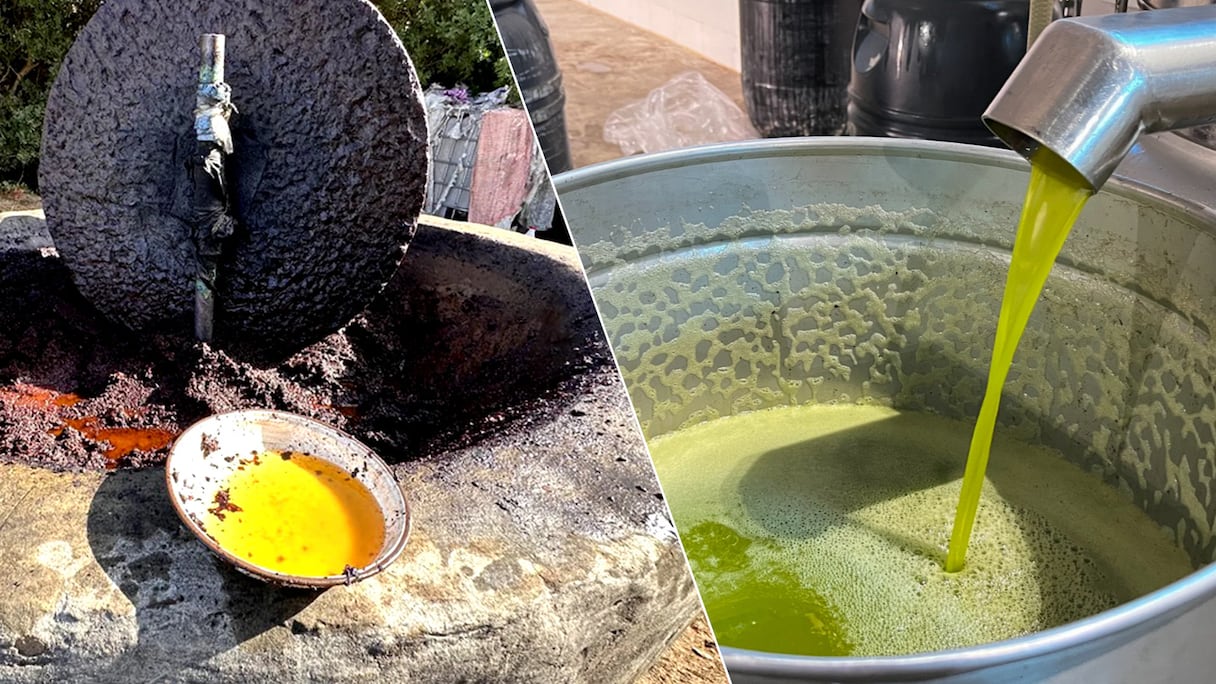
These quality problems are directly linked to working conditions at traditional mills. Olives are often piled up and stored for long periods in plastic bags before crushing, encouraging fermentation and damaging the taste of the resulting oil. Inadequate temperature control during pressing and the use of exposed equipment can also lead to oxidation of the oil.
Modern mills, by contrast, use automated, enclosed centrifugation systems designed to preserve the oil’s natural components and authentic flavor.
Morocco targets higher-value olive oil exports by 2030
The figures underline the need to upgrade the country’s olive-processing sector, particularly as the domestic market absorbs between 84% and 85% of national olive oil production. Exports remain modest. In 2024, Morocco exported 8,593 tons of virgin olive oil, worth around $79.7 million.
The contract-program running through 2030 aims to address these structural weaknesses through investments totaling nearly 16.9 billion dirhams, including 8.3 billion dirhams in public support. Its targets include increasing olive production to 3.5 million tons and raising exports of olive oil and olive pomace oil to 100,000 tons.
According to industry professionals, achieving these goals will depend on curbing unregulated activity among traditional mills and encouraging producers to send their harvests to modern facilities. The challenge is to turn the sharp rise in olive production into genuine added value and strengthen the position of Moroccan olive oil in global markets.
