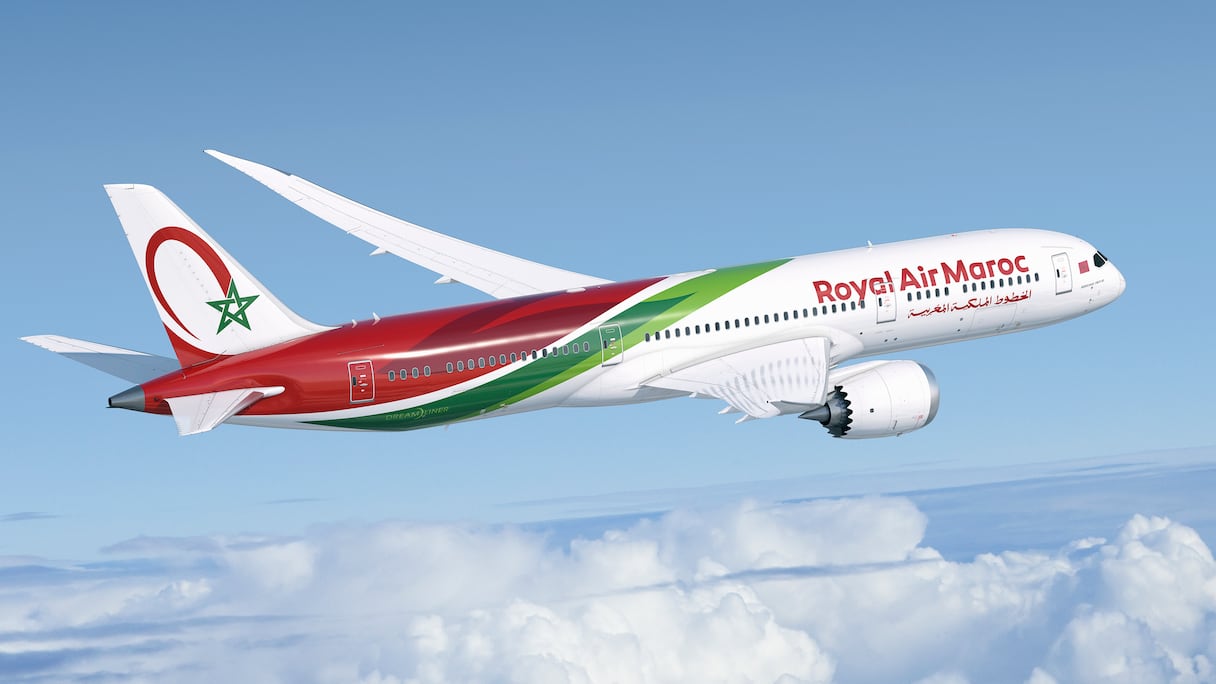
On July 23, Michael Achimugu, Director of Public Affairs and Consumer Protection at Nigeria’s Civil Aviation Authority (NCAA), published a sharply worded post on X announcing his intention to recommend the suspension of Royal Air Maroc’s (RAM) operations in Nigeria. He accused the airline of repeatedly violating passenger rights and failing to cooperate with regulators despite having already been sanctioned.
“My department will be taking a very firm stand over this matter, and Royal Air Maroc will stop taking for granted, the relationship Morocco has enjoyed with Nigeria and Nigerians,” Achimugu wrote.
He also listed three airlines that passengers could use instead of RAM: EgyptAir, Ethiopian Airlines and Air Algérie.
That final recommendation has prompted questions. Royal Air Maroc currently operates three daily flights between Morocco and Nigeria—two to Abuja and one to Lagos—with Nigerian travelers accounting for the bulk of its passenger traffic. Air Algérie, by contrast, has a much smaller presence on the route.
The issue is examined in a note published by the Moroccan think tank Institut Géopolitique Horizons, titled "Why Air Algérie? The Detail That Raises Questions in Nigeria’s Offensive Against Royal Air Maroc."
The dispute between the NCAA and Royal Air Maroc predates the latest exchange.
Since 2025, the Moroccan carrier has been among the airlines sanctioned by Nigeria’s aviation regulator over consumer protection violations, including delayed notification of passengers about mishandled baggage, compensation deemed insufficient for affected travelers and complaint handling that often occurred only after NCAA intervention.
Achimugu argues that those shortcomings have persisted despite previous penalties and says his department will recommend suspending the airline’s operations in Nigeria.
According to Institut Géopolitique Horizons, the tone of the statement is as noteworthy as its content.
The Nigerian official publicly named RAM’s country manager, Ahmed Boussouf, alleging that he responded, “Whatever you want to do, do” during an exchange with regulators. He also suggested the airline should not take Morocco’s close relationship with Nigeria for granted.
The think tank notes, however, that this confrontational communication strategy is not unprecedented. As early as September 2025, the NCAA openly embraced a policy of publicly identifying airlines that violated consumer protection rules, describing it as part of a broader directive from Nigeria’s federal government.
“That precedent puts the language used into perspective,” the report says. “What is new, however, is the degree of personalization, with a specific executive named and what was presented as a private exchange made public—an intensity absent from Achimugu’s previous statements, which focused on airlines as corporate entities.“
Why Mention Air Algérie?
The analysis devotes particular attention to the three airlines cited as alternatives to Royal Air Maroc.
EgyptAir and Ethiopian Airlines are viewed as logical choices given their extensive African networks and strong presence in Nigeria.
Air Algérie, however, stands out.
The Algerian carrier launched a direct Algiers-Abuja service in April 2025, but it operates only about one flight a week—far fewer than Royal Air Maroc’s services linking Casablanca with Abuja and Lagos.
As the report notes, Air Algérie “does not offer the same network density or service frequency to Nigeria as Royal Air Maroc.”
If the objective was simply to demonstrate that passengers had alternative travel options, the think tank asks, why highlight an airline whose capacity to replace RAM’s services is significantly more limited than that of EgyptAir or Ethiopian Airlines?
The report offers one possible explanation.
Achimugu personally represented the NCAA’s Director General at the inauguration of the Algiers-Abuja route in April 2025.
“He therefore has first-hand knowledge of Air Algérie’s presence in Nigeria, which provides a plausible operational explanation for mentioning the airline,” the report states. “But that familiarity does not fully answer the question. It explains why the airline came to mind, not necessarily why it was invoked in such a personalized attack against a Moroccan carrier.”
A Geopolitical Dimension?
The think tank cautions against conflating observation with speculation.
The reference to Air Algérie, it says, “does not in itself constitute evidence of coordination with Algiers.”
At the same time, it argues that the mention “cannot be entirely separated from the broader context of the structural rivalry between Rabat and Algiers, in which publicly presenting an Algerian airline as a substitute for a Moroccan one inevitably carries significance beyond the regulatory sphere.”
The report also notes that Achimugu’s post was published just four days after West African leaders signed the Intergovernmental Agreement for the African Atlantic Gas Pipeline (AAGP) in Freetown on July 19, 2026—a flagship project jointly championed by Morocco and Nigeria.
Even so, the analysis rejects any suggestion of a direct connection.
“The temporal proximity alone is insufficient to establish causality. The timeline of the NCAA-RAM dispute is, by itself, enough to explain the timing of the statement,” it says.
Ultimately, the report concludes that while the explicit reference to Air Algérie may carry contextual significance against the backdrop of Moroccan-Algerian rivalry, there is no evidence that Algeria played any role in the episode.
The real question is not whether Air Algérie is behind this affair—there is no evidence to support such a claim—but rather why it was chosen as a point of reference by an official with first-hand knowledge of the airline’s recent expansion into Nigeria.
“The real issue is understanding why this airline, whose service offering remains objectively more limited than Royal Air Maroc’s, was explicitly cited in such a highly personalized public statement,” the think tank concludes.
