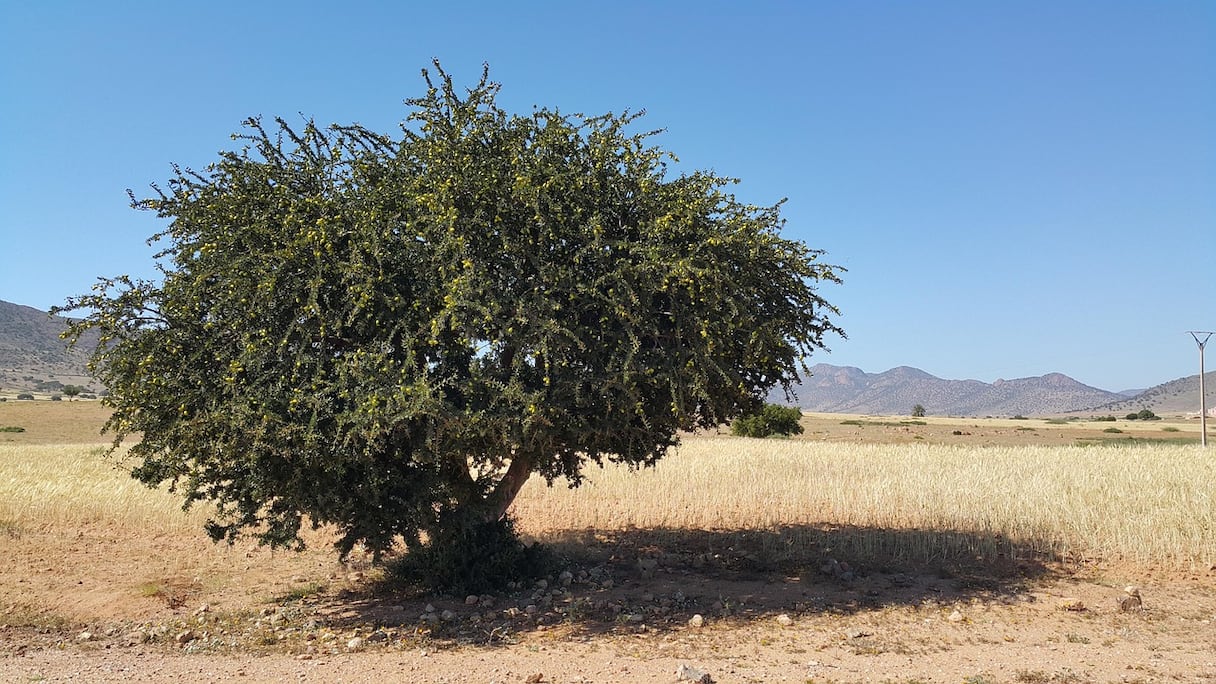
Women’s cooperatives in Tiznit and Essaouira are turning to new argan planting and drought-adapted crops as successive dry years and rising raw-material costs put increasing pressure on their livelihoods.
The “Argan Ambassador” project has begun in Igherm and Arbaa Sahel in Tiznit province and Smimou in Essaouira province, according to Jamila Idborrous, director of the Tisalouine Argan Women’s Cooperatives Union.
European partners are expected to participate in the initiative, which combines large-scale argan planting with medicinal and aromatic plants suited to local conditions.
Cactus, capers and rosemary are among the crops being introduced, alongside support for beekeeping.
For the cooperatives, many of which bring together women from rural villages, the project is as much about securing income as protecting the argan tree.
Idborrous told Le360 that successive years of drought and rising raw-material prices have placed the sector under increasing strain.
Planting argan trees directly on land belonging to local cooperatives, coupled with adequate irrigation, could give communities a more direct share of the income generated by the tree, she said.
The union also hopes that creating more stable local income could help families remain in their villages while increasing supplies of argan oil and other products for domestic and export markets.
Expansion planned if pilot succeeds
The first phase covers Igherm, Oulad Jerrar and Arbaa Sahel, as well as Smimou in Essaouira province.
If it proves successful, Idborrous said the union plans to extend the model to other provinces across Guelmim-Oued Noun, Souss-Massa and Marrakech-Safi.
For women involved in the participating cooperatives, that could mean a new source of income on land already under their control.
Halima Rachid, a representative of one of the cooperatives, said planting on cooperative land could provide rural women facing unemployment with more stable earnings while encouraging greater self-reliance.
British supporter Abi Wixson also said she was prepared to work with the Tisalouine union to support participating cooperatives and efforts to preserve the argan tree.
She pointed to demand for argan products across both the food and cosmetics sectors.
Water becomes central to argan survival
Agricultural engineer Tariq Mohamed Amine said repeated droughts have made water management increasingly important to efforts to protect and expand argan planting.
The priority, he said, is to prevent the tree from disappearing, support communities protecting it, and expand planting using efficient irrigation methods that conserve water.
He also called for greater awareness of the importance of the argan tree and stronger protection against practices that contribute to its uprooting.
