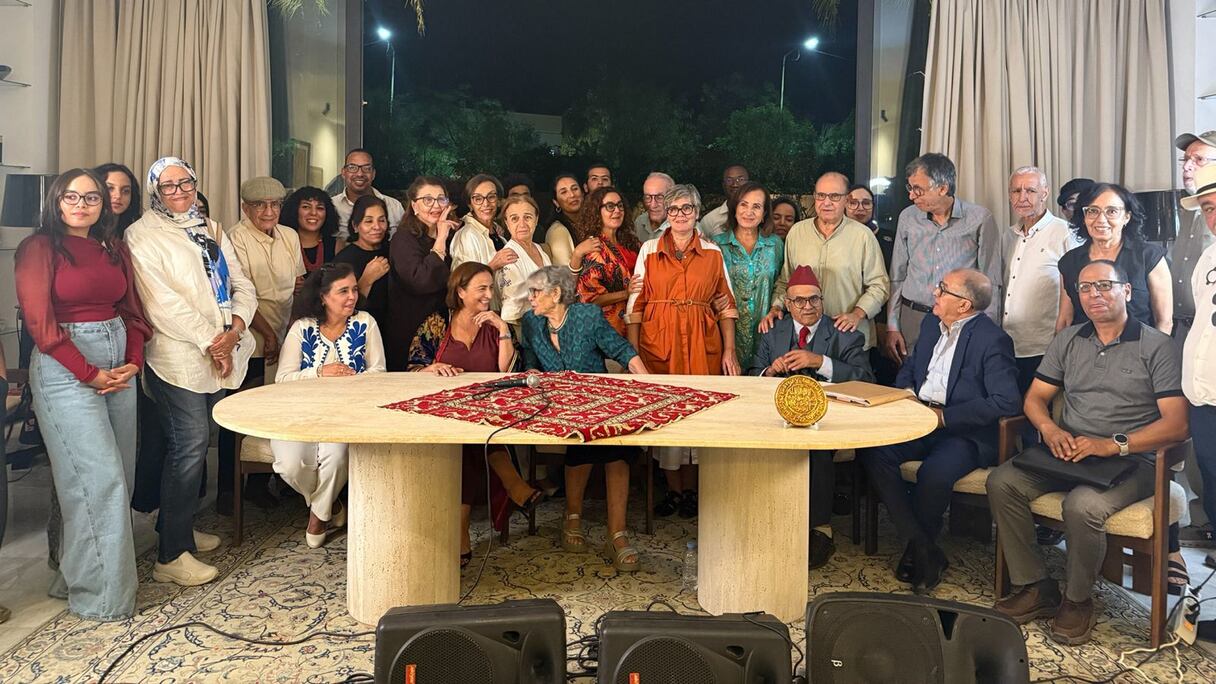
Historian and academic Hamid Triki died on Thursday, July 30, 2026, at the age of 82. His death prompted several tributes, including from member associations of the Morocco Memory Coalition, among them the Safi Memory Association. Nearly two months later, Laila Binebine’s literary salon held a tribute event for him in Marrakech, bringing researchers and people close to him together to reflect on his career and work.
Speakers highlighted the international dimension of Hamid Triki’s career. Over several decades at foreign universities, the researcher became an expert consulted by institutions dedicated to heritage and history. He reportedly worked with the Institut du monde arabe in Paris and the Aga Khan Trust for Culture in Geneva. His career earned him two distinctions mentioned during the event: the Grand Medal of Arts, Sciences and Letters from the Academy of Paris, and the Atlas Prize, awarded by the French Embassy in Rabat for his book on the Ben Youssef Madrasa in Marrakech.
His written work, which includes more than 12 scholarly publications, was presented as a bridge between academic knowledge and the discovery of places. His books approach the history of cities not simply as collections of buildings and streets, but as living entities that carry memory. Among the titles mentioned were Marrakech, History and Monuments, and The Potters’ Hill: History of a City and Its Pottery, dedicated to his hometown.
The third focus of the event was Hamid Triki’s commitment to Safi, described as one of the most personal aspects of his career. He served as honorary president of the Safi Memory Association for 10 years and supported a project documenting more than 1,000 years of the city’s history. After three years of research, fact-checking and revisions, the work resulted in a traveling exhibition presented to visitors from different generations.
Speakers also discussed an inventory of the city’s historic monuments and the creation of tourist signage, as well as a project to bring together academic experts to help preserve the Château de la Mer. Another project, focused on the city’s spiritual routes, sought to have Safi’s monuments included on the World Heritage inventory and advance the nomination to UNESCO.
These efforts echo information made public following his death. Hamid Triki had coordinated several academic partnerships, including with the University of Évora in Portugal, to help preserve the historic Qasr Al Bahr monument in Safi. He had also supported the inscription of Safi pottery on UNESCO’s Representative List of the Intangible Cultural Heritage of Humanity.
Read also : L’Boulevard 2026 names six winners of its Tremplin competition
Beyond his academic and institutional work, several speakers highlighted the human side of the late historian: his constant kindness, a captivating sense of humor, and his ability to combine scholarly rigor with a light and easy manner in conversation. One speaker recalled his strong passion for art, saying he never missed an exhibition opening unless travel, professional duties or illness prevented him from attending.
A founding member of the Dar El Bacha Museum in Marrakech, Hamid Triki also left a lasting impression on many of his colleagues. One speaker recalled working alongside him since 1998, when he asked her to transcribe a text about women of the Almohad dynasty. She described the experience as the starting point for a renewed relationship with the country’s history.
She also spoke about an unfinished project: compiling a glossary of orally transmitted Darija vocabulary, which she had planned with Hamid Triki before his death. She now hopes to continue the project with the help of residents and young people from the Marrakech medina.
The historian’s family and in-laws attended the event alongside researchers and representatives of cultural institutions, who came to honor the memory of a man whose work remains, for many, a bridge between Morocco and the wider world.
