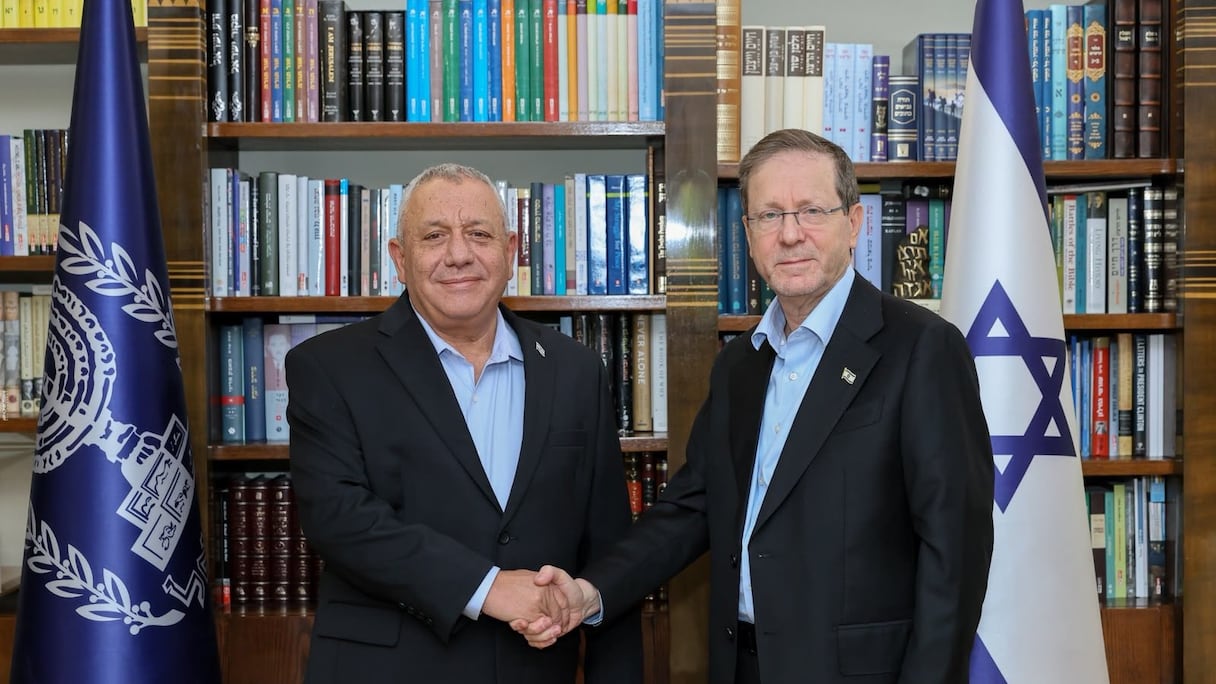
Israeli President Isaac Herzog has chosen Gadi Eisenkot to form the country’s next government, handing the former army chief a major political victory. The son of Moroccan Jewish immigrants, Eisenkot is set to receive the official mandate on Sunday, November 8, after securing the backing of a majority of Knesset members.
“The decision follows the conclusion of consultations with the parliamentary groups in the Knesset. In recent days, the president also held in-depth talks and further exchanges with several figures on the political scene. He notably met with Prime Minister Benjamin Netanyahu and Gadi Eisenkot, informing them of his intention,” the Israeli presidency said in a statement.
The statement added that groups representing 67 lawmakers had recommended Eisenkot to the president, compared with 46 who backed Benjamin Netanyahu, the prime minister and Likud leader. A group of seven lawmakers chose not to recommend anyone. Eisenkot now has 28 days to try to assemble a governing coalition.
Who is Gadi Eisenkot?
Born in Tiberias and raised in the southern city of Eilat, Gadi Eisenkot, 66, has a surname that many Israelis might mistake for an Ashkenazi one. His family roots, however, lie in Morocco, with his parents coming from Safi, Marrakech and Casablanca.
Read also : Israel makes first official appearance at Marrakech Air Show with Elbit, IAI and Rafael
Born on May 19, 1960, he is the second child of Meir and Esther Eisenkot, Moroccan Jews who immigrated to Israel. His family comes from Safi, while his mother was born in Casablanca and his father in Marrakech. When he was appointed army chief in 2014, Israeli media expressed surprise that a man of Moroccan descent had a surname with Ashkenazi-sounding origins.
His family moved to Eilat, on the Red Sea, when he was one year old. His father worked as a miner in the copper deposits of the Timna Valley, while his mother stayed at home. Israeli media have described him as a child of the country’s south, raised in modest circumstances and far removed from the centers of power. He married in 1984 a woman he had met at a sailing club. They have five children and live in Herzliya.
Eisenkot began his military service in 1978, joining the Golani Brigade, Israel’s oldest elite infantry unit, known for its tough combat record. He remained with the brigade until 1992 and served as a company commander during the 1982 Lebanon War.
He commanded the Golani Brigade from 1997 to 1998. Between 1999 and 2001, he served as military secretary to Prime Ministers Ehud Barak and then Ariel Sharon. He subsequently commanded the 366th Division and the Judea and Samaria Division from 2003 to 2005, during the Second Intifada.
In 2005, he took charge of the military’s Operations Directorate. In October 2006, following the resignation of Udi Adam, he was appointed head of the Northern Command. He was among the architects of the so-called “Dahiya doctrine,” a strategy based on massive retaliation against Hezbollah. In January 2013, he became deputy chief of staff.
In November 2014, Benjamin Netanyahu and Defense Minister Moshe Ya’alon selected him to succeed Benny Gantz. Eisenkot took office on February 16, 2015, becoming the 21st chief of staff of the Israel Defense Forces (IDF). He handed over the post to Aviv Kochavi on January 15, 2019, becoming the first Israeli of Moroccan origin to lead the military.
Read also : Embassies, RAM flights and economic deals: Morocco and Israel chart a new course
During his tenure, he launched the multi-year “Gideon” plan and established a cyber command. In 2019, he disclosed that the Israeli military had struck thousands of Iranian targets in Syria. In November 2018, he opposed an all-out war in Gaza, a position that put him at odds with then-Defense Minister Avigdor Liberman, who eventually resigned. The United States awarded him the Legion of Merit in August 2016. After leaving the army, he joined the Washington Institute as a researcher in 2019.
From the military to the Knesset
Eisenkot entered politics in 2022, winning a seat in the Knesset under the National Unity party led by Benny Gantz and Gideon Sa’ar. On October 12, 2023, he became a minister without portfolio and joined Israel’s war cabinet.
He argued that securing the release of hostages should take priority, a position that brought him into conflict with Benjamin Netanyahu. He left the government in June 2024.
On June 30, 2025, he announced his departure from National Unity and resigned from the Knesset two days later. On September 16, 2025, he founded his own party, Yashar, a Hebrew word meaning “straight” or “upright.” He launched his campaign on June 30, 2026, near Hod Hasharon.
By July, Yashar had overtaken Likud in a Channel 13 poll. A separate Channel 12 survey gave Eisenkot a 43% favorable rating as a potential prime minister, compared with 34% for Netanyahu. Eisenkot made clear he had no intention of playing second fiddle. “I will not be anyone’s number two,” he said in June.
His political journey has also been marked by profound personal loss. His son Gal, a 25-year-old master sergeant, was killed in Gaza in December 2023. Two of his nephews also died: Maor Cohen Eisenkot the following day, and Yogev Pazy in November 2024.
Read also : Gaza: Hamas agrees to deal with Israel
Eisenkot rarely speaks publicly about his Moroccan roots, but several Israeli analysts consider his background a political asset. According to Hebrew-language media, he embraces that heritage and says he does not belong to the Ashkenazi elite that has dominated Israel since its founding. The message has also made its way into his campaign material. Five days before the election, Yashar billboards appeared in outlying cities bearing the slogan “Prime Minister Dialna,” using the Moroccan Arabic word for “ours.”
His origins were also at the center of a controversy on October 17. That Saturday evening, Yinon Magal, a presenter on Channel 14, a station close to Netanyahu, called Eisenkot a “monkey” manipulated by Ashkenazi elites.
Eisenkot said he had “nothing to say in response to such a low level” of discourse. His party answered with a billboard campaign denouncing discrimination against Sephardic Jews.
