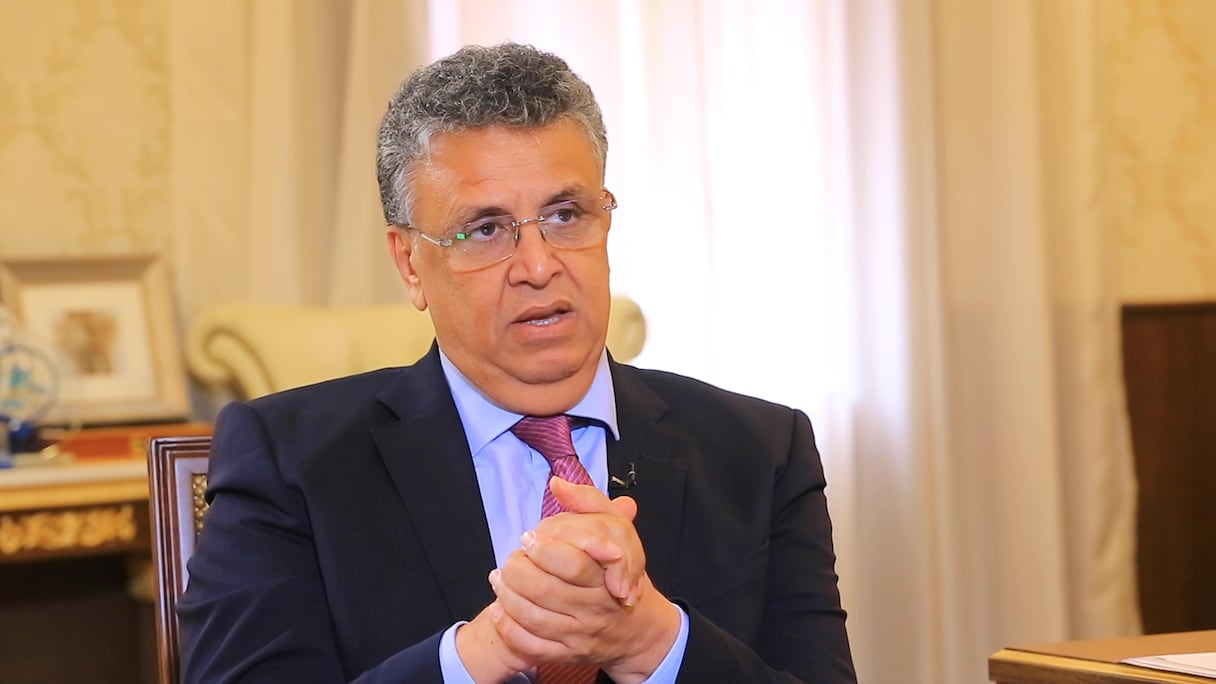
Morocco’s claims to Ceuta and Melilla remain firmly on the table and are raised in discussions with Spain, Justice Minister Abdellatif Ouahbi said, describing Rabat’s approach as a long-term strategy built on persistence and dialogue rather than confrontation.
“This issue remains on the table. Every time we meet the Spaniards, we raise the question,” Ouahbi said in an interview with Asharq News.
Morocco does not expect the dispute to be resolved immediately, he said, but neither does it intend to abandon its longstanding position on the two cities.
“Our policy regarding this issue is a long-term one. We continue to claim our territories, and we want to resolve the problem through dialogue,” Ouahbi said.
His comments do not represent a change in Morocco’s position or the opening of a new territorial dispute. Rabat has never relinquished its rights to Ceuta and Melilla, while Madrid maintains that Spanish sovereignty over both cities is not open to discussion.
Those opposing positions have not prevented Morocco and Spain from building increasingly extensive cooperation in recent years, spanning trade, investment, security, justice and migration.
Ouahbi’s remarks have nevertheless drawn criticism in Spain, where some political figures have portrayed them as a renewed challenge to the country’s territorial integrity.
Alma Ezcurra, deputy secretary for sectoral coordination of Spain’s opposition Popular Party, said Wednesday that the “Spanishness” of the two cities “is neither under discussion nor up for debate,” while linking Ouahbi’s remarks to the recent migration crisis.
Ouahbi, however, explicitly separated the two issues. Morocco’s territorial claims, he argued, follow their own political and diplomatic course, while migration management is a shared operational challenge requiring cooperation between Rabat and Madrid.
Morocco rejects claims it uses migration as leverage
Ouahbi categorically rejected accusations that Morocco uses migration flows to extract concessions from Spain or the European Union.
“We have never used this issue as a tool, and we have no intention of doing so,” he said.
Morocco considers Spain and the European Union strategic partners, he added, arguing that irregular migration is a common challenge rather than a bargaining chip.
Official Moroccan figures illustrate the scale of the Kingdom’s efforts. In 2025, authorities thwarted 73,640 irregular migration attempts toward Europe, dismantled more than 300 human trafficking networks, and rescued 13,595 migrants at sea, according to Interior Ministry figures. Another 4,372 migrants participated in voluntary return programs to their countries of origin.
Following the mass crossing attempts in late July, Spanish Interior Minister Fernando Grande-Marlaska publicly thanked Morocco for its cooperation and described the Kingdom as an “absolutely reliable partner.”
That assessment from the Spanish minister directly responsible for border policy contrasts with political accusations portraying Morocco as deliberately fueling migration pressure.
Ouahbi argued that the debate also exposes a broader contradiction in how irregular migration is managed.
Spain expects Morocco to prevent unauthorized departures, but once migrants reach territory under Spanish administration, Spanish authorities must apply their own procedures governing protection, identification, asylum, and residency, the minister said.
“Do they want to combat irregular migration, or simply make statements that contradict what they do in practice?” Ouahbi asked.
His argument was not that legal protections afforded to migrants should be disregarded, but that the two countries need a coherent joint policy defining what happens before, during and after an irregular crossing.
From Morocco’s perspective, migration cooperation cannot be reduced to policing the southern side of the Mediterranean. It also requires legal mobility channels, effective return mechanisms, intelligence sharing and coordinated action against criminal organizations that exploit migrants.
“What lies behind irregular migration is more dangerous than irregular migration itself,” Ouahbi said, citing human trafficking, the sexual exploitation of minors, rape and organ trafficking.
Returning Moroccan minors
Ouahbi also addressed the situation of Moroccan minors currently in Spain, calling for their return and reaffirming Morocco’s responsibility toward them.
“We do not abandon our children. We want and demand that our children return to Morocco,” he said.
For Ouahbi, Moroccan minors who cross irregularly should not be viewed solely through the administrative lens of migration. They may also be vulnerable to trafficking networks, misleading campaigns and organizations seeking to exploit them.
Morocco and Spain already have a bilateral framework intended to address precisely that issue.
An agreement signed in Rabat on March 6, 2007, and published in Spain’s Official State Gazette in 2013 establishes mechanisms for cooperation to prevent the irregular migration of unaccompanied minors, protect them and organize their “assisted return.”
Any return must comply with the laws of both countries, the Convention on the Rights of the Child and, above all, the best interests of the child.
Morocco is therefore not calling for indiscriminate returns outside the law. Ouahbi’s position is that an existing bilateral mechanism should be implemented effectively, including procedures to identify minors, locate their families and ensure that the conditions necessary for their reintegration are in place.
“We are not a state whose purpose is to solve another country’s demographic problem,” Ouahbi said.
Where the necessary safeguards exist, he argued, Moroccan minors should be able to return to their families and grow up within their own social and cultural environment.