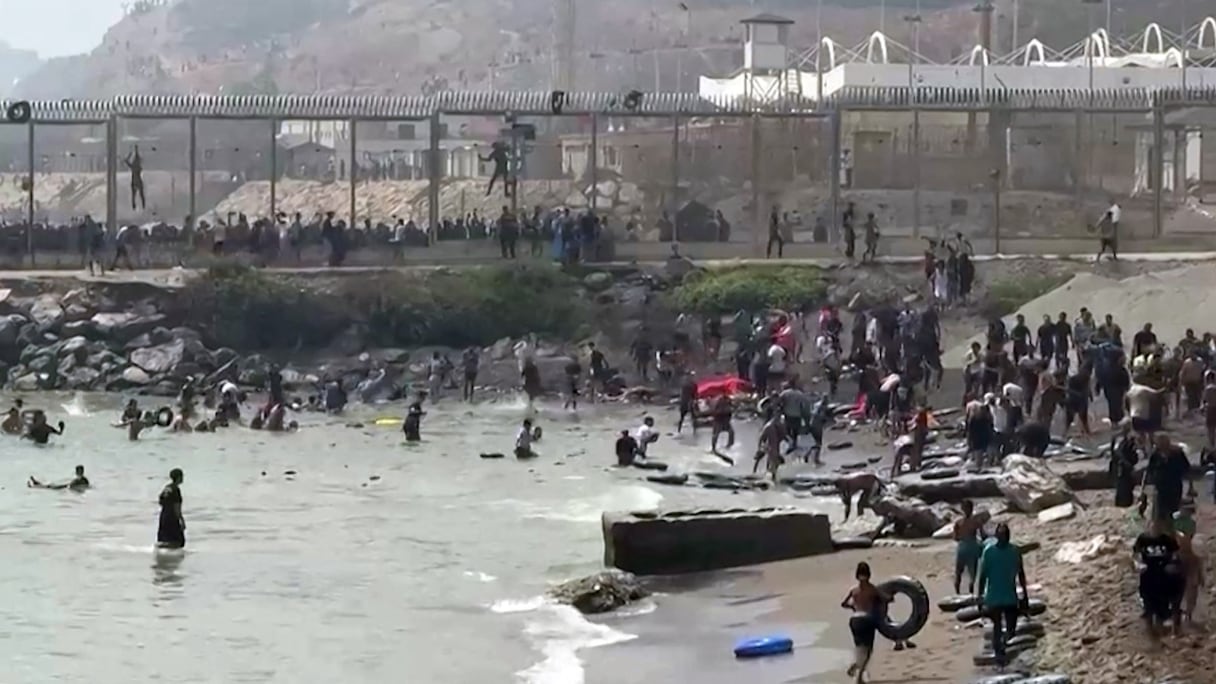
The tension that had built up along the Fnideq coastline suddenly descended into chaos. After several days marked by a proliferation of infiltration attempts, the crisis reached its peak on Wednesday, July 29, and Thursday, July 30, 2026. Thousands of young would-be clandestine migrants threw themselves into the sea in an attempt to swim to Sebta. On the ground, law enforcement officers, already under intense strain as they sought to block these mass movements, were directly targeted. Faced with groups that were both extremely determined and violent, the pressure became almost unmanageable.
At the origin of this sudden gathering was a call circulated on social media and by word of mouth, spreading like wildfire. Within hours, the message had convinced hundreds of people to converge on Fnideq, the nearest gathering point to Sebta, from which it is separated only by a simple metal fence and a sea breakwater.
According to our sources, 60% of the migrants gathered there are Algerian nationals, lying in wait in the region and watching for the slightest breach through which to cross, while 35% are Moroccan nationals, mainly young people drawn by rumors of impunity and immediate regularization. The remaining 5% come from sub-Saharan Africa.
The Origin of the Pull Factor
Setting out from the beaches of Fnideq to swim to Sebta is an extremely perilous undertaking. The area is swept by powerful sea currents and strong turbulence along the breakwater. The provisional toll is tragic: at least nine confirmed deaths, with the bodies recovered in Sebta, around 20 people missing, and several others seriously injured.
Read also : Morocco, Spain agree to repatriate all migrants who reached Ceuta from Fnideq
Behind this sudden rush lies a specific legal decision that acted as the trigger. On July 8, 2026, Section V of the Administrative Litigation Chamber (Sala de lo Contencioso-Administrativo) of Spain’s Supreme Court issued a ruling that set events in motion. Acting on the case of an Algerian national who had been returned after swimming to Sebta, the country’s highest court confirmed the illegality of devoluciones en caliente—hot returns or pushbacks—for migrants arriving by sea.
As a result, any migrant intercepted at sea or arriving by swimming must now be subject to an individual administrative identification procedure, barring immediate expulsion without prior examination.
Widely reported from July 10 onward, the ruling was distorted and exploited by smuggling networks. The information was interpreted as a signal: arriving by sea would guarantee that migrants would not be immediately returned and would provide a gateway to the benefits of an ongoing regularization drive in Spain. The illusion proved short-lived.
Systematic Repatriations and Criminal Proceedings
On Thursday, the Moroccan and Spanish authorities immediately coordinated their response at the highest level to restore order. Those who entered Sebta illegally will not benefit from any regularization. The measures adopted include the systematic repatriation of all migrants who arrived during the assault. Criminal proceedings are also being considered. Those arrested will be placed in detention, brought before the courts, and sentenced to prison terms for illegal crossing and violence against law enforcement officers.
Spain’s Interior Ministry denounced the exploitation of a court ruling by human-trafficking networks. Interior Minister Fernando Grande-Marlaska, who announced an emergency visit to Sebta on Friday, stressed the “exemplary cooperation” between Rabat and Madrid and expressed his gratitude to Morocco’s security forces, which had thwarted thousands of attempts before they could take place. He recalled that, before this crisis, no arrivals by sea had been recorded in Sebta in 2026 up to July 15, compared with four in 2025 and 28 in 2024. “We are mobilizing all necessary resources, working with the Moroccan and international authorities, and preparing the measures required to restore normality as quickly as possible,” Spanish Prime Minister Pedro Sánchez said on X.
Sebta and Melilla: The Geographic Anomaly
The crisis response is immediate, but this episode has once again highlighted the untenable status of the occupied enclaves of Sebta and Melilla. These two cities represent geographic, political, and security anomalies in the 21st century. How can parcels of territory in Morocco still be claimed as Spanish when only a narrow stretch of water separates them from Fnideq, in Sebta’s case, and from Nador, in Melilla’s? A stretch of water that can be crossed with flippers and an inner tube? Morocco’s security forces exhaust themselves securing them throughout the year. But is this reasonably sustainable? Especially since, even for Spain, the financial, human, and logistical cost of this protection continues to weigh heavily on the state budget.
Territorial and demographic realities always end up asserting themselves. Sebta, a city located in Morocco, in Africa, with an overwhelmingly Muslim population and dependent on its immediate Moroccan surroundings, cannot physically and indefinitely remain a Spanish city anchored on Moroccan soil. Looking at the long sweep of history, the Arab-Muslim presence in Spain, essentially Moroccan, lasted nearly eight centuries, creating there a brilliant civilization, enduring architecture, and knowledge that radiated throughout Europe before disappearing from the peninsula because it was not its natural space. Conversely, what do these continental enclaves represent other than the remnants of a bygone era that radiate nothing and generate only security friction?
The restitution of Sebta and Melilla appears, in the long term, to be an inevitable outcome under the combined force of geography, demography, and common sense. The question is no longer whether these enclaves will be reintegrated into their natural environment, Morocco, but how long it will take and how many more human tragedies will have to be mourned before then.
