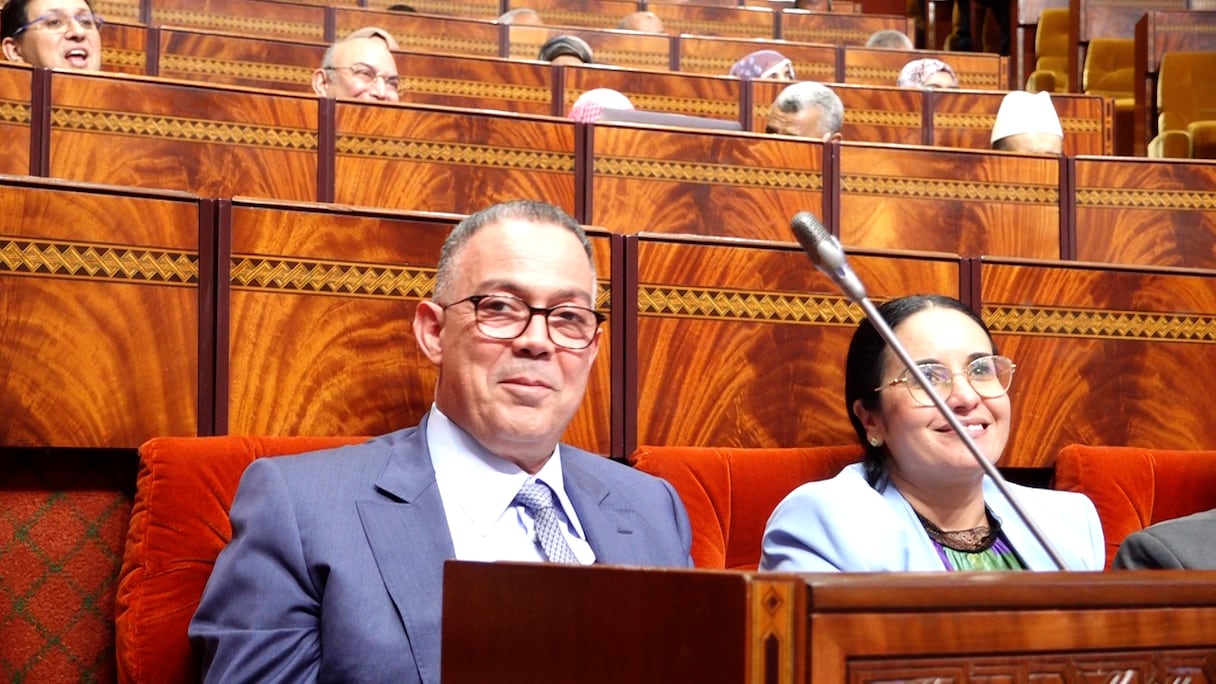
The House of Representatives adopted the 2027 Finance Bill by a majority vote on Saturday evening, November 14, with 179 votes in favor, 126 against and no abstentions, following a lengthy closing session marked by heated exchanges between the majority and opposition.
The first budget under the government led by Fatima Ezzahra El Mansouri focuses in particular on supporting purchasing power, social protection, healthcare and public investment, against a backdrop of sharp exchanges between the two sides.
The Speaker of the House had to exercise considerable restraint to bring the particularly heated session to a close, following several hours of debate over the new government’s economic, tax and social policy choices.
The opposition, which includes the National Rally of Independents (RNI), the Justice and Development Party (PJD), the Popular Movement and the Federation of the Democratic Left, voted against the bill. The majority presented it as a political project marking a break with several policies pursued by the previous government.
The 2027 Finance Bill is based on a projected growth rate of 3.7%, with a target budget deficit of 3% of gross domestic product (GDP). Overall public investment is expected to reach 400 billion dirhams.
The bill also places considerable emphasis on measures aimed at supporting purchasing power and strengthening social policies.
Read also : House of Representatives to debate and vote on 2027 Finance Bill on Friday and Saturday
The governing majority, led by the Authenticity and Modernity Party (PAM) and also comprising the Istiqlal Party, the Socialist Union of Popular Forces (USFP) and the Party of Progress and Socialism (PPS), has earmarked a total of 62 billion dirhams for socioeconomic assistance.
The healthcare budget will increase by 3 billion dirhams to reach 45.4 billion dirhams in 2027.
The government also plans to raise the minimum amount of direct social assistance from 500 to 600 dirhams per month starting in January 2027. This will be the first step in a gradual increase intended to bring the amount to 1,000 dirhams by 2031.
The government also plans to raise the minimum monthly retirement pension to 1,700 dirhams in 2027, before gradually increasing it to 3,000 dirhams during its term.
Commenting on the Finance Bill in a statement to Le360, PAM lawmaker Adib Benbrahim said projected total revenues stood at around 482 billion dirhams, including 437.4 billion dirhams in tax revenues and nearly 45 billion dirhams from public institutions, among other sources.
According to the figures presented by the lawmaker, these revenues would cover operating expenses, estimated at 387 billion dirhams, as well as debt interest payments, leaving a surplus of around 49 billion dirhams.
“Adding the investment budget of 139 billion dirhams and repayment of 69 billion dirhams in principal on the debt, the financing requirement comes to 158 billion dirhams. This will be covered through borrowing, including 120 billion dirhams needed to complete the financing,” he explained.
Read also : Parliamentary groups submit more than 130 amendments to 2027 Finance Bill
Benbrahim also said public debt remained manageable as long as “tax revenues cover interest payments.”
For his part, Driss El Azami El Idrissi, chairman of the PJD parliamentary group, confirmed that his party had voted against the Finance Bill as a whole, while noting that it had supported several provisions relating to national sovereignty, defense and national security.
The PJD also backed certain measures intended to support purchasing power and vulnerable and middle-income groups, particularly the increase in retirement pensions.
However, El Azami criticized what he considered an insufficiently fair distribution of the budgetary effort, arguing that low-income households and the middle classes had not received a sufficient share of the proposed measures compared with wealthier groups.
Tax policy
On tax policy, the PJD reiterated its support for raising corporate income tax to 40% for large companies importing or distributing petroleum products. The party had also proposed extending this rate to major telecommunications and cement companies generating high profits, arguing that these sectors also operate in “oligopoly” conditions and generate “substantial profits.”
After the majority rejected the amendment, the PJD parliamentary group voted against the article in its government-proposed wording, while reaffirming its support for the principle of higher taxation on major petroleum companies.
Read also : Who stands to gain from income tax reform? Why Lekjaa’s MAD 10,000 figure is causing confusion
For his part, Ahmed El Abadi, chairman of the PPS parliamentary group, defended the bill’s policy priorities, particularly measures aimed at combating speculation and reorganizing food distribution channels.
He specifically pointed to the creation of regional distribution and marketing companies in several major agricultural areas, as well as the reorganization of wholesale markets.
The aim, he said, was to “reduce the chain of intermediaries and curb speculators and monopolies.”
With Saturday’s vote, the first Finance Bill under the El Mansouri government has completed its passage through the House of Representatives. Beyond the figures, the debate confirmed the divide between a majority presenting the budget as a break with the previous government’s approach to social policy and an opposition determined to challenge its choices, funding and distribution of the tax burden.
