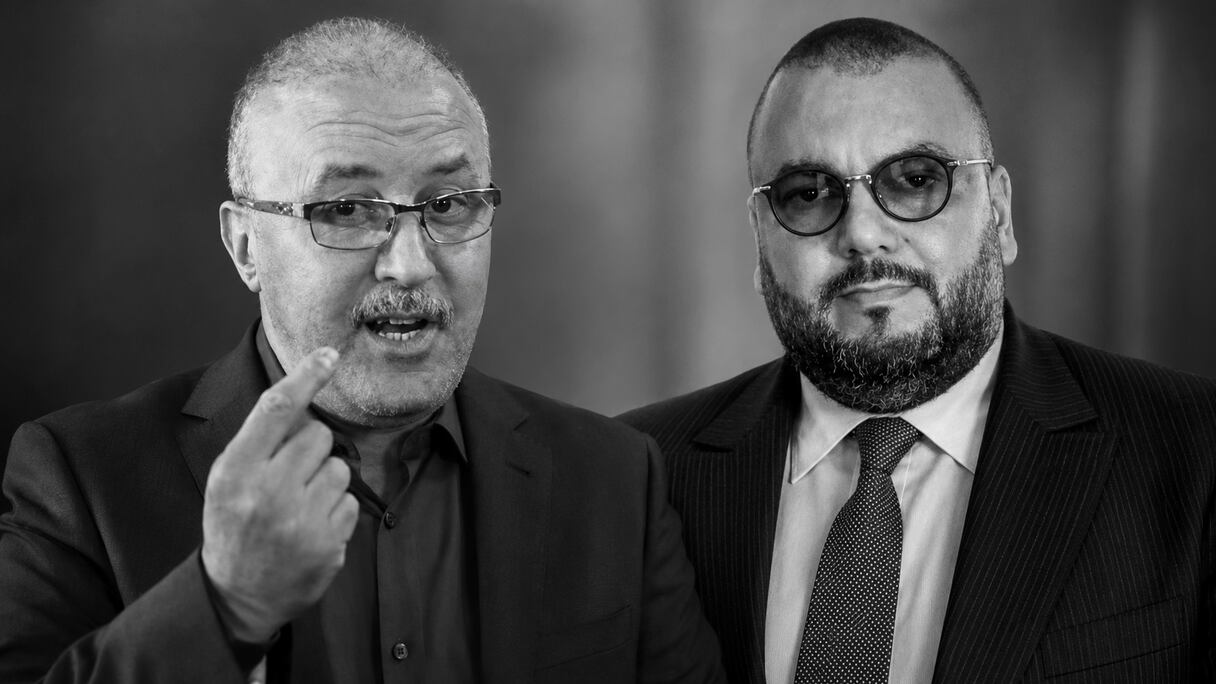
Audio recordings possess a uniquely poisonous allure. They betray, without mercy, every carefully constructed façade. Between a self-proclaimed intelligence insider and a professional online agitator in perpetual search of the next sensation, the conversations recently unearthed verge on the absurd, exposing exchanges of such staggering mediocrity that they defy common sense. Yet these verbatim recordings reveal something far more valuable: the unvarnished truth about the real nature of the two protagonists and the exact contours of their operetta-like conspiracy.
On one side stands Mehdi Hijaouy, 53, a man fond of draping his ego in a costume far too large for him—that of the former number two at Morocco’s General Directorate for Studies and Documentation (DGED), the country’s foreign intelligence service. Now living in Canada after fleeing Morocco to escape prosecution on fraud charges, he has spent his North American exile peddling increasingly fantastical delusions disguised as explosive revelations.
On the other end of the line is Hicham Jerando, a controversial businessman who is also based in Canada. Reinventing himself as a combative YouTuber, he has made the systematic denigration of Moroccan institutions his principal stock-in-trade, drawing the entirety of his pseudo—“scoops” from the inexhaustible reservoir of absurdities supplied by Hijaouy.
Read also : Hijaouy case: Ex-wife’s denial deals a major blow to defense’s Paris surveillance claims
Between the two men, the machinery is perfectly calibrated—a deal of exquisite cynicism. A swindlers’ version of a win-win arrangement. Hijaouy uses Jerando to spew his venom. Jerando blindly siphons off the fantasies of his source to feed his traveling carnival of scandals. Then came the turning point. Following the massive leak of audio recordings and documented conversations released on social media by a collective calling itself Atlas Hacks, the mask finally slipped. The spectacle is extraordinary.
The spook and the YouTuber under his spell
Throughout the exchanges, Hijaouy speaks in an inflated register overloaded with bargain-basement intelligence jargon—“triangulation,” “files,” and the like. It takes little more than that to leave Jerando utterly spellbound. Clearly dazzled, he awkwardly attempts to elevate his own vocabulary in order to appear worthy of the great “strategist” he believes he has before him.
What strikes immediately is Hijaouy’s astonishing detachment from reality. With disarming self-satisfaction, he confesses to being the executioner entrusted with the dirtiest assignments. He does not merely admit to unlawful break-ins. He calmly portrays himself as a cold-blooded killer. Not one, not two, not three—but eight eliminations to his name.
The gulf separating this self-portrait from the image cultivated by certain naïve—or accommodating—foreign media outlets could hardly be greater. Those same publications have labored to portray Hijaouy as “the man who knew too much,” persecuted for his ideas and his opposition to the “Makhzen.”
One excerpt from the Atlas Hacks recordings offers a masterclass in self-exposure. Hijaouy proudly recounts breaking into the hotel room of a strategic source, picking the lock of a safe and stealing a diplomatic passport.
The passport had initially been issued by the authorities at the request of Ilyas El Omari, the former leader of the Authenticity and Modernity Party (PAM) and former president of the Tanger-Tétouan-Al Hoceïma region, before Moroccan authorities reversed their decision.
Enraged at having been outmanoeuvred, El Omari telephoned Hijaouy to ask whether he was responsible for the operation. Morocco’s self-styled “James Bond” readily answered in the affirmative, visibly savoring the bravado.
As the story unfolds, El Omari is methodically diminished.
“Ilyas? He’s finished. He’s nobody anymore. His fatal mistake was wanting to bask in the spotlight by leading both the party and the region. Today he’s worth nothing. You see, we have our own code. Mouatten [Citizen] is the code name we use for an operative. There is the Grand Mouatten—that’s Fouad [Ali El Himma, adviser to King Mohammed VI]—and then there’s the Petit Mouatten... that’s me. As for Ilyas, he’s nothing more than an anonymous Mouatten."
Jerando then ventures what he imagines to be a subtle follow-up about El Omari’s real influence. Hijaouy replies with pontifical certainty.
“The only power Ilyas ever had was Fouad. Everything he was came from Fouad—and nowhere else.“
Burglaries, killings and grand delusions
What conclusion emerges?
By his own admission, the self-proclaimed former deputy head of Morocco’s powerful DGED was, in reality, nothing more than an ordinary safecracker.
But the portrait darkens further.
The burglar also casts himself as a professional executioner, boasting of having orchestrated multiple targeted killings. More remarkably still, he claims to have been one of the last—if not the very last—operatives still capable of carrying out such missions in Morocco.
“Tell me, who is still capable of carrying out major liquidation operations in Morocco? Nobody! I was at the very heart of the reactor, and I can tell you with certainty: nobody remains capable of handling that kind of contract. I’m talking about genuine operations—targeted, transnational, effective. There were only two of us. We were trained exclusively for that purpose. Even the other one walked away."
Attempting to display his own geopolitical sophistication, Jerando interrupts, arguing that after international scandals on the scale of the Khashoggi affair, such old-style elimination operations had inevitably come to an end. He goes on to mention the brother of Hicham Mandari—the notorious fraudster who claimed close ties to the Royal Palace before being found shot in the head in a car park between Mijas and Fuengirola on Spain’s Costa del Sol during the night of August 3-4, 2004—as someone involved in this type of operation.
His remark wounds Hijaouy’s vanity as a self-styled super-assassin.
“Him? He’s an idiot! He couldn’t run 100 meters! There was only me and the other one, full stop. All the other spooks only know how to operate behind computer screens. Me? I carried out one, two, three, four, five, six, seven, eight operations on the ground.”
Taking his campaign of self-glorification to its most absurd extreme, Hijaouy ultimately claims personal responsibility for Mandari’s assassination in Spain.
“Mandari—that was me. From A to Z. I was behind the entire operation from beginning to end."
When Jerando expresses hesitant doubt, explaining that he is personally acquainted with one of the alleged perpetrators—“the one who pulled the trigger and put a bullet in Mandari’s head”—Hijaouy barely manages to contain his fury.
“That’s complete nonsense. Totally false. Your contact lied to you from start to finish. Besides, the man who fired the shot was never Moroccan.”
When Jerando mentions yet another operative supposedly involved in the commando, Hijaouy retreats even further into contradiction while playing what he believes is his trump card.
“He was only an OPP [senior police officer], whereas I was a police commissioner.”
That detail proves crucial—and one confession too many.
For at what point, in what country possessing a serious institutional architecture, could an ordinary police commissioner simultaneously serve as the de facto deputy head of the foreign intelligence service? Especially in a country such as Morocco, internationally recognized for the sophistication of its security and strategic intelligence capabilities?
The shattered mirror of an imposture
The conclusion is devastating.
The man who draped himself in the mantle of the DGED’s former strategist, supposedly persecuted by an entire state apparatus for the nobility of his political convictions, ultimately betrays himself through his own words.
The recordings reveal an ordinary hired hand, a Sunday safecracker, and a self-proclaimed assassin boasting of eight summary executions, incapable of tolerating either competition or the slightest doubt about his supposed exploits.
A pathological fabulist—or perhaps something worse—with a grotesquely inflated ego, who never rose beyond the rank of police commissioner, an entry-level position open to any graduate in law or economics.
What remains profoundly scandalous is the willful blindness displayed by certain courtrooms and by sections of the French press. It is to this kind of unstable, criminogenic profile that opportunistic lawyers and ideologically driven media outlets choose to grant a respectful platform, allowing him to wage, by proxy, a vendetta against Morocco and its institutions.
And it is precisely these fraudsters—who also portray themselves as unrepentant killers—to whom democratic countries such as Canada have naively granted asylum and public platforms. From those platforms, they freely disseminate fake news, calls to hatred, and incitement to murder and chaos, as Hicham Jerando has done relentlessly.
Until, at last, the facts themselves swept away the elaborate fiction spun by the fabulists.
