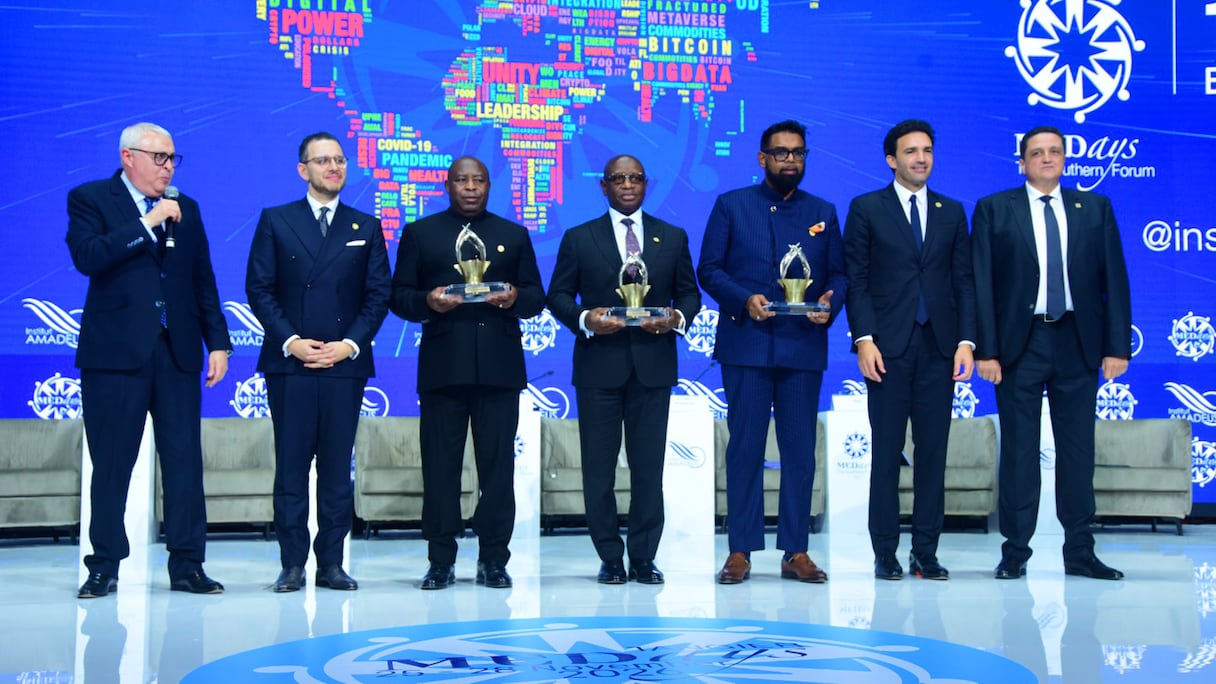
At the opening ceremony of the 18th edition, held under the theme “A Fragmented World: The Time for Choices,” Fassi Fihri presented the awards to Burundi’s President Évariste Ndayishimiye, who is also the current chairperson of the African Union (AU); Sierra Leone’s President Julius Maada Bio; and Guyana’s President Mohamed Irfaan Ali.
The three award recipients and the conference host, Fassi Fihri, voiced concern over instability across Africa, a continent facing terrorism, crises and underdevelopment. They called for tensions to be overcome and resolved, and for foreign interference to be avoided.
“Interference is unacceptable,” Burundi’s president said emphatically. Mohamed Irfaan Ali, for his part, praised Morocco’s political and economic role in Africa and paid tribute to King Mohammed VI for his efforts on behalf of the continent.
Burundi and Sierra Leone support Morocco’s territorial integrity, considering the autonomy initiative under Moroccan sovereignty and UN Security Council Resolution 2797 the only solution to the artificial dispute over the Moroccan Sahara. Both countries have also opened consulates in Laayoune in a show of support for Morocco’s territorial integrity.
In his remarks, Brahim Fassi Fihri gave an extensive account of the history of the southern provinces, emphasizing the international consensus around Morocco’s autonomy proposal. He also referred to the adoption of Resolution 2797 and Russia’s recent veto, which he said had marked the beginning of the end for MINURSO. Paraphrasing King Mohammed VI, he declared that “Morocco is in its Sahara, and the Sahara is in Morocco.”
Former Senegalese President Macky Sall was among those attending. Speaking to Le360, he highlighted the brotherly ties between Senegal and Morocco and paid tribute to King Mohammed VI for his efforts in Africa. “We are brothers; football is just a passion,” he said, referring to the events surrounding the 2025 Africa Cup of Nations final between the two national teams.
Guyana’s president also spoke about Morocco’s position in Africa and the wider world. “I think the way its economy is developing, its level of diversification and the importance of its geographical position mean that it can play a key role in Africa, serving as a bridge between Africa, Latin America, the Caribbean and Europe,” Mohamed Irfaan Ali said. He also stressed the importance of looking at “how the country is investing in infrastructure and systems to serve as this bridge, and that is precisely what we like to see.”
MEDays 2026 brings together more than 8,000 participants and over 300 high-level speakers from more than 120 countries, further consolidating the forum’s position as one of Africa’s and the Arab world’s leading geopolitical and economic platforms.
Heads of state and government, ministers, leaders of international institutions, business executives, investors, intellectuals and youth representatives will exchange views and perspectives on the major decisions ahead.
